Breaking
Abdulsalami Abubakar Advises Me Privately, He Chose Honour Over Allure Of Power, Says Tinubu

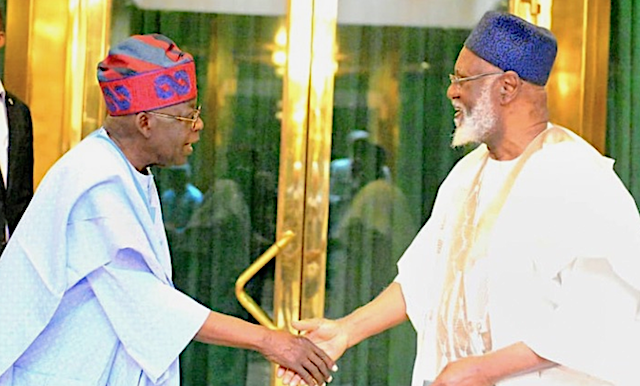
President Bola Ahmed Tinubu has paid glowing tribute to former military Head of State, General Abdulsalami Abubakar, describing him as one of his most trusted and discreet advisers whose counsel has continued to shape his leadership from behind the scenes.
Speaking on Saturday at an event organised to commemorate Abdulsalami’s 84th birthday and the public presentation of three books written in his honour, Tinubu said the retired general has distinguished himself by offering guidance privately rather than criticising leaders publicly.
The President noted that Abdulsalami, unlike many former leaders, has maintained a tradition of engaging sitting presidents through personal communication and confidential advice rather than public commentary.
“As President, General Abubakar has been one of my best and most discreet advisers,” Tinubu said.
He added: “He does not criticise publicly the occupant of the office he once held, but offers counsel through thoughtful memos and suggestions. I have found his advice invaluable, and I am a better leader for it. Thank you, sir.”
Tinubu also reflected on his relationship with the former Head of State, tracing it back to Nigeria’s transition from military rule to democracy in 1999. He said Abdulsalami’s commitment to restoring democratic governance played a decisive role in convincing many pro-democracy activists in exile that the military government was sincere about handing over power.
The President recalled that several democracy campaigners at the time remained sceptical of the transition process, believing the military would be unwilling to relinquish power after years of dominance in the nation’s political affairs.
“As a beneficiary of your political transition programme, I must recall your pragmatic efforts that made what seemed impossible possible,” Tinubu said.
According to him, organisations such as the National Democratic Coalition (NADECO), the National Liberation Council of Nigeria (NALICON), and the Campaign for Democracy had serious doubts about the military’s willingness to exit power.
“Many of us were in exile, campaigning for the return of democracy, uncertain and fearful of returning home,” he stated.
Tinubu disclosed that he was among those living in exile during the period and revealed that a personal telephone call from Abdulsalami significantly influenced his decision to return to Nigeria and participate in the democratic transition.
“I was one of those in exile. My decision to return and participate in the transition programme would not have been possible without a phone call that still resonates with me today,” he said.
“That call from General Abdulsalami Abubakar, as Head of State, assured some of us in exile that he would implement a sincere transition programme and, if we returned, guarantee our safety.”
The President further commended Abdulsalami for steering the country through a delicate political period and ensuring a swift return to democratic rule despite widespread uncertainty.
“At a critical juncture in Nigeria’s political history, Gen. Abubakar, by providence, assumed leadership amid uncertainty and apprehension,” Tinubu said.
“He made a solemn commitment to restore democratic governance and, despite immense challenges, fulfilled his promise within 11 months, a record in Nigeria’s transition history.”
Tinubu praised the former military ruler for resisting the temptation to remain in office, saying his decision to transfer power as scheduled demonstrated uncommon integrity and patriotism.
“He didn’t prolong the transition to civil rule but handed over power on schedule, choosing honour and integrity over the allure of power,” the President said.
He maintained that Abdulsalami placed national interest above personal ambition, describing his stewardship as a defining moment in Nigeria’s democratic journey.
“It is on record, General, that you placed the love of country above personal interests and gains,” Tinubu stated.
The President added that the transition programme implemented by Abdulsalami laid the foundation for Nigeria’s Fourth Republic, which began in 1999 and remains the country’s longest uninterrupted democratic dispensation.