Breaking
State Police Bill Empowers Governors To Appoint Commissioners, Bars Arbitrary Arrests

The Senate has formally passed a historic constitutional amendment bill seeking to establish state police services across Nigeria, with provisions empowering state governors to appoint Commissioners of Police while also introducing safeguards against the abuse of policing powers.
Considered as one of the most far-reaching security reforms in recent years, the proposed legislation will birth a dual policing system that allows state police formations to operate alongside the existing federal police structure.
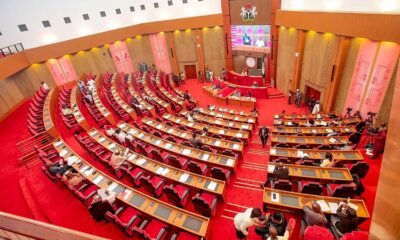
The bill scaled through on Wednesday after senators adopted its 26 clauses during the Committee of the Whole and subsequently secured the constitutionally required support of more than two-thirds of lawmakers through a manual voting process.
Senate President, Godswill Akpabio, announced the passage of the legislation after an overwhelming majority of senators voted in its favour during plenary.
The bill was passed following the presentation of the report of the Senate Committee on the Review of the Constitution by Deputy Senate President and committee chairman, Barau Jibrin.
Leading debate on the proposal, Senate Leader, Opeyemi Bamidele, urged lawmakers to support the measure, describing it as a critical step towards addressing Nigeria’s growing security challenges.
A major provision of the bill grants governors the authority to appoint Commissioners of Police for their states, subject to confirmation by their respective state Houses of Assembly.
Clause 17 of the proposed amendment provides that while the Federal Police Service will continue to be headed by the Inspector-General of Police, each State Police Service shall be led by a Commissioner of Police appointed by the governor and confirmed by the state legislature.
The legislation also defines the relationship between state governors and police commands under their jurisdictions.
Section 17(6) stipulates that a governor may issue lawful written directives of a general policy nature to the Commissioner of Police on matters relating to public safety and public order within the state.
Mindful of longstanding concerns that state police could be exploited for political purposes, lawmakers incorporated provisions aimed at protecting civil liberties and preventing arbitrary use of police powers.
Under Section 17(7), a state Commissioner of Police is prohibited from arresting, detaining, investigating or deploying force against any individual, political party or group merely for criticising the government except in accordance with the law.
The provision is intended to ensure that state police formations are not weaponised against political opponents, journalists, activists or dissenting voices and that all law enforcement actions are carried out within the bounds of due process.
The passage of the bill came after the Senate abandoned plans to use its electronic voting system for the exercise followings technical glitches that affected some voting devices.
Lawmakers instead adopted a manual voting procedure after concerns were raised that the malfunctioning system could disenfranchise some senators and cast doubts on the credibility of the process.
Supporting the switch to manual voting, Bamidele argued that every senator deserved an equal opportunity to participate in what he described as a historic constitutional exercise.
Akpabio also backed the move, saying an open voting process would guarantee transparency and allow Nigerians to know where their representatives stood on critical constitutional issues.