Viral
Vatican Expels Breakaway Catholic Bishops After Unauthorized Ordinations

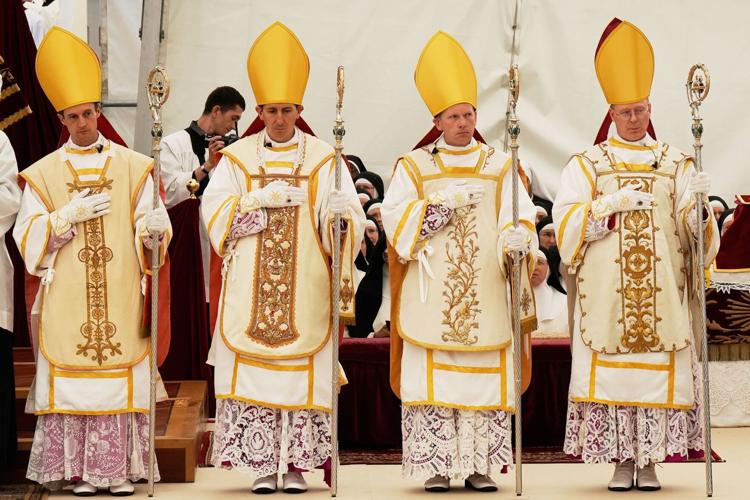
The Vatican has formally declared members of the Society of Saint Pius X (SSPX), a breakaway traditionalist Catholic group, to be in schism after the organisation proceeded with the unauthorized ordination of four bishops despite explicit warnings from Pope Leo XIV.
In a decree issued on Thursday, the Vatican’s doctrinal office announced that the four newly ordained bishops, along with the two bishops who presided over the ceremony, have been excommunicated from the Roman Catholic Church.
The ordinations took place on Wednesday without the approval of Pope Leo XIV, who had urged the group to abandon the move, warning that carrying out the ceremony would constitute a grave act of disobedience and a serious rupture of communion with the Church.
According to the Vatican, the unauthorized consecrations represent a schismatic act that undermines the unity of the Catholic Church and violates long-standing Church law governing the appointment and ordination of bishops.
The decree extends beyond the six bishops involved in the ceremony. It states that priests belonging to the Society of Saint Pius X, as well as lay faithful who formally align themselves with the organisation, are also considered to be in schism and are subject to excommunication.
Under Catholic canon law, excommunication is the Church’s most severe ecclesiastical penalty. Those affected are barred from receiving the sacraments and participating fully in the life of the Church until the penalty is lifted through reconciliation.
The Vatican further warned clergy and Catholic faithful worldwide against formally joining or supporting the SSPX, stating that anyone who knowingly adheres to the group’s schismatic position would automatically incur the same penalty.
In an accompanying explanatory note, the Holy See outlined the conditions under which excommunicated priests may seek restoration to full communion with the Catholic Church. Among the requirements are a personal appeal to Pope Leo XIV requesting that the penalty be lifted, a formal profession of the Catholic faith, and a written commitment not to publicly oppose the Pope or the teachings of the Church.
Although Pope Leo XIV has not publicly commented since the ordinations took place, he had addressed the issue days earlier, stressing that episcopal ordinations carried out without papal approval would constitute an act of exceptional gravity.
The Vatican’s Secretary of State, Cardinal Pietro Parolin, also expressed profound regret over the development, describing the ordinations as a serious attack on the unity of the Church that carries clearly defined canonical consequences, including excommunication.
The Society of Saint Pius X was established in 1970 in Switzerland by French Archbishop Marcel Lefebvre, who opposed several reforms introduced by the Second Vatican Council during the 1960s.
Five years after its founding, the group was officially suppressed by the Bishop of Fribourg because of its growing conflict with Church authorities.
Tensions escalated dramatically in 1988 when Archbishop Lefebvre ordained four bishops without the approval of the Pope. That action resulted in the excommunication of the bishops involved, although the sanctions at the time were limited primarily to those directly participating in the consecrations.
The Vatican’s latest decision is significantly broader, extending the penalties to priests and lay followers who formally remain aligned with the SSPX.
The new ruling also reverses concessions previously granted under the pontificate of Pope Francis. While Pope Francis had permitted priests of the society to validly celebrate the sacraments of confession and marriage under certain conditions, the Vatican has now declared that marriages and confessions conducted by SSPX clergy will no longer be recognised as valid by the Catholic Church.
Despite the disciplinary measures, the Vatican emphasised that the Church remains open to reconciliation. It stated that those who sincerely desire to return to full communion with the Catholic Church will be welcomed with pastoral care and compassion.
The roots of the dispute date back to disagreements over the reforms of the Second Vatican Council, which introduced significant changes to Catholic worship and doctrine.
The SSPX rejects several of the Council’s teachings, including its positions on religious freedom, ecumenical dialogue with other Christian denominations, and the celebration of Mass in local languages rather than exclusively in Latin. The group has also opposed other aspects of the Council’s reforms, including its condemnation of antisemitism.
Since assuming the papacy, Pope Leo XIV has repeatedly identified Church unity as one of the central priorities of his pontificate, stressing that communion with the Pope is an essential element of Catholic identity.
Speaking to journalists on June 16, the Pope noted that the SSPX continues to reject fundamental teachings of the Second Vatican Council and expressed regret over the group’s decision to proceed with the ordinations despite repeated appeals.
“If that is the choice they make,” he said at the time, “I am sorry, but the Church must move forward.”
The Society of Saint Pius X maintains a significant presence in the United States, where it operates its headquarters in Missouri and a seminary for priestly formation in Dillwyn, Virginia.
One of the newly consecrated bishops, Father Michael Goldade, serves as rector of the Virginia seminary. Speaking after Wednesday’s ordination ceremony, Goldade sharply criticised the modern Catholic Church, describing it as “a desert that kills everything that it touches,” underscoring the deep theological divide that continues to separate the SSPX from the Vatican.