World
Trump Had 4 Objectives For His War In Iran. He Has Not Accomplished Any Of Them.

On Feb. 28, shortly after the U.S. and Israel embarked on an extensive bombing campaign against Iran, President Donald Trump appeared in a prerecorded video to announce that a “major combat operation” had begun.
“The hour of your freedom is at hand,” Trump told the “great, proud people of Iran” in the address. “When we are finished, take over your government. It will be yours to take.”
Just four days later, and in what was a sign of things to come, the White House quietly dropped any mention of liberating the Iranian people from its list of stated objectives.
Instead, White House press secretary Karoline Leavitt said the U.S. would:
Destroy Iran’s ballistic missiles and its capacity to manufacture new ones.
“Annihilate” Iran’s navy.
Destroy Iran’s ability to fund and arm terrorist proxies throughout the region.
Guarantee Iran can never obtain a nuclear weapon.
Based on reports of the text of the memorandum of understanding between the U.S. and Iran, it’s clear: The U.S. has not accomplished any of those things.
Going Nuclear
Trump’s oft-repeated main objective of the war — preventing Iran from developing a nuclear weapon — appears to have backfired.
“The only thing that matters when I’m talking about Iran, they can’t have a nuclear weapon,” he said last month. “I don’t think about Americans’ financial situation, I don’t think about anybody.”
(Nevermind that a month earlier, the president told Reuters he didn’t actually care about securing the uranium at all. “That’s so far underground, I don’t care about that,” he said.)
An internal report by the International Atomic Energy Agency determined Iran is more likely to covertly pursue nuclear weapons now than it was a year ago, before the U.S. and Israel began military strikes on the country.
Prior to the U.S.-led 2025 bombing of Iran’s principal nuclear sites, inspectors from the IAEA reviewed Iran’s enriched uranium stockpiles on a weekly basis to ensure they weren’t being diverted to a weapons development program.
That has since ceased to be the case.
The IAEA can no longer “draw any conclusion regarding this nuclear material,” the report found. “This gives rise to a proliferation concern as this nuclear material, which the agency was not able to verify, includes a large amount of high-enriched uranium.”
It’s worth noting that under the nuclear agreement negotiated by former President Barack Obama, Iran had zero highly enriched uranium. Now it has half a ton, according to the IAEA.
Trump’s new deal with Iran doesn’t even attempt to resolve the issue, instead giving both sides an additional 60 days to negotiate, and saying that “pending a final agreement, they will maintain the status quo.”
“The Islamic Republic of Iran and the United States have agreed that the fate of enriched material and the fate of all other mutually agreed nuclear-related issues, including Iran’s nuclear needs, will be adequately addressed in a final agreement,” the memorandum of understanding between the U.S. and Iran says, according to CNN.
Meysam Mirzadeh/Tasnim News Agency via AP
Dire Straits
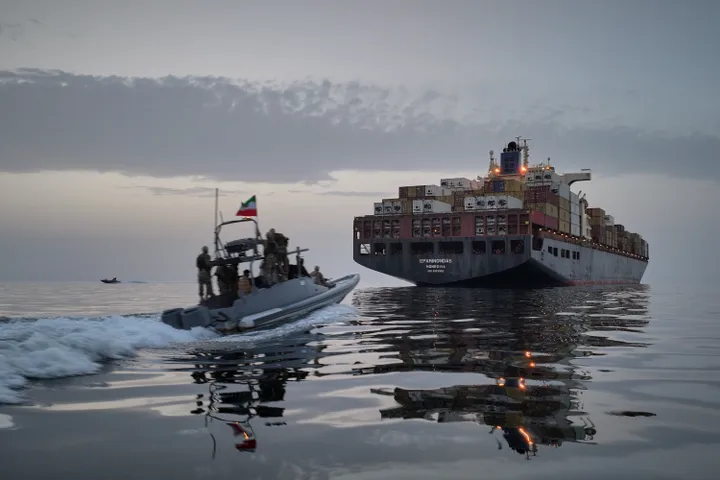
Iran’s navy is indeed battered, an analysis by the Center for Strategic and International Studies shows. In a perverse outcome, however, Trump’s strikes showed Tehran just how much leverage it has by controlling the Strait of Hormuz, and how easily it can do so, even without a large fleet of boats.
“Far from crumbling, the regime, if anything, has come out of this stronger because they’ve discovered the potency of the Strait of Hormuz weapon, which was always suspected but now they’ve tested it, and it really works,” BBC’s international editor Jeremy Bowen explained in an interview with Radio 4.
Closing the strait caused economic chaos around the world, cutting off fertilizers, oil and gas, and industrial chemicals to allies and foes alike ― with Trump’s war of choice and America’s increasingly erratic foreign policy as the clear culprit.
An analysis by the World Bank concluded the Iran war caused “the biggest supply shock in 50 years,” leading to the worst global economic growth since the onset of the COVID pandemic in 2020.
In characteristic fashion, Trump took no responsibility for Hormuz’s closure; instead, he blamed America’s allies for not cleaning up the mess for him.
“You’ll have to start learning how to fight for yourself, the U.S.A. won’t be there to help you anymore, just like you weren’t there for us,” Trump complained on social media. “Iran has been, essentially, decimated. The hard part is done. Go get your own oil!”

ATTA KENARE via Getty Images
About Those Missiles
Intelligence assessments in late May showed that since the initial bombing, Iran has rapidly rebuilt its military capabilities — which, despite U.S. and Israeli bombardment, were never that degraded in the first place.
Around half of Iran’s drones are intact, as are two-thirds of its missile launchers, sources told CNN last month. Thanks to support from China and Russia, Iran has missile components on hand and is already making more.
It’s actually America’s supply of arms that’s now in question.
The U.S. carried out more than 1,000 strikes in the first 24 hours of the war before settling into a tempo of 300 to 500 strikes a day in the four weeks that followed. Israel, which relies on the U.S. for weapons, also burned through a large number of munitions, stockpiles of which are now extremely low.
The Center for Strategic and International Studies estimates it will take until 2030 to replace the U.S. military’s Tomahawk missiles (at a cost of $3.5 million apiece), and until 2029 to restock Terminal High Altitude Area Defense (THAAD) and Patriot missile defense systems.
That has had repercussions elsewhere. In May, acting Navy Secretary Hung Cao ordered a pause on U.S. weapons sales to Taiwan. And Ukraine, long since cut off from Patriots by the Trump administration, is now developing its own alternative.

AP Photo/Osamah Abdulrahman
Iran’s Proxies Aren’t Going Anywhere
Iran is now far more conservative and militant than before the war. There’s no reason to assume Tehran, set to be flush with cash from the Trump deal, won’t seek to revive the groups it spent decades cultivating and funding.
Remember the Houthis? They’re very much still around, even after Trump said they’d been “completely annihilated” and claimed victory over the militia after they developed a knack for downing expensive U.S. drones.
So are Hezbollah and Hamas, albeit in a depleted state following sustained military action by Israel. Meanwhile, an estimated 73,000 Palestinians have died in Israel’s assault on Gaza since Hamas’ Oct. 7, 2023, terror attack in Israel, half of them women and children, according to Gaza’s Health Ministry.
Esmail Qaani, the commander of Iran’s Quds Force that oversees the proxies, appeared on state TV Monday to reaffirm Iran’s support for the groups.
“Bab al-Mandeb Strait is fully in the hands of the guys in Hezbollah, the Ansarallah [Houthis] in Yemen, and even some of the comrades and children of resistance who are not Yemeni,” Qaani said, in a translation provided by Al Jazeera.
Qaani also said Hamas would soon rebuild.