Breaking
Weak Law Enforcement, Economic Imbalance Top Agenda as Stakeholders Draft Gender Policy for Ebonyi

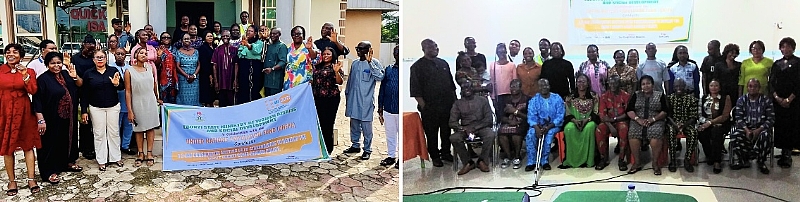
Women’s exclusion from family inheritance and weak implementation of gender-related laws dominated discussions at a 2-day consultative meeting held to draft a Gender Policy for Ebonyi State.
The meeting was organised by the State Ministry of Women Affairs and Social Development in collaboration with UNFPA, the UN’s sexual and reproductive health agency. It held Tuesday, June 9 and Wednesday, June 10 in Abakaliki, the Ebonyi state capital.
Stakeholders drawn from Civil Society Organisations, and relevant ministries, departments and agencies including Women Affairs, Justice, Budget and Planning, Finance, Health, Information, the Police and other security and regulatory agencies, reviewed the state’s gender landscape.
Participants agreed that gender-based violence remains high. While GBV affects both sexes, they noted women and girls are most vulnerable due to social and cultural imbalances: harmful widowhood practices, women disinheritance, early/forced marriage, boy-child preference, exclusion of women from leadership, and denial of reproductive rights.
They raised concerns that despite existing laws like the VAPP Law, Child Rights Law, and Maternal Mortality Law, impact has been minimal due to poor implementation.
Stakeholders insisted the Ebonyi Gender Policy must prioritise women’s education, economic empowerment/inheritance rights, and political inclusion. They stressed that implementation strategies for existing laws should be strengthened with adequate punishment for individuals or institutions that obstruct justice in GBV cases.
Declaring the meeting open, the Commissioner for Women Affairs and Social Development, Barr. Mrs Felicia Nwamkpuma, described it as “a journey towards a truly equitable Ebonyi State,” noting a modern prosperous state cannot be built on an unequal foundation.
“This is a Roadmap for Equity: This policy will serve as our official blueprint to mainstream gender into budgetary allocations, legislative frameworks, and socio-economic programs. It will provide structured mechanisms to tackle Gender-Based Violence (GBV), improve girl-child education, and ensure equal economic opportunities for all,” she said.
Represented by the Director of Administration in the Ministry, Chief Charles Nwali, the Commissioner thanked UNFPA for its continued support and urged participants to localise the draft.
“Let us ensure localization of context, community channels and resources; We are not here to copy a generic template, but we are here to draft a policy rooted in the realities, cultural nuances, and specific needs of the people of Ebonyi State,” she emphasised.
Head of Department, Women Affairs and UNFPA Project Director in the Ministry, Mrs Nwakaego Igboke, said the objective was to produce a document that guarantees gender equality and human rights where “no one: man or woman, boy or girl, young or elderly, including people with disabilities is left behind in access to opportunities and benefits.”
She noted the draft, after validation, would be the state’s domesticated version of Nigeria’s 2021 National Gender Policy. Igboke blamed poverty and ignorance for hindering the fight against GBV and expressed optimism the policy would reduce prevalence.
Project consultant and lead facilitator, Dr. Mrs Doris Aja-Okohu, a medical sociologist and data expert, said progress on GBV indicators has been slow compared to the vulnerable population.
“We looked at the Nigeria Demographic and Health Survey (NDHS) 2013, 2018 and 2024 across all indicators: GBV, women economic empowerment, child marriage and FGM among others, and we found out that we have been progressing, but very slow.
“It shows that we are not really where we used to be, but we really need to work harder because a lot of progress needs to be made in most indicators such as women attendance to school, women economic independence, domestic violence and women inclusion in politics and leadership,” she said.
Okohu expressed confidence that the calibre and spread of participants would produce a draft that “will go a long way in addressing all issues around gender.”
Goodwill messages were delivered by the Secretary to the State Government, Prof. Grace Umezurike, represented by Patrick Opoke, and the Executive Director of BERWO, Chukwuma Elom, who spoke for CSOs.