World
Sudan's war refugees describe horrors in Egypt's jails, surging deportations

CAIRO, June 24 – Al-Nazir Al-Sadig sought safety in Egypt from the civil war in Sudan. Instead, the 18-year-old died of pneumonia after more than three weeks in a squalid Cairo jail, where he had suffered beatings and extortion at the hands of other inmates, his friends and relatives said.
A high-school student, Al-Sadig was detained as part of what lawyers and human rights groups describe as a sweeping crackdown on refugees that contrasts sharply with Egypt’s stated role as a safe haven.
Egypt rejects the claims that it is unwelcoming to refugees. It took in more than a million people when war broke out in Sudan in 2023, acting as a buffer to those who might otherwise continue north to Europe. But authorities, facing an economic crisis and rising anti-migrant sentiment, have since taken an increasingly strict line with a series of arrests and deportations.
Starting late last year, plain-clothes security officers have detained thousands of refugees and other migrants in homes and workplaces, pulling them off streets into unmarked vehicles, according to 45 refugees, seven lawyers and eight advocates. The reporting found some were leaving Egypt and taking their chances in war-torn Sudan rather than risk being separated from their families and deported. Others have gone into hiding, at a time activists warn a newly implemented law risks further eroding asylum protections.
Authorities have deported more than 5,500 people since November, a fraction of the overall refugee population but a sharp escalation from around 100 formal deportations each year in 2023 and 2024, three security officials said, speaking on condition of anonymity and citing previously unreported figures.
Egypt does not publish detailed immigration data and Reuters could not independently verify the deportation and detention figures in the current crackdown.
Reuters documented three fatalities of Sudanese refugees in Egypt’s overcrowded prisons this year: a 30-year-old who collapsed 72 hours after he was detained; a 67-year-old diabetic man and the high schooler Al-Sadig. Two of the security officials said a total of nine Sudanese nationals had died in custody, without elaborating on the circumstances of the deaths. Reuters could not independently verify the other fatalities.
Ten former detainees in police-run jails described refugees sleeping in shifts because of a lack of floor space, beatings and other abuse, assaults for clothing and food, and filthy sanitary conditions. One Eritrean refugee detained in the crackdown recounted a violent sexual assault by other female inmates, her account supported by medical records from a Cairo hospital.
Karim Ennarah of the Egyptian Initiative for Personal Rights, a human rights group, described the scope of the campaign as “unprecedented,” going against Egypt’s obligations under international law that restrict deportations of refugees.
“Protection as it existed in Egypt for decades has collapsed,” he said.
Egypt’s State Information Service said in a statement to Reuters that deportation is “generally carried out only though clear legal procedures and judicial guarantees,” and only when an individual is proven to have broken the law or to pose a national security threat. It denied that a broad-based campaign against refugees exists.
Egypt’s government has said individual incidents do not reflect state policy, highlighting that millions of Sudanese and other migrants live, study and work in Egypt and benefit from public services such as education and healthcare.
Egypt had the second highest number of asylum applications globally in 2025, according to U.N. numbers, “reflecting the confidence of individuals seeking protection,” in the country, the information service said in a statement to Reuters.
Reuters questions to relevant authorities, including to the police, were sent via the information service, which liaises with foreign media in coordination with other Egyptian institutions.
RETURNING TO A NATION AT WAR
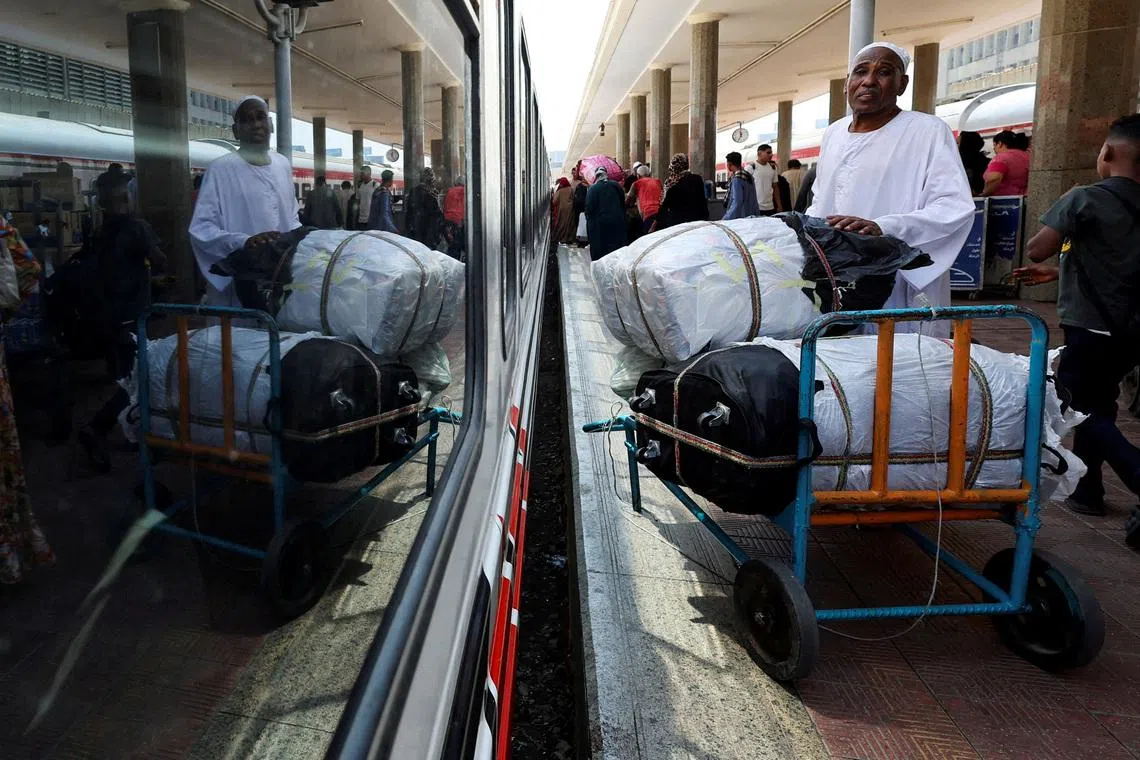
At a bus stop in the heart of downtown Cairo, Hosna, a 40-year-old school teacher, waited with her four children and hundreds of other people for transport back to Sudan.
Hosna said she feared her two teenage sons could be arrested because, despite receiving U.N. refugee status upon arrival two years ago, the family was still awaiting an appointment for Egyptian residency. The children of two families in her apartment building in Cairo had been detained and deported, she said.
“I came here searching for safety but there is no safety. It’s better to die in my country than lose my children,” Hosna said, giving only her first name.
More than a dozen refugees, including Hosna, expressed concern about returning to a precarious security situation in Sudan, where the capital Khartoum suffers frequent drone strikes and barely functioning basic services despite the army regaining control from paramilitary forces last year and large numbers of residents returning there at the behest of Sudan’s government.
Sudan’s information ministry did not respond to a request for comment about deportations from Egypt and risks deportees may face.
The civil war that started in 2023 has displaced millions of people fleeing racially charged campaigns of ethnic cleansing and other violence, including a massacre in Darfur that was the subject of a Reuters documentary. Millions are surviving on one meal a day in one of the world’s largest humanitarian crises.
A new asylum law Egypt passed in 2024 grants refugees the right to work and seek education and healthcare. But it drew criticism from UNHCR, the U.N. refugee agency, for giving officials wide discretion over who qualifies as a refugee.
Ennarah said implementing bylaws published this month offered insufficient protection from refoulement, the forcible return of refugees to a territory where their life or freedom is at high risk.
“The law’s expanded grounds for denial and revocation risk codifying the crackdown,” he said.
In its statement to Reuters, the Egyptian government said the law “affirms respect for human dignity and the principle of non-refoulement” and guarantees refugees the right to be free from discrimination or inhuman or degrading treatment.
UNHCR said it was concerned by the arrests, detention, and deportations, including of women and children registered with the U.N.
“Returns to Sudan should not take place under the current circumstances, given the ongoing conflict and humanitarian situation, which do not allow for safe and sustainable return,” UNHCR said in response to questions from Reuters, while recognising the strain the refugee crisis had placed on public services.
Egypt has deported Sudanese migrants before, including turning away thousands at the border, the security sources said. But the latest campaign has more frequently targeted population centres including Cairo, including some who settled in Egypt years before the conflict, several refugees said, describing raids on homes and workplaces.
More than 1.1 million people are registered with UNHCR in Egypt, overwhelmingly Sudanese, along with Syrians, Eritreans and others. The population fluctuates as people return to Sudan when fighting abates in their home regions, while others flee more dangerous parts of the country, U.N. monitoring shows.
The European Union in 2024 pledged Egypt 7.4 billion euros, partly in recognition for taking in migrants who otherwise might continue north. Previous crackdowns have driven Sudanese and other migrants to try risky routes through Libya and onward to Europe.
OVERCROWDING, BEATINGS, STOLEN FOOD
On January 18, a white microbus made an abrupt stop outside Al-Nazir Al-Sadig’s house, where he was standing with three friends. Plainclothes men jumped out and arrested them all, Al-Sadig’s sister Nadia told Reuters.
Al-Sadig had smuggled himself across borders from Sudan’s capital Khartoum with his family in October 2024. They settled in Badr, an east Cairo suburb. Hoping to quickly return to Sudan, he didn’t legalise his presence in Egypt, two family members said.
Locked up with more than 140 inmates in a 6m x 6m cell thick with cigarette smoke, Al-Sadig fell victim to criminal detainees who robbed him, one of the detained friends, Nabil Suleiman, told Reuters. They struggled for air.
“It was suffocating. There was no oxygen. Only one broken AC,” he said.
Al-Sadig told visiting relatives other prisoners took the food they brought, Nadia said.
They ate only jail rations of bread and cheese, Suleiman said. Water came from a hose inside a toilet block. Inmates stole clothes, including Al-Sadig’s sweater, leaving him shivering in Cairo’s chilly winter nights.
During his mother’s final visit, Al-Sadig complained about a chest infection and asked for medicine, saying none was provided in the lockup, Nadia and another family member said. The next day, a police officer called and notified the family Al-Sadig was dead.
The public prosecutor’s office recorded the cause of death as pneumonia, Nadia said, citing a judicial official who oversaw the case. Reuters could not independently verify the cause of death. The information service did not respond to questions about Al-Sadig.
The same day, Suleiman and the others detained with Al-Sadig were deported to the Sudanese border town of Halfa, Suleiman said.
Speaking to Reuters from Khartoum’s twin city, Omdurman, where he is without work, he described an excruciating journey to the border in Egyptian custody that took 18 hours, legs and hands chained, without food, water or sleep. He said he was not given a reason for the deportation.
The Egyptian government has previously said it was unfair to “generalize individual allegations and transform them into broad judgment,” adding that it opposed any infringement of refugees’ rights.
‘’NIGHTMARISH’
Nine other former detainees described similar conditions, including severe overcrowding, scarce food, dirty water, robbery and beatings by other inmates, and abuse or lack of protection by guards.
Sudanese and darker-skinned refugees were particularly targeted by the inmates, they said.
One 23-year-old Sudanese asylum seeker who said he spent three weeks in a police station said there was a price for everything, including a space to sleep – those who declined to pay were forced to stand.
“This is when you suffer from hallucinations,” he said.
An Eritrean tea seller in Cairo, who showed Reuters her Egyptian residency and U.N. refugee status, said plainclothes policemen arrested her while she was working in August. One tore her residency permit, she said. While detained in a police lockup, she said, three female convicts sexually assaulted her with a water bottle.
The medical report from Cairo’s Mostafa Mahmoud clinic after her release showed she was treated after her release for uterine bleeding. The hospital confirmed the authenticity of the records but declined to comment.
The 40-year-old said she was now too scared to leave the house and, out of work, was surviving on charity from neighbours.
Abazar Youssef, 37, a dual British-Sudanese citizen was visiting family in Egypt on a visitor visa when he was caught up in a January 25 raid in downtown Cairo.
During a two-week incarceration, Youssef said he witnessed criminals assaulting, blackmailing and extorting refugees. Police officers regularly beat detainees during morning lineups, he said.
He was deported to Britain on February 14. Asked about his case, the British embassy in Cairo said it had provided consular assistance to a detained British national and was in contact with Egyptian authorities about the case. REUTERS