World
Life Finds a Way: Mother Gives Birth in the Rubble as Venezuela Searches for Survivors

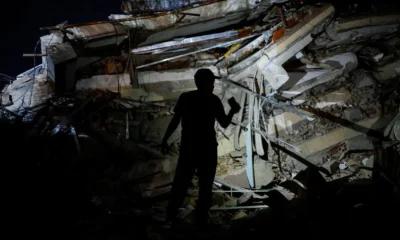
There is a particular kind of silence that settles over a disaster zone once the dust stops falling and the search begins. It is the silence rescuers listen into, hoping to hear a voice, a cry, anything. In Venezuela this week, amid the broken concrete and twisted rebar of a collapsed building, that silence was broken not by a cry for help, but by the first cry of a newborn child.
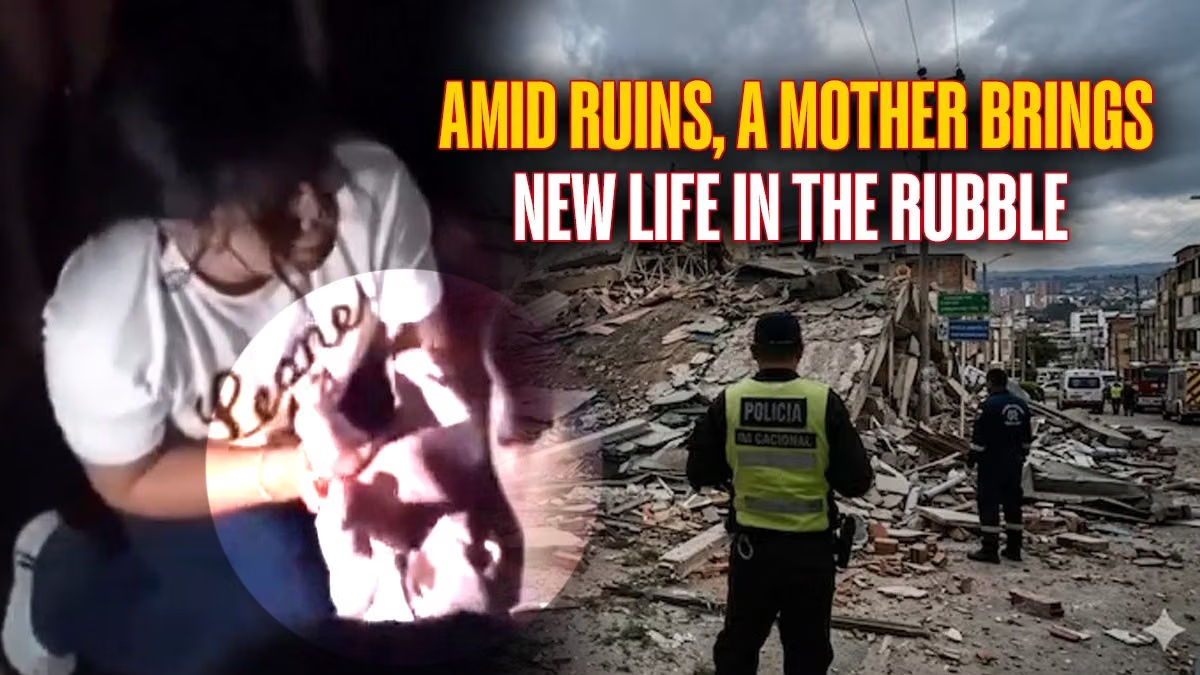
A woman has reportedly given birth in the rubble after the earthquake, with rescue workers at her side as she did what mothers have done since long before buildings ever stood. The video of the moment has since travelled far beyond Venezuela’s borders, landing in front of strangers thousands of miles away who, for a few minutes, forgot the headlines and simply watched a new life arrive.
A single small sound, and the world stopped to listen
There is something almost unbearable about the timing of it all, a body bringing forth life in the same instant the earth had tried to take so much of it away. Details of the mother’s condition and her baby’s health are still coming in, but the footage needs little explanation. It shows what it shows: that even buried under broken homes, even surrounded by grief, the body does not negotiate with disaster. It simply continues.
It is perhaps why the comments beneath the video read less like reactions and more like prayers. “God bless this mother and child, and those who helped her,” one person wrote. “Every mother knows that when you’re giving birth, absolutely nothing happening around you will stop that. Have a happy, healthy life, baby.” Another wrote simply, “Life showing up even in the middle of rubble… Humanity is unbreakable. Prayers for this baby and all of Venezuela.” A third found the words many were reaching for: “Nature’s way of reminding us that hope is stubborn.” And beneath nearly every clip, a quieter, simpler line kept repeating itself: “Deep respect to the rescuers and this brave mother.”
The scale of what this child was born into
To understand why this moment has travelled so far, it helps to understand what it was born against. On Wednesday, two earthquakes, 7.2 and 7.5 in magnitude, struck northern Venezuela within seconds of one another, a seismic event so violent it is now being called the country’s worst in over a hundred years. More than 235 people have died. Over 4,300 have been injured. Thousands remain missing, swallowed somewhere beneath the wreckage of homes that, just days ago, were simply where people lived their ordinary lives. Rescue teams are still working through what they call the critical 72 hours, the narrow window in which survival becomes less and less likely with every passing hour.
It is into this, into collapsed apartment blocks and grieving families and a death toll still climbing, that this child arrived. Not despite the chaos. Through it.
Other small mercies, found in the same ruins
This was not the only moment that has given people something to hold onto this week. Across the disaster zone, rescue workers have kept finding reasons, small and enormous all at once, to keep digging.
In one widely circulated video, rescuers can be seen lifting a baby, another baby, gently from beneath a collapsed building, passing him hand to hand with the kind of care usually reserved for something fragile and irreplaceable, because that is exactly what he was. His first cries, caught faintly on someone’s phone, drew applause from rescue workers who had spent the better part of the day pulling far more sorrowful things from that same pile of debris.
Elsewhere, a mother who had spent hours not knowing whether her child was alive found him, finally, inside a rescue vehicle on its way to a hospital. The footage of their reunion needs no narration. She runs. She does not let go. Around her, volunteers who had not stopped working all day stopped, just for a moment, to watch two people find each other again.
Even an animal was not left behind. Rescuers, hearing faint sounds beneath a collapsed structure, uncovered a dog, frightened, coated in dust, but alive. They gave it water before easing it free. It wagged its tail. The people standing around it, who had spent hours in far heavier silence, cheered.
And in La Guaira, one of the regions hit hardest near the capital, Caracas, rescuers continue to carry children out of what remains of their neighbourhoods, one careful step at a time, each child a small, fierce argument against the scale of the destruction around them.
What remains, when so much has fallen
Venezuela is still counting its losses, and will be for some time. But in between the wreckage and the waiting, in between the names read out and the names still searched for, there have been these moments: a baby’s first cry, a mother’s arms closing around her child, a dog’s tail wagging in the dust. Small things, perhaps. But in a week like this one, perhaps small is exactly the right size for hope to come in.
Read More: A Baby’s Cry, A Mother’s Hug, A Dog’s Whine: Venezuela’s Most Heartbreaking Rescue Stories That Are Melting Hearts After Earthquake Horror