World
Kushner floats cash-for-normalisation with Israel to expand ‘Abraham Accords’

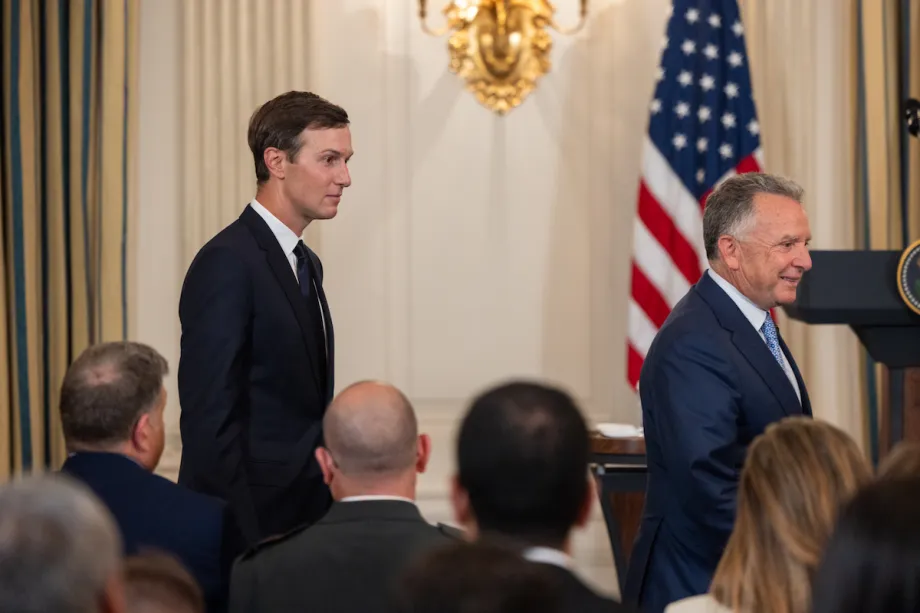
Jared Kushner has suggested that countries which normalise relations with Israel through the Abraham Accords could be rewarded with investment money and political backing.
Speaking in a video interview, the son-in-law of US President Donald Trump and so-called “Special Envoy for Peace” said he and his partners were looking at opportunities to invest in countries which have joined, or may join, the Abraham Accords. The comments appear to frame normalisation with Israel not as a principled diplomatic breakthrough, but as a gateway to private capital, political favour and economic inducements.
Kushner said he had been helping US envoy Steve Witkoff “promote the Abraham Accords” and “find new opportunities.” He added that one of his partners, Asher, is of Moroccan and Syrian descent, and that they had been looking at “opportunities to bring investment to Morocco” in order to help create “dividends from the Abraham Accords.”
Read: The normalisation plague is deadlier than the Covid-19 pandemic
“We’re looking at opportunities to invest in countries who have joined the Abraham Accords,” Kushner said. “But we’re also looking at opportunities to invest in countries that might join the Abraham Accords, and to create economic packages, to incentivise them.”
Kushner then raised Syria as a possible target for such an approach, saying that one of his partners had suggested putting together “a big investment package” for the country.
“He said, Jared, we should put together a big investment package, maybe for Syria, so that if they joined the Abraham Accords, they could have a big incentive to do it,” Kushner said.
Kushner’s remarks point to a direct system of incentives behind the Abraham Accords: countries that normalise relations with Israel can expect investment packages, political backing and access to US-linked capital. For Palestinians, the framework offers no route to self-determination; for governments willing to bypass them, it offers rewards.
The Abraham Accords were launched during Trump’s first term and formalised relations between Israel and several Arab and Muslim-majority countries, including the United Arab Emirates, Bahrain, Morocco and Sudan. Kushner was “instrumental” in bringing the accords to fruition and later launched the Abraham Accords Institute to deepen normalisation through trade, tourism and people-to-people programmes.
For Palestinians and many critics of the accords, the deals have always represented a form of diplomatic bribery. Morocco’s entry into the normalisation framework, for example, came alongside the Trump administration’s decision to recognise Moroccan sovereignty over Western Sahara, a dramatic break with longstanding US policy. Morocco became the fourth Arab country to normalise relations with Israel, while Trump recognised Rabat’s claim over the disputed territory as part of the US-brokered deal.
The comments also come amid mounting scrutiny of Kushner’s overlapping diplomatic and financial roles. In April, Rep. Jamie Raskin opened an investigation into Kushner’s “foreign entanglements and staggering conflicts of interest,” warning that his dual role as US negotiator and financier funded by Middle Eastern governments posed grave risks.
Raskin said Affinity Partners, Kushner’s investment firm, had amassed around $6.16 billion in assets under management, with 99 per cent of its funding derived from foreign nationals, including sovereign wealth funds in Saudi Arabia, the UAE and Qatar.
Senator Ron Wyden and Rep Robert Garcia also demanded answers from the White House in March over reports that Kushner was soliciting billions of dollars from Middle Eastern sovereign wealth funds while simultaneously helping lead US negotiations in the region. Garcia warned that Kushner’s role raised concerns that he could be “profiting by selling access to influence US policy to foreign investors.”
Trump has also sought to link the Abraham Accords to any future agreement with Iran, framing normalisation with Israel as part of a broader regional settlement. His remarks have been viewed by many analysts as an attempt to place Israel at the centre of a US-backed regional order.