World
Israel-Lebanon talks extended an extra day as deal on IDF withdrawal remains elusive

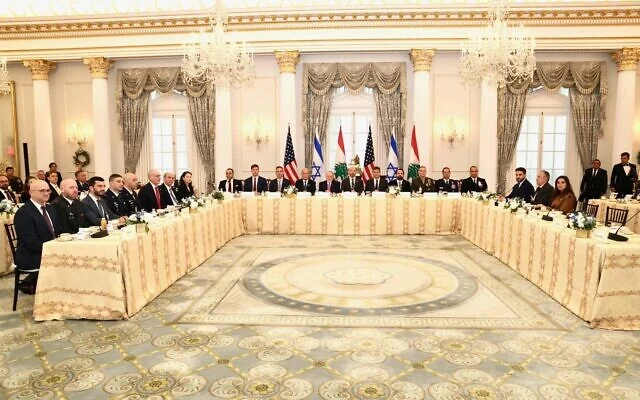
Israel and Lebanon on Thursday wrapped up a third day of US-mediated negotiations in Washington without an agreement on a partial Israeli withdrawal from southern Lebanon, though the sides agreed to extend talks for an extra day, an Israeli embassy spokesperson told The Times of Israel, with negotiators to reconvene Friday at the State Department
The fifth round was supposed to wrap up Thursday at the State Department, with the US hoping it would culminate with the signing of a framework agreement that would include Israel partially withdrawing from small areas of its large buffer zone in southern Lebanon. Israeli troops would then be replaced by members of the Lebanese Armed Forces.
The areas were this changing of the guard are planned for have been dubbed “pilot zones.” An Israeli source argued that it could barely be called a withdrawal because the IDF would still be maintaining its six mile-deep buffer zone in southern Lebanon and only pulling back from areas that it already cleared of Hezbollah infrastructure.
In some cases, the IDF has gone about clearing that infrastructure by razing entire Lebanese villages along the Israeli border to the ground, arguing that Hezbollah was using much of them to plan and carry out attacks against Israel.
Despite the lack of an agreement between Israel and Lebanon, a source familiar with the talks told The Times of Israel that the sides made progress on Thursday after a rocky first two days.
Both Israel and Lebanon came into what was the fifth round of negotiations furious at the US for the latter’s decision to sign a deal with Iran last week that included a ceasefire in Lebanon.
Jerusalem and Beirut argued that the memorandum of understanding undercut a key element of their direct talks, which the US specifically established to try and prevent Iran from having a say on affairs in Lebanon.
The US conduct led Israel to initially harden its position in talks with Lebanon this week, significantly limiting the areas from southern Lebanon from which it said it was prepared to withdraw, the source said.
Lebanon, meanwhile, felt that it had to take a harder line in negotiations with Israel to counter the notion that Iran wields greater influence over affairs in Lebanese territory than it does, the sources said.
Accordingly, Lebanese negotiators presented maps for a proposed IDF withdrawal that were more expansive than what Israel was willing to accept at this stage — which was already very little due to the political pressures Prime Minister Benjamin Netanyahu’s government is facing, the source claimed.
Thursday’s talks saw gaps between the sides on the potential Israeli withdrawal shrink, though still not enough for a deal to be reached, the source said.
However, due to significant US pressure on the parties to end this week’s negotiations with some sort of deal, they have agreed to return to the State Department on Friday to see if a consensus can be reached, the source explained.
Asked for its own update on the status of talks, a State Department spokesperson sufficed by confirming that they would pick back up again on Friday at 9 a.m. local time when the sides will “continue their work toward an agreement.”
The day began with Reuters quoting a State Department official who claimed that Israel had already agreed to begin withdrawing some of its troops. The report was quickly denied by both sides.
The State Department did not respond to repeated requests for clarification, so it was not clear if Reuters relied on an uninformed source or if the US had falsely leaked that progress had been made in talks in order to push the sides toward such a result.
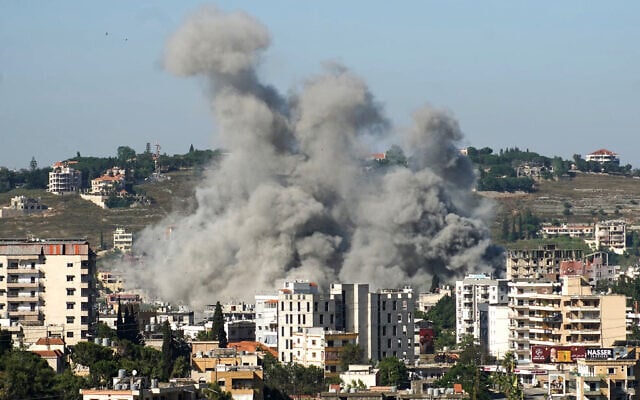
As the talks continued in Washington, Israel carried out strikes Thursday in southern Lebanon against what it said were Hezbollah operatives who posed threats to troops.
Hezbollah accused Israel of a “flagrant” ceasefire breach after what it said was an Israeli drone strike that killed three civilians traveling in a car in the Nabatieh district village of Mayfadoun.
The IDF had earlier said that five Hezbollah operatives were killed in the strike. It also said troops killed a Hezbollah gunman in another incident.
לאחר שזוהו במרחב הביטחוני: צה”ל חיסל מחבלי חיזבאללה שהיוו איום על כוחותינו הפועלים במרחב ההגנה הקדמי
מוקדם יותר היום (ה’), כוחות צוות הקרב החטיבתי גולני בפיקוד אוגדה 36 הפועלים בזוטר א-שרקייה, זיהו חמישה מחבלים מארגון הטרור חיזבאללה שהיוו איום על כוחותינו הפועלים בתוך המרחב… pic.twitter.com/uNRdIgou5P
— צבא ההגנה לישראל (@idfonline) June 25, 2026
Hezbollah said it was the third “flagrant violation” by Israel “of the ceasefire to which it has committed itself so far.”
Israel and Hezbollah engaged in a major exchange of fire last week before the US and Qatar brokered another shaky truce. Iran and its proxy Hezbollah have continued to demand an end to Israel’s presence in southern Lebanon, claiming it violates the Islamic Republic’s deal with the United States.