World
Iran is China’s indispensable partner, but Beijing will never fight its war

There is a seductive myth that China and Iran are allies bound by blood and ideology, that Beijing would ride to Tehran’s rescue the way NATO would for a member under Article 5. Nothing could be further from the truth. What binds Beijing and Tehran is colder, more durable, and in some ways more dangerous than sentiment: mutual utility. China needs Iran. It will not die for Iran. Understanding that distinction is the key to understanding everything Beijing has — and has not — done since the guns of the 2026 war began firing.
A partnership without a promise
When China and Iran signed the 25-year Comprehensive Strategic Partnership, Chinese state media hailed it as a civilizational bond. The agreement covers energy, infrastructure, banking, and “military-technical” cooperation. However, it conspicuously omits a mutual defense clause. It stops short of the ironclad commitments Beijing has made to Pakistan, or that Moscow has promised North Korea. Farzin Nadimi of the Washington Institute put it plainly: the China-Iran treaty “stopped short of any mutual defense clause.” Put simply, Tehran is viewed as a second-tier partner, while Islamabad occupies a first-tier position.
That asymmetry was laid bare in the starkest possible terms during the 2026 war. When Israeli and American strikes killed Iran’s Supreme Leader and plunged the region into its bloodiest confrontation in a generation, Beijing did not send a single warship, missile battery, or soldier. Foreign Minister Wang Yi condemned the killing and called the conflict “a war that should never have happened and benefits no party”. Dissected with a sharp scalpel, the statement is a studiously neutral formulation that scholars at the Chicago Council on Global Affairs noted was “not an outright condemnation of the United States or Israel, or indeed of Iran,” but rather “a more generalized statement of regret.” China and Russia jointly requested an emergency UN Security Council session and abstained from resolutions critical of Tehran, the diplomatic equivalent of sending condolences rather than reinforcements.
The sidelines were profitable
Beijing’s caution was not cost-free neutrality; it was profitable neutrality. China spent the better part of the past two years quietly assembling one of the largest strategic petroleum reserves in its history, an estimated 1.2 billion barrels, equal to some 109 days of import cover, built substantially on sanctioned Iranian, Russian, and Venezuelan crude bought at discounts of $5 to $15 a barrel below Brent.
Why Beijing cannot let Tehran fall
None of this means China is indifferent to Iran’s fate. On the contrary, Iran sits at the geographic and ideological hinge of two projects Beijing cannot abandon.
If Iran were to fall into a Western orbit, that corridor terminates abruptly at the Pakistani-Iranian frontier. The oil-rich Gulf states, the ultimate prize of the Middle Eastern leg of the initiative, would become unreachable by land. For a project Xi Jinping has staked his legacy on, that is not an acceptable outcome.
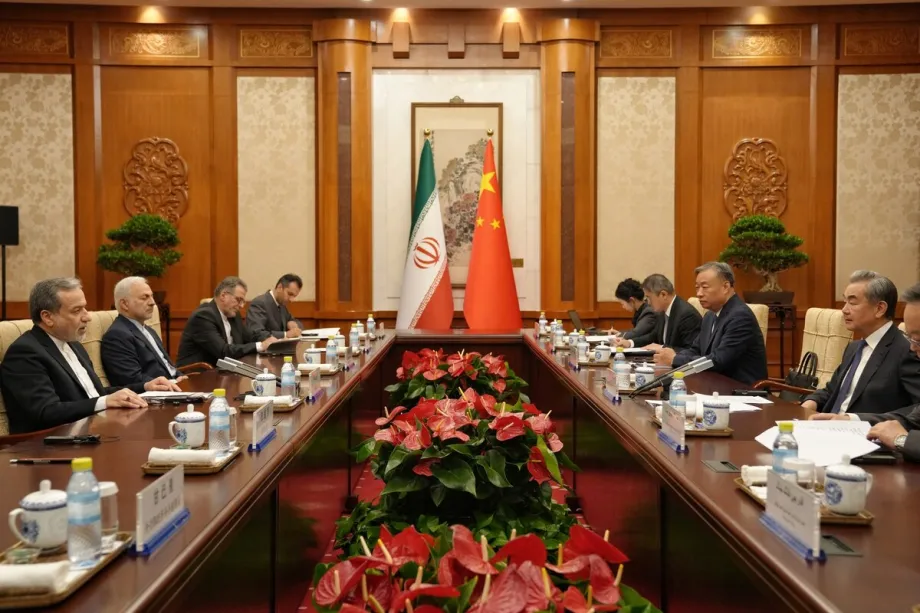
The second is the Sino-Russian view of the regional balance of power. Moscow and Beijing have coordinated closely throughout the crisis, jointly convening UN sessions and declining to abandon Tehran diplomatically even as they withheld direct military support. Russian President Vladimir Putin, hosting Iran’s foreign minister in St. Petersburg as the war ground on, told him: “We see how courageously and heroically the Iranian people are fighting for their independence and sovereignty,” pledging that Moscow would “do everything that serves your interests” to secure peace. It was solidarity in words, not in warships. Yet, it signaled unmistakably that Moscow and Beijing view an Iranian collapse as unacceptable, even if neither is willing to underwrite Iran’s survival militarily.
The Pakistan variable
To understand why Beijing calculates this way, look east to Islamabad. Pakistan is the only country in the region to have received the kind of unambiguous Chinese military backing that Iran has been denied. Between 2020 and 2024, more than 60 percent of all Chinese arms exports went to Pakistan. That investment paid a visible dividend in May 2025, when Pakistan’s Chinese-built J-10C fighters, firing PL-15 beyond-visual-range missiles, were credited by Islamabad with downing multiple Indian Air Force jets, including French-made Rafales, during the most intense aerial engagement between the two nuclear-armed neighbors in decades. China’s own defense-industry regulator later confirmed, for the first time, that an exported Chinese jet had scored a combat kill. Indian Deputy Chief of Army Staff Lt. Gen. Rahul Singh offered a blunter reading of the relationship, telling reporters that Beijing “is using Pakistan like a live weapons laboratory.”
That alliance matters enormously to Beijing to counter the containment calculus spearheaded by the US. China faces an increasingly coordinated quadrilateral of rivals — the United States, Japan, Australia, and India — and needs every reliable partner it can find on India’s periphery. Pakistan, locked in its own long dispute with New Delhi over Kashmir, is the most dependable of those partners.
READ: Iran’s supreme leader vows to avenge slain predecessor Ali Khamenei