Latest
I told Abacha to disband clique of ‘bad influence’ officers around him — General Abubakar

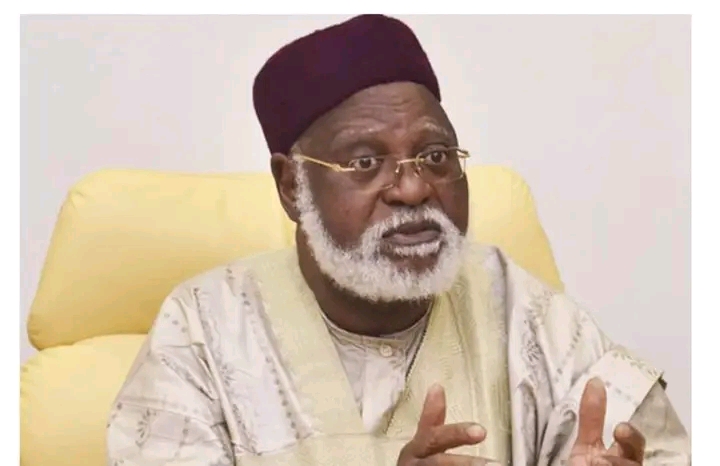
Former Head of State, General Abdulsalami Abubakar, has revealed how a clique of officers who acted as a kitchen cabinet for the then Head of State, General Sani Abacha, had marked him and a few other senior military officers down for elimination from the regime.
General Abubakar said he told General Abacha to disband the clique of officers around him because they were a bad influence on his government.
These and other accounts are contained in the autobiography of General Abubakar titled Call of Duty, which, alongside two other books — Nigeria’s Grand Patriot and Mediating for Peace in Africa — were presented at the event marking his 84th birthday at the Old Banquet Hall, Presidential Villa, Abuja.
The event was attended by President Bola Tinubu, represented by his deputy, Vice President Kashim Shettima; former Head of State, General Yakubu Gowon, who chaired the event; and former presidents Olusegun Obasanjo and Goodluck Jonathan, among other high-profile personalities.
In his autobiography, General Abubakar gave insight into the group he described as “caucus members” in General Abacha’s military administration, who wielded significant influence in the running of government. He said some officers initially penciled for retirement escaped because the late General Sani Abacha was devoted to his friends.
“To be fair, General Abacha was loyal to his friends. A caucus that sprang up when he became Head of State didn’t want to see some faces around, and they often insisted that some officers be retired. All the time, four of us who were slated for retirement survived because Abacha was devoted to friendship. They wanted him to retire Lt-Gen Jeremiah Useni, Lt-Gen Garba Duba, Maj-Gen Mohammed Balarabe Haladu and myself. Ironically, all those hawks were retired before us. They became a pain in Abacha’s neck and he had to get rid of them,” he stated.
Abubakar, who was Chief of Defence Staff (CDS) to Abacha, said: “I didn’t bother to find out why I was made Chief of Defence Staff. I believed it was Abacha who insisted. As I noted already, he was very loyal to his friends. This same group of people urged him to arrest General Babangida. He asked them what his offence was and they said charges could always be found after his arrest. People who knew Abacha through Babangida would come and ask Abacha if it was okay for them to go and visit Babangida.
Abacha had some qualities that I respected. We were friends. In our discussions, I would call him ‘Sani’ and he would call me ‘Mallam.’ In one of our conversations, I told him that he needed to disband the group of officers that formed the clique around him. He initially wanted me to talk to them and ask them to be careful, but I refused and insisted that he should be the one to speak to them. Finally, one by one, he retired them from the military. However, two or three were lucky to escape retirement because they were not as exuberant.”
Abubakar, a member of the then Provisional Ruling Council (PRC), the highest ruling body, said contrary to reports that the regime did not hold meetings, they actually did. However, he found out that some matters were discussed by the kitchen cabinet and in some cases decisions were already taken prior to the meetings. He noted that Abacha sometimes asked their opinion on the political crisis rocking the country, and although the buck stopped at his desk, some of them still managed to pass their suggestions to him.
“Abacha was not bound to listen to us or take our advice. We asked him to release Bashorun MKO Abiola from detention and to discuss with him one-on-one the way forward after he was arrested for proclaiming himself President based on the June 12 election. However, Abacha did not give our advice any positive consideration. It was a difficult period for Nigeria. Powerful foreign nations imposed sanctions on us.
Some were targeted at the military and members of Abacha’s government. In the end, we were all part of the administration. No matter what I say, I cannot deny that I was his Chief of Defence Staff and a member of the PRC. But the final decision was for the Head of State to make,” Abubakar said.
General Abubakar said the reports that looted funds were traced to Abacha were very strange to him, stressing that the Abacha he knew was very strict with accountability. He noted that whenever Abacha commanded any unit in the Army, he hardly spent allocated funds, and the new commander always found the money in the account. He remembered that when he was Chief of Defence Staff, Abacha would sometimes call him to his office to do proper costing before releasing money for the military because he hated waste and would bring out his calculator before releasing money for equipment.
“It was in the closing days of our administration in 1999 that I was shown papers of money transfers to accounts traced to members of his family and associates. After I left office, I was told that Abacha took those monies out of the country in the event of sanctions on Nigeria by Western countries. He was said to have been so advised by Colonel Muammar Gaddafi, the Libyan leader who faced heavy sanctions from the West.
He reportedly advised Abacha that if the Western powers froze Nigeria’s assets, his government would be stranded if he did not have funds abroad. I honestly cannot confirm or deny these explanations. But I would be lying to say I thought of Abacha as a thief. Unfortunately, he didn’t put some of us in confidence about what he was doing.
Perhaps it would have been a different story. I know that he bought vehicles for all the security agencies. All the security agencies received the famous Tata trucks. Again, he sustained the Economic Community of West African States Monitoring Group (ECOMOG) operations. Nigeria bore the brunt of those operations in terms of logistics, armament and others,” he added.
He concluded that Abacha’s government was never short of events and that the June 12 crisis was the biggest, alongside issues of alleged coup plots and incidents of bomb blasts.