World
As deal takes force, Trump says ‘it’s okay’ for Iran to have some ballistic missiles

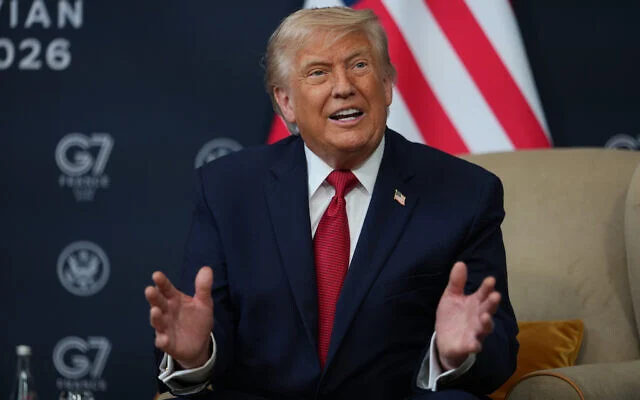
US President Donald Trump on Wednesday claimed Iran should be allowed to keep some of its ballistic missiles, as he defended the signed memorandum of understanding between his administration and Tehran shortly before the deal entered into force.
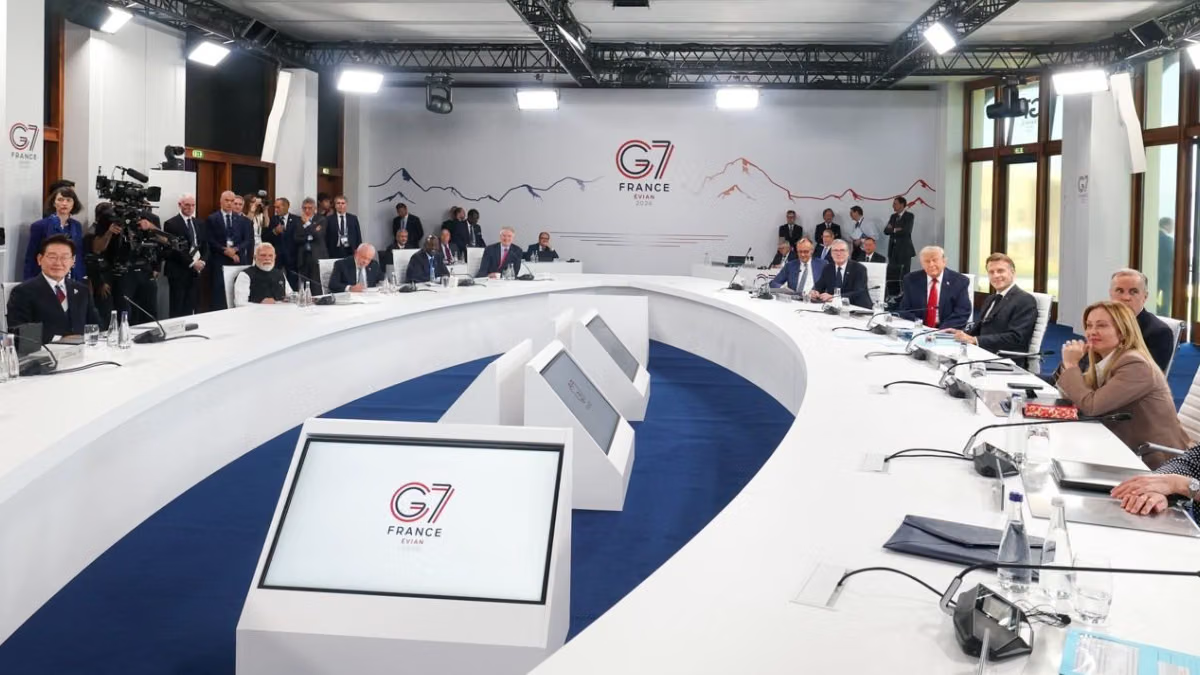
“If other countries have them, it’s a little bit unfair for them not to have some,” Trump said in France, where he held a press conference on the sidelines of a G7 summit. “If Saudi Arabia and Qatar, and they all have some, I would say that in relative proportion, I think it’s okay” for Iran to have ballistic missiles as well.
“Missiles aren’t the problem… They hurt a little location, but they don’t blow up the planet (like nuclear weapons do),” Trump said.
Destruction of Iran’s missile program had been an aim on the same footing as others for Israel when it launched a war against the Islamic Republic alongside the US on February 28. While the US for weeks waffled on its own aims for the war, it has insisted throughout that Iran was attempting to use its missile program as a shield to make it impossible for other countries to prevent it from building a nuclear weapon.
Trump’s de-prioritization of the missile issue appeared to mark a shift for the US, though, though he did clarify that the program would be discussed in follow-on talks that the sides agreed to hold for the next 60 days.
Hours after Trump’s press conference, the Iranian foreign ministry announced that the text of the MOU had been “officially” signed by the presidents from both countries, which Trump confirmed following a dinner with French President Emmanuel Macron at the Palace of Versailles.
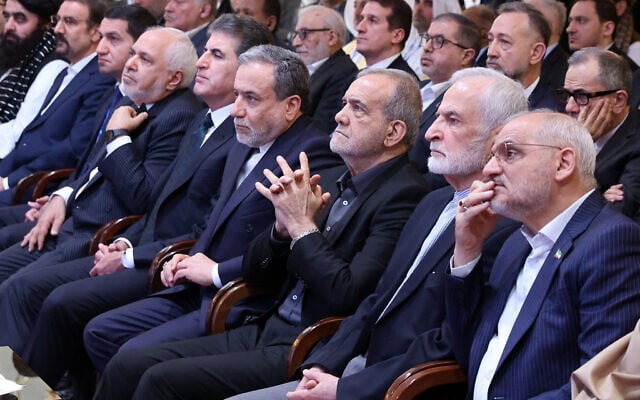
A US official clarified to Reuters that Trump and Iranian President Masoud Pezeshkian signed it after the memo was signed digitally on Sunday by Vice President JD Vance and Iran’s chief negotiator Mohammad Baqer Qalibaf and witnessed by Trump.
“The text of the Islamabad Memorandum of Understanding was finalized with the signatures of the presidents — now it is time to test the implementation of the agreement,” Iranian foreign ministry spokesperson Esmaeil Baghaei said, quoted by the state news agency IRNA.
Despite the signings, the US has refrained from officially releasing the text of the deal, leading to mounting criticism that it was trying to hide the terms.
As different versions of the deal began leaking, the White House decided to hold a phone briefing for reporters with two of the top officials in the Trump administration during which they read out the full MOU.
Enriched uranium not that important either
The readout confirmed that the MOU also does not require Iran to hand over its stockpiles of highly-enriched uranium, which can be used to produce 11 nuclear bombs.
Instead, it states that the US and Iran have agreed to address the issue through a mechanism that will be negotiated over the next two months, “with the minimum methodology to be down-blending on site under the supervision of the IAEA.”
Pushed on the issue during his press conference, Trump downplayed the importance of obtaining Iran’s uranium stockpiles, claiming that Tehran cannot access them anyway.
He again asserted that the “nuclear dust” is buried deep under rubble after bombing Iran’s three main nuclear sites last year. He said only the US and China have the equipment to reach it.
“It’s actually not valuable, but we’d like to get it psychologically,” Trump said. “Nobody’s touching it. We also have Space Force cameras” monitoring the sites.
It has not been publicly confirmed that the stockpiles are actually located in any of those three sites. Iran is also said to have other stockpiles of uranium enriched to lower levels — which could also ultimately be turned into a nuclear weapon — located elsewhere.
Regardless, Trump said the issue will still be a key topic of discussions with Iran over the next two months.
“They’ll work closely with us to turn over the so-called enriched material,” he says, before again suggesting that the goal is not that important to him, as Iran is likely to push back on the demand.
More bombing would’ve led to ‘economic catastrophe’
After spending much of the war defending the decision to use military force against Iran, Trump on Wednesday found himself asserting the limits of such force.
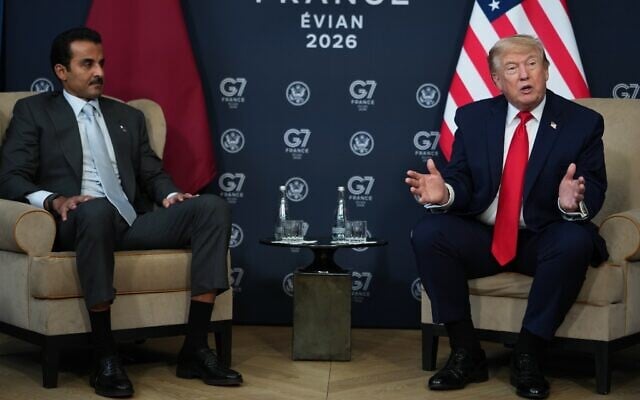
“If we didn’t do this deal, we could have dropped more bombs for another three weeks, two to four weeks, [but] you would never have the Hormuz Strait open, the market would have… gone down to levels that nobody ever saw before,” Trump said, arguing that he staved off “economic catastrophe.”
Trump knocked hawkish critics who oppose the deal, calling them, “the tough guys that would drive the country right down the tubes.”
“If we keep bombing… You’re talking about $500, $600, $700 million a day. It’s a lot of money,” Trump said.
He then suggested the US would have run out of ammunition had it continued bombing Iran, rather than reaching a deal this week.
“We run out of reserves in about four weeks… There are reserves all over the world, and we would really run out, and there’ll be a time when you wouldn’t be able to get it.”
Ready to bomb some more
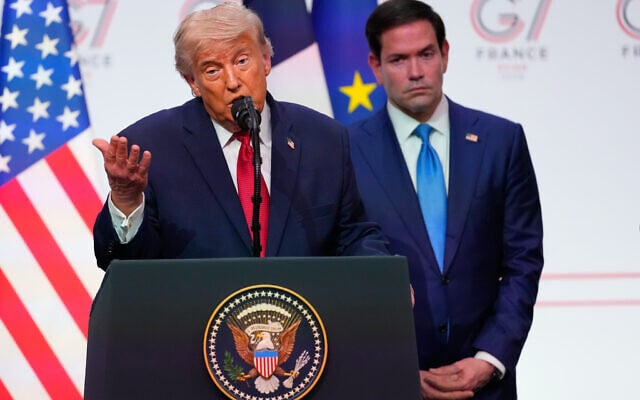
While Trump maintained that additional strikes would have caused major harm to both civilians in Iran as well as the global economy, he still went on to threaten to resume the bombing if Tehran does not comply with the MOU.
But given that the MOU is a rather general document, Trump was pressed on how exactly it binds Iran.
“There doesn’t have to be” anything enforceable in the agreement, Trump said during the press conference, insisting his threat to bomb Iran if it does not comply is sufficient.
“What else am I going to do? Am I going to say, ‘I’m going to take you to court’? No. We’re gonna bomb the hell out of them if they violate the agreement,” Trump said.
Trump was also pressed to explain his claim from recent days that the MOU permanently prevents Iran from obtaining a nuclear weapon, given that the actual text suffices with, “Iran reaffirms that it shall not procure or develop nuclear weapons.”
“When I say permanently, it should be permanently, but if it’s not permanently, we will bomb them,” Trump said.
“That’s with me as president. If you have a weak, pathetic president, maybe that doesn’t happen,” he added, admitting that he cannot control what will happen after his term ends.
On the separate phone briefing, the senior US official said the administration was working to get as much oil out of the Strait of Hormuz as possible so that the global supply can be restocked in case Trump decides to resume the war against Iran.
The official argued that the US is not risking very much by agreeing to an MOU this week with Iran because the bulk of the sanctions relief it may provide will only be realized if Tehran makes concessions in the subsequent nuclear negotiations that will be held over the next two months.
“In the meantime… we’re working to get as much oil out of there as possible and to let everyone restock global supplies and help everyone get into position for if Iran misbehaves and there has to be another round of efforts,” the senior US official said.
The official said negotiators from both sides will be meeting over the weekend in Switzerland, where the MOU is set to be formally signed on Friday. That sit-down “will be quite critical in order to see how we get to the next phase.”
The official noted that the meeting will be held at a Swiss hotel owned by officials from Qatar, which shares a gas field with Iran.
“It will be a very good illustration to show that with the money that comes out of this gas field, [it] can either be used to buy great properties that give you cash flow and returns to reinvest in your population… or you could fund terrorism, which basically has led to destruction and devastation that makes them much worse off,” the senior US official said.
However, Iran’s foreign ministry later suggested the meeting in Switzerland may be called off now that the deal was signed by Trump and the Iranian president.
“The Friday meeting was confirmed until a few hours ago, but when it was decided that the presidents of the two sides (Iran and the US) would sign the agreement, it was decided to pause consideration of the Friday meeting for now,” Baghaei said.
US downplays up-front sanctions relief granted to Iran
Trump also faced questions regarding the up-front sanctions relief that the US has agreed to provide Iran after repeatedly insisting that it would only do so after Iran makes concessions in the follow-up nuclear talks.
In going over the text of the MOU on the briefing call, the senior US official revealed that a US waiver on sanctions against Iran oil exports is actually in the text itself, which states that it will be “immediately” applied upon the deal’s signing.
The senior official claimed that Iran was able to sell oil, regardless of the sanctions, and was “giving China a massive discount” — a benefit that the US wanted to end.
A second senior US official on the call argued that the war caused hundreds of billions of dollars in damages to Iran, while the relief from the sanctions waiver will only be in the “single digit billions of dollars.”
“It’s not that significant in the scheme of things. They were able to (export oil) anyway by opening the strait, so we thought that was actually a fair concession to give them, as it also helps bring down global oil prices,” the US official said.
As for Iranian funds that the US has frozen in accounts abroad, Trump indicated during the press conference that he will allow Tehran to access those as well, without specifying any conditions.
“We have taken a lot of their money — it’s their own money, and we froze it at a certain point in time,” Trump said. “I guess we’re going to have to give it back.”
“If we didn’t give it back, nobody would ever invest in the dollar again,” Trump claimed.
‘That’s what Iran asked us to do’
Attempting to explain why the US had refrained from releasing the text of the MOU despite it first being signed Sunday, the senior US official briefing reporters claimed Tehran asked that it not be released until the Friday signing ceremony.
“The motto that we want to have with this deal is no side-deals and full transparency, so it was unfortunate we weren’t able to put it out right away,” the US official said.
“We were trying to accommodate their domestic messaging and their domestic politics, and we’re trying to build trust with them, and that’s what they asked us to do,” the US official said.
Trump revealed during the press conference that the US had “sent a copy” of the MOU to Israel. Earlier in the week, Hebrew media reported that the US had refused Israeli requests to see the text.
The senior US official on the briefing call denied those reports.
“Nothing has been requested of us. We’ve always shared with them some of the concepts of what it was. We’ve had consultations with [the Israelis] along the way,” the official said.
Netanyahu “has not asked us for a copy of (the MOU). Maybe he hasn’t seen the final document, but he can’t say that he’s not up to speed on what’s occurring,” the US official insisted.
“What (Netanyahu) said to us is that if we can get all of these concessions out of Iran the way that we’re thinking about it, he thinks that would be a historic deal,” the US official continued. “He remains skeptical that we’ll do it, but we remain skeptical as well. That’s why we’re going to go forward to the next negotiations, and see what we’re able to accomplish.”
The other senior US official on the call went on to knock “the Iranian and Israeli press for misrepresenting or misunderstanding” the MOU — lumping Iran’s state-controlled media together with Israeli outlets.