World
6 said killed in Gaza strikes as Hamas health ministry says war toll surpasses 73,000

Israeli strikes and gunfire killed at least six Palestinians in the Gaza Strip on Sunday, health officials said, as mediators stepped up efforts to salvage the US-brokered ceasefire.
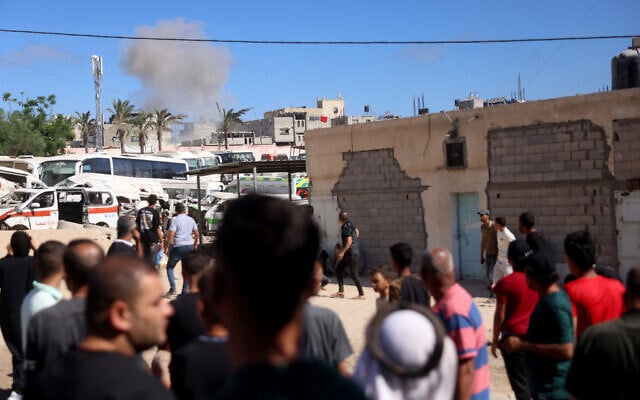
Medics said an Israeli airstrike killed at least four people near Al-Yeman Al-Saeed Hospital in the Jabalia refugee camp, in the north of the enclave, while two others were killed in separate shooting incidents in Khan Younis in the south, and in Gaza City.
The casualties in northern Gaza were taken to Shifa Hospital.
The IDF did not immediately comment on the incidents, although an Israeli military official told AFP that the strikes had targeted “terrorists” in the area, without elaborating.
The strikes came as mediators Egypt, Qatar, and Turkey wrapped up week-long talks with Hamas and other Palestinian factions on implementing the second phase of US President Donald Trump’s Gaza plan, which would involve Hamas disarming and Israel withdrawing its forces.
An October 2025 truce brokered by Trump has failed to fully halt Israeli attacks in Gaza or to secure the disarmament of the terror group, and both sides have repeatedly accused the other of violating the terms.
Israeli strikes in Gaza have killed more than 950 Palestinians since the start of the truce, according to figures provided by the Hamas-run health ministry, which does not differentiate between combatants and civilians.
Palestinian terror operatives have killed four Israeli soldiers in the same period, with a fifth soldier killed in the Strip in a friendly fire incident.
Hamas blames the absence of a full agreement to end the Gaza conflict on what it says is Israel’s refusal to fulfill first-phase obligations agreed in October, which halted major fighting but did not end Israeli operations. Israel says its strikes are intended to thwart imminent attacks by Hamas and other terror operatives.
On Sunday, Hamas and other factions said they had given a written response to a 15-point blueprint presented to them by the mediators and Trump’s Board of Peace, but did not provide details of their response.
Sources close to the talks said the factions agreed to 14 out of the 15 items. Disagreement remains over the disarmament of Hamas, which links any full disarmament to launching a political track toward a Palestinian state.
Israel insists Hamas must disarm, cede power in Gaza, and play no role in the future of the enclave. Prime Minister Benjamin Netanyahu and his government have repeatedly insisted that it will not allow the creation of a Palestinian state.
On Sunday, the Hamas-run health ministry said the death toll from the Israel-Hamas war in the enclave is now 73,001. Over 173,200 people have been wounded since the start of the war, following the Hamas-led invasion of Israel on October 7, 2023, in which terrorists killed some 1,200 people and took 251 hostage.
The Israeli military believes that Hamas’s overall toll is largely accurate, with IDF officials estimating that two to three civilians were killed for every dead terror operative.
Even as the death toll continues to rise in the war-torn enclave, The Guardian newspaper reported on Sunday that the International Committee of the Red Cross fears that thousands of Palestinians who are still buried beneath the rubble may never be identified.
The bodies that have yet to be recovered “could soon become difficult to identify,” a spokesperson for the ICRC told The Guardian, explaining that once a body reaches the “advanced stages of decomposition,” it is significantly more difficult to identify.
The recovery process has been slow, he told the newspaper, as Israel has not responded to repeated requests for heavy machinery, forcing recovery teams to use shovels, pickaxes, and even their own hands as they search through the rubble that covers the Gaza Strip.
“Search and recovery teams need access to all sites where human remains are thought to be located,” the spokesman said, adding that the ICRC is in “ongoing direct dialogue with the relevant authorities” to allow heavy machinery into Gaza to aid with recovery efforts.