World
Why Has the UK Finally Decided to Crack Down on Pro-Palestine Protests?

Something shifted in Britain this week. After months of rising tension, a knife attack on two Jewish men walking through Golders Green, one of London’s most recognisable Jewish neighbourhoods, appears to have pushed the government into taking a harder public stance on pro-Palestinian demonstrations.
What Happened in Golders Green?
The attack took place on Wednesday, on the main street running through the area, leaving both victims seriously wounded. One remained in hospital as of Friday. The alleged attacker, Essa Suleiman, a 45-year-old British national born in Somalia, was charged Friday with attempted murder.
This was not an isolated incident. It followed a terrorist attack on a synagogue in Manchester last October that killed two people, and a recent series of arson attacks targeting synagogues, Jewish schools and businesses owned by Jewish families. By Thursday, the situation had become serious enough that the UK government raised its national terror threat level to “severe,” a classification that signals a high probability of another attack occurring within six months.
Why Are Pro-Palestinian Protests Being Blamed?
The debate around whether the regular marches held in cities across Britain have contributed to rising anti-Jewish sentiment has been simmering for some time. This week it boiled over.
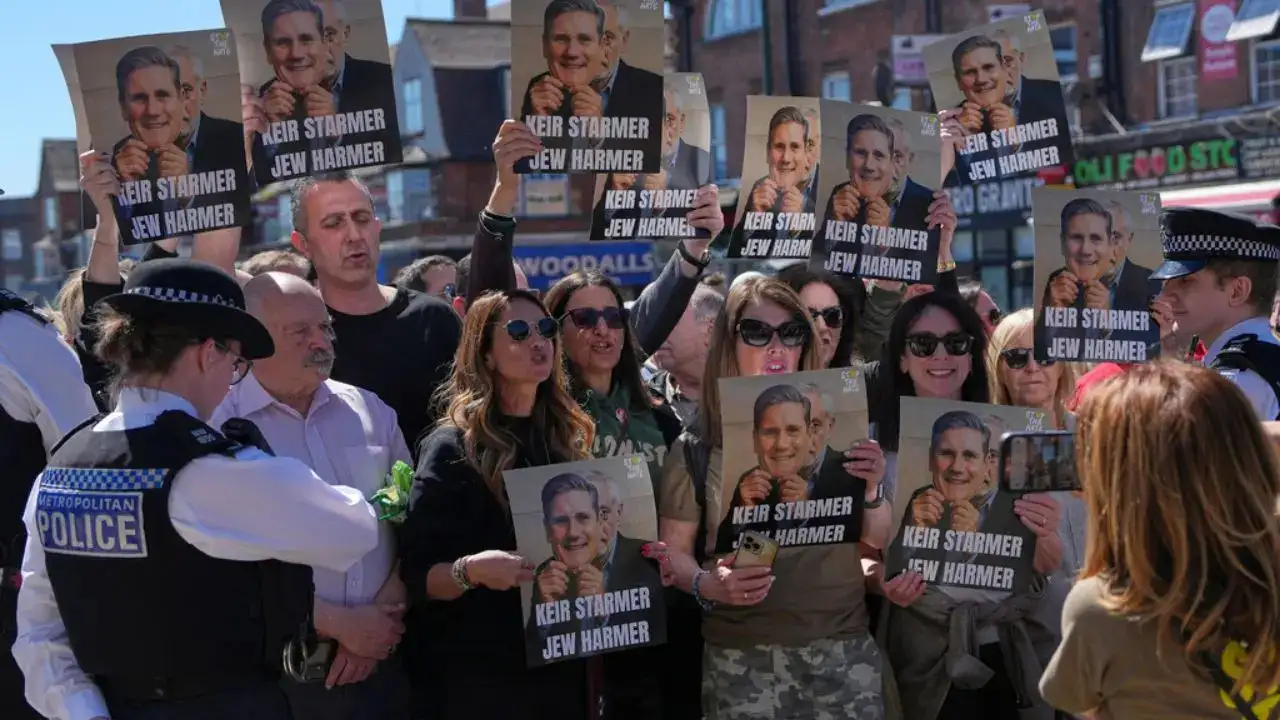
Jonathan Hall, the government’s counterterror chief, called for a temporary halt to pro-Palestinian protests, arguing they had effectively become environments where antisemitism was taking root and growing. A government minister, Alex Davies-Jones, echoed that view, saying the marches had been taken over by individuals seeking to spread division and hatred, even if many attendees had no such intentions.
Prime Minister Keir Starmer went further, specifically calling out the chant “globalise the intifada,” urging police to arrest those who use it. To many Jewish people and others, the phrase is heard as a call to spread the kind of violence that characterised the Second Intifada, a period between 2000 and 2005 marked by terrorist attacks on Israeli civilians.
Protesters argue it is simply an expression of international solidarity with Palestinians resisting ‘occupation’. Metropolitan Police Commissioner Mark Rowley told the BBC that people using the chant were likely to face arrest.
Starmer was unambiguous about where he stood. Chanting the phrase, he said, amounted to calling for terrorism against Jewish people, and those who did so should face prosecution. He described it as extreme racism that had left a minority community in Britain feeling frightened and unwelcome.
What Do the Protest Organisers Say?
According to a report from The Journal, the Stop the War Coalition, one of the main groups behind many of the demonstrations, rejected the accusations entirely.
The organisation said the claims that its marches fostered antisemitism were false, pointing out that the protests were directed at the Israeli government’s conduct and British complicity in the Gaza war, not at Jewish people as a whole. It also noted that Jewish individuals regularly attended the marches themselves.
Where Does Free Speech Come In?
Britain’s laws on this are fundamentally different from those in, say, the United States. There is no equivalent of the First Amendment, and hate speech or incitement to violence carries legal consequences. That legal framework is now being tested as the government tries to define where legitimate protest ends and criminal conduct begins.
The far-left Green Party has pushed back strongly against the government’s direction. Party leader Zack Polanski warned that using the pain of the Jewish community as justification for restricting protest rights would be a serious mistake. He argued that curtailing civil liberties was not the answer to antisemitism.
Is the Green Party a Safe Haven For Anti-Semites?
His party, however, is not without its own complications on this issue. This week, police arrested two Green Party candidates ahead of upcoming local elections over alleged breaches of hate speech laws related to posts made online.
One candidate, Saiqa Ali, had shared an image appearing to show a Hamas fighter alongside the words “Resistance is Freedom,” had suggested the September 11 attacks were orchestrated by Israel, and had claimed Jewish people control Donald Trump.
Another, Sabine Mairey, had reposted content that appeared to endorse violence against a synagogue. She had reposted an Instagram post which read “Ramming a synagogue isn’t antisemitism. It’s revenge.”
What Powers Does the Government Already Have?
Legislation passed recently gave authorities additional tools to manage protests, including the ability to restrict demonstrations near places of worship and to prevent protesters from climbing war memorials.
Outright bans remain off the table, but police now have broader scope to request that a march be confined to a fixed location rather than moving through city streets. That power was used recently to limit a Quds Day march, an annual demonstration held on the last Friday of Ramadan in support of Palestine.
The Bigger Picture
Antisemitism in Britain has risen sharply since the Hamas attacks on Israel on October 7, 2023, and the war in Gaza that followed. The government now finds itself trying to balance the protection of a community that says it no longer feels safe, the preservation of the right to peaceful protest, and the legal boundaries around free expression. None of those things sit easily together, and the debate over where the lines fall is far from settled.