World
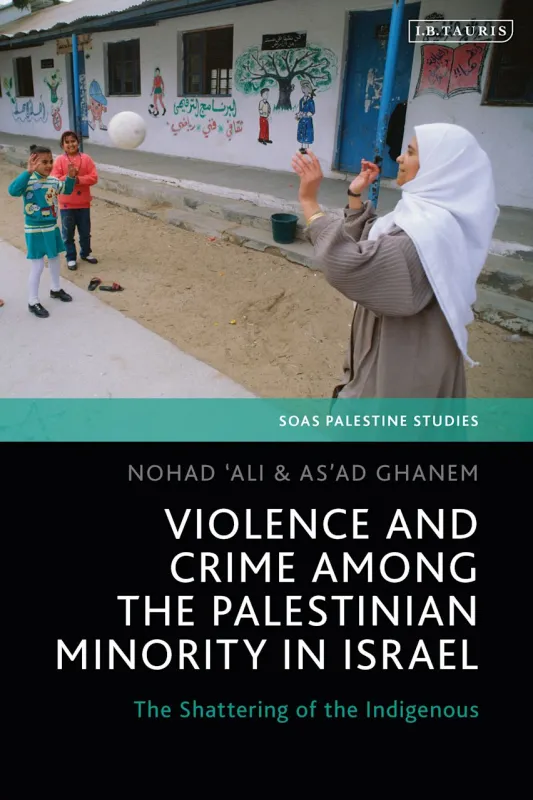
Violence and Crime Among the Palestinian Community in Israel: The Shattering of the Indigenous

Through concise but extremely detailed chapters in their book Violence and Crime Among the Palestinian Community in Israel: The Shattering of the Indigenous, Nohad ’Ali and Asad Ghanem break down the politics, science and sociology of a rising violence and crime rate among Palestinians in Israel. Setting the scene immediately for the repercussions of colonialism on the indigenous population, ’Ali and Ghanem take note of “a decline in the frames of reference” that are important for organisation and control in society. “This lack of ‘references’ results from the complex predicament of the Palestinian-Arab minority in Israel, which has worsened significantly in the last two decades.”
The authors identify three main reasons for this decline. One is due to Israel’s ethnic state policies and settler colonial structure; the second is the fact that Palestinians in Israel are excluded from the Palestinian national movement, while the third is attributed to the process of the community’s social change. Notably, ’Ali and Ghanem reiterate throughout the book that Palestinians in Israel lack “important components that would make it a normal society.”
Noting that various disciplines build their own arguments for the phenomenon of violence within a society based on their area of expertise, ’Ali and Ghanem advocate for a comprehensive approach that looks at the particular problem of minorities within a society. The book finds similarities with other minorities in Western countries with regard to the overrepresentation of the minority community when it comes to violence and crime. In the case of Palestinians in Israel, the authors state that prior to 1999, Palestinian representation was relatively low. The statistics rose in the last two decades: for example, gun-related violence among Palestinians in Israel rose from 1,645 in 2015 to 2,205 in 2019.
’Ali and Ghanem link the increase in violence – a lot of statistical data is presented in the book – with Israel’s settler-colonial policies and their impact of the Palestinian people. Drawing upon other studies of settler-colonialism, the authors discuss settler-colonialism as elimination of the indigenous, and settler-colonialism and both eliminating and weakening the indigenous. Through such disorder inflicted on the colonised, indigenous population, equality is disrupted. Drawing briefly upon the historical colonial process, ’Ali and Ghanem write, “The Palestinians did not consider the new state to be their own, nor did the new state consider then to be part of its project.”
BOOK REVIEW: Ongoing Return: Mapping Memory and Story Telling in Palestine
Exclusion from Israeli society as a result of Israel’s settler-colonial politics and policies exacerbates the fragmentation among Palestinians in Israel. The authors write, “Israeli state settler-colonial, segregation, and racial supremacy policies constitute the main forces behind the deterioration at the group, social, national, and legal levels of order and control structures and mechanism among the Palestinians in Israel.”
Having discussed the implications of settler-colonialism on the Palestinian society in Israel, the authors note that addressing violence from within the community itself, by Palestinian leaders, can partly remedy the violent expression and build cohesion. The authors reject the argument made by some Palestinian leaders and activists that Israel is responsible for providing solutions. The book does not shift responsibility away from the colonial power, and indeed there is a contradiction in expecting Israel to destroy the supremacy it created through settler-colonialism. However, there are also limitations as to what Palestinians in Israel can achieve within the framework of settler-colonialism itself. Thus, the internal, collective solidarity among Palestinians in Israel can provide the groundwork to build at grassroots level and rebuild organisation. In terms of the Palestinian national struggle, the authors note how national identity among Palestinians in Israel is not reinforced by their leaders.
Several other contradictions exist which influence the rising violence and crime rate among Palestinians in Israel. More policing, for example is contradicted by the fact that the police are also fomenting more violence by not bringing law and order to the community, which further weakens their position. While organised crime constitutes the greatest part of statistical data, Palestinian society itself which remained inside Israel after the 1948 Nakba also grapples with its own cultural and religious differences. With regard to the latter, the authors identify lack of controlling structures in the community relating to traditional social and religious roles, the diminishing collective national identity, and “the supremacy apparatus of the Jewish state and the weak civil status of Palestinian-Arabs in Israel, as well as the lack of references based on civilians’ sense of belonging as equals.”
The book devotes ample space to discussing the many different forms in which violence and crime manifests itself among Palestinians in Israel, and provides possible alternatives to remedy the social situation. However, the authors do so while consistently noting that “a main manifestation of the settler-colonial state policies is to dismantle the native society and crate a situation in which the internal social capacity to deal with internal and external challenges to society is lacking.” The suggested strategies, therefore, need to be kept in mind as much as how settler-colonialism is the cause of undoing cohesion within Palestinians in Israel.
Strategically, the authors note, the Palestinian community would need to establish new norms to reorganise and build foundations to deal with the prevailing and increasing violence. Various changes are required and each comes with its own set of difficulties and discrimination across both the settler-colonial reality and the Palestinians themselves. However, from beginning the end, the authors’ strongest point is the constant contextualising within Israeli settler-colonialism, thus making this study particularly relevant to the Palestinians’ own lived reality.
BLOG: The US creates convenient loopholes for Israel