World
US weighs boosting ties with PA as it seeks to advance Gaza plan and Abraham Accords

The United States is in talks with the Palestinian Authority about boosting what has been a strained bilateral relationship, as Washington seeks Ramallah’s cooperation to advance its policies in the region, three government officials familiar with the matter told The Times of Israel.
US President Donald Trump’s administration is working to transfer billions of dollars in PA revenues currently withheld by Israel to the underfunded Board of Peace, which Washington established to actualize its 20-point plan for ending the war in Gaza and rebuilding the enclave. That plan envisions the PA taking over governance in the Gaza Strip after it has carried out comprehensive reforms.
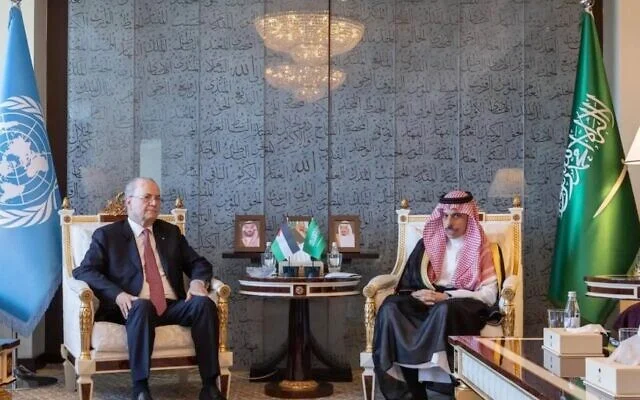
A PA official told The Times of Israel that Saudi Arabia is helping Ramallah with the reform process, which Riyadh views as essential for establishing a pathway to the establishment of a Palestinian state.
The Trump administration has embraced the Saudi effort, viewing it as complementary to its bid to expand the Abraham Accord, as Riyadh has expressed willingness to normalize relations with Israel if an “irreversible pathway” to a Palestinian state has been created, a US official said.
Against this backdrop, the US has been engaging in talks with the PA for several months, which Ramallah hopes will lead to the “normalization” of its strained relationship with the Trump administration, a Middle East intelligence official said, claiming that Washington has largely ignored the PA as it tends to view the Palestinian issue with a focus on Gaza, with the West Bank more of an afterthought.
Under discussion has been a memorandum of understanding in which the sides recommit to Trump’s 20-point plan, particularly the last two points embracing Palestinian self-determination and the launching of US-led peace talks between Israel and the Palestinians, once the redevelopment of Gaza and the reform of the PA have moved ahead.
The MOU would also see the PA commit to specific benchmarks for Saudi-chaperoned reforms of its welfare and education systems, as well as a plan to combat incitement, the three officials said.
It would include the US expressing readiness to lift sanctions against the PA once the reforms have been verifiably completed, with Ramallah hoping the MOU would include a reference to the potential reopening of the Palestine Liberation Organization’s diplomatic mission in Washington, according to the Palestinian official.
Trump shuttered the de facto Palestinian embassy in DC during his first term over Ramallah’s refusal to cooperate with the US peace initiative, which the PA viewed as overwhelmingly tilted in favor of Israel.
The US is considering reviving that 2020 peace plan after Israeli elections in the fall and is hoping that the PA’s weakened position will force it to reconsider the proposal, the Mideast intelligence official said.
In the meantime, the US is seeking a Palestinian commitment to halt efforts to internationalize the conflict against Israel and to withdraw cases against Jerusalem in international legal forums, the American official said, adding that the PA in turn asked for a line in the MOU on halting Israeli settlement expansion and cracking down on rampant settler violence.
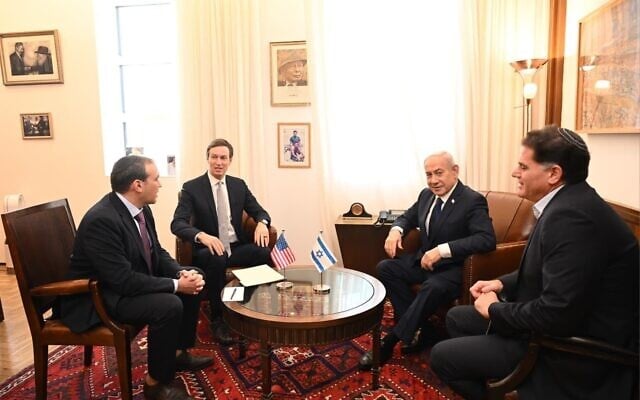
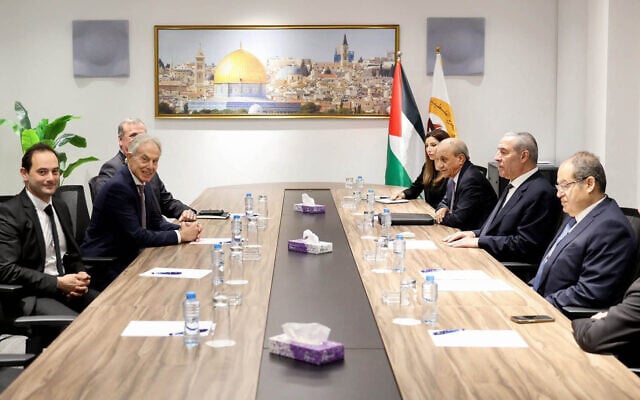
Leading the talks for the PA has been Vice President Hussein al-Sheikh, while senior State Department officials Aryeh Lightstone and Scott Leith have represented the Trump administration, with periodic involvement from the US president’s top envoy and son-in-law, Jared Kushner, the officials said. Others involved more tangentially have been former UK prime minister Tony Blair, who has been leading the Board of Peace’s engagement with the Palestinians, along with senior Saudi official Manal Radwan who has helped craft Riyadh’s policy on the Palestinian issue.
Prisoner payments hurdle
But the negotiations have slowed in recent days, with US officials expressing hesitance about signing onto something as formal as a MOU, instead entertaining an exchange of letters between Sheikh and US Secretary of State Marco Rubio in which some of the aforementioned points would be addressed — albeit not jointly, the Middle East intelligence official said.
The PA official speculated that the hesitance in Washington has to do with pushback from Jerusalem to the US elevating its relationship with Ramallah.
Israel insists the PA has not genuinely been carrying out reforms, particularly of its welfare program, which has included payments to security prisoners based on the length of their incarcerations.
Ramallah announced the scrapping of that controversial scheme in February 2025, installing a new system that conditioned all payments strictly on the financial status of the recipient, in line with other welfare programs abroad.
But a State Department report to Congress from April determined that the PA continues to “provide a system of compensation in support of terrorism through new mechanisms and under a different name.”
The report relied exclusively on open-source information from the Israeli government and several other groups that have long been critical of the PA, while preliminary results from an external audit of the PA bodies involved in the new welfare program determined that the reform is being properly implemented to ensure recipients are no longer being awarded based on whether a relative carried out an attack against Israel, two Western diplomats briefed on the audit told The Times of Israel last week.
This determination may no longer be sufficient, though, with Israeli officials now arguing that no family of a prisoner or slain attacker should be allowed to receive stipends from the PA, even if they meet the criteria for being poor enough to receive welfare.
The PA official expressed concern that Jerusalem is convincing the Trump administration to adopt its position after both the US and Israel agreed during the Biden administration that welfare payments to anyone deemed poor enough would be accepted.
The Middle East intelligence official asserted that further complicating US-PA talks have been certain elements in the Trump administration, particularly in the State Department, who are inclined to collapse the PA, rather than see it reformed.
The US official insisted that Washington recognizes the PA’s utility, pointing to Ramallah’s support for a November UN Security Council resolution endorsing Trump’s 20-point plan that was critical for getting it over the finish line.
Still, the US official did not deny the lack of enthusiasm in the administration for elevating ties with the Palestinians, as focus and political capital are being spent elsewhere in the region.
But with Trump appearing to turn on Prime Minister Benjamin Netanyahu in recent weeks over the war with Iran and Israel’s conflict with Lebanon’s Hezbollah, the PA official speculated whether such a chilling of US-Israeli ties could work in Ramallah’s favor.
The official recalled how Trump — after leaving office in 2021 — lashed out at Netanyahu and asserted that PA President Mahmoud Abbas was more interested in peace than the Israeli premier.
Smotrich blocks release of PA funds to Board of Peace
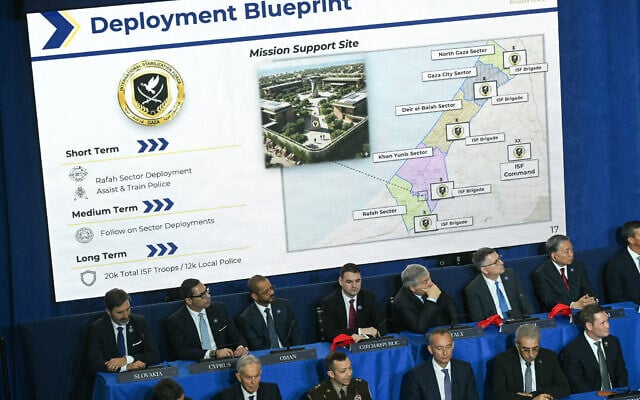
The three officials said that the US also hoped to use the talks with the PA to secure its approval for transferring a significant portion of the over $5 billion in Palestinian clearance revenues being withheld by Israel to the National Committee for the Administration of Gaza (NCAG), the panel of Palestinian technocrats overseen by the Board of Peace that is tasked with replacing Hamas rule in Gaza until the PA has finished its reform process.
The sides have gone back and forth regarding the amount of money that would be transferred to the NCAG and the amount that would be sent back to Ramallah.
After initially chafing at the idea of its own desperately-needed funds being sent to a potentially rival governing entity, the PA agreed to get on board, viewing the acquisition of any amount of its funds as better than nothing, given the dire nature of its current financial situation.
Ramallah did, however, request that the US recommit to using a formal communication channel that was established in February to keep the PA involved in Gaza decision-making.
The clearance revenues make up the majority of the PA’s budget and Israel has refused to transfer any of those funds for over a year, in violation of the Oslo Accords. It used to deduct funds deemed equivalent to the amount the PA was paying to security prisoners, before Finance Minister Bezalel Smotrich made a habit of not sending any portion of the Palestinian funds.
Smotrich, whose office declined to comment, has advocated for collapsing the PA and has also spoken out against Trump’s 20-point plan for Gaza.
Accordingly, he has refused to cooperate with the proposals discussed by the US and PA to release the clearance revenues — even to pay off PA debts to Israel — and the three officials familiar with the matter said they do not expect any progress until after the fall Israeli elections, when a new government and finance minister may be installed.

Still desperate to secure some amount of funding for the Board of Peace as only a tiny fraction of pledges have been actualized, the US has explored unilaterally seizing some of the PA funds held by Israel, the Mideast intelligence official revealed, while clarifying that the legal justification for such a move would be thin.
A Board of Peace official declined to comment on the matter, but said the Gaza oversight body would follow US law.
Another idea explored by the US has been to convince the World Bank to send aid earmarked for Gaza services to the Board of Peace rather than the PA, the Mideast intelligence official said.
Asked for comment on the matter on the US efforts to boost ties with Ramallah, a State Department spokesperson said, “PA reform is a critical prerequisite to assuaging Israeli security concerns.”
“The president’s 20-Point Plan and UN Security Council Resolution 2803 make clear: the PA must verifiably complete comprehensive reforms, including ending all payments to terrorists and their families,” the statement continued. “The PA’s prospects of having more financial stability must begin with verifiably completing its long-promised reforms.”