World
US strikes Iran again, after IRGC attacks ship in Hormuz and declares strait closed until further notice

The US military said it launched another round of strikes on Iran early Sunday, the third in recent days, after the Islamic Revolutionary Guard Corps struck a container ship traveling through the Strait of Hormuz and declared the waterway closed until further notice.
Tehran later appeared to target Gulf states and an air base in Jordan, having threatened to expand its response to new US-related targets if it faced new attacks. It was unclear whether it would make good on its Friday threat to possibly target Israel as well if American strikes persisted.
The fresh hostilities followed a series of similar attacks over the past several days, which led US President Donald Trump to declare the end of a ceasefire meant to halt the fighting that the US and Israel began on February 28, though Trump has left the door open to continued negotiations.
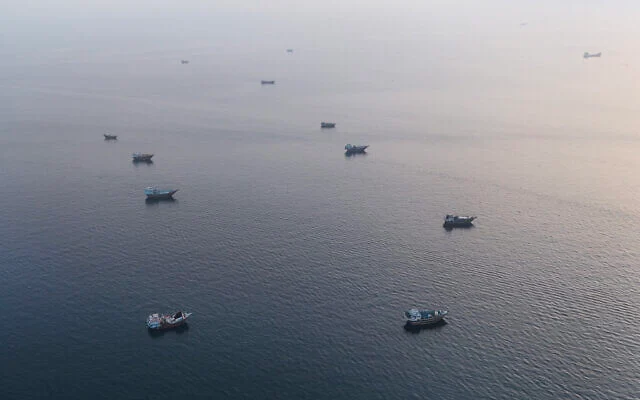
The Revolutionary Guards Corps said multiple vessels “disregarded our warnings and instructions to correct their course and proceed along the approved route.” One of them “was struck by a warning shot and brought to a stop.”
Iran said that the strait would remain closed “until further notice.”
It warned that any retaliation over the incident would be met with a “severe response,” and said it would consider targeting “additional enemy bases in the region” if it faced more attacks.
US Central Command identified the targeted vessel as the M/V GFS Galaxy, a Cyprus-flagged container ship, saying it suffered significant engine-room damage and that a civilian crew member was missing.
The United Kingdom Maritime Trade Operations Centre said the crew of the container ship, damaged east of Oman, had abandoned the vessel and were in a lifeboat.
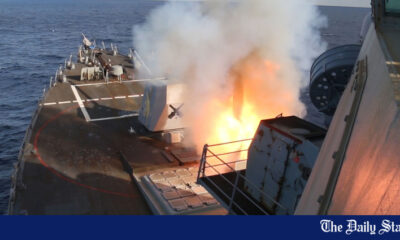
Central Command said its forces began a third round of strikes against Iran, a little more than an hour after the Revolutionary Guard statement. Iranian media reported explosions in several coastal areas along the Strait of Hormuz, the Persian Gulf and the Gulf of Oman, including Bushehr, Asaluyeh and Chabahar. Three blasts were reportedly heard in Bandar Abbas and two in Sirik, with explosions also heard in Qeshm Island.
“The United States is imposing a heavy cost by continuing to degrade Iran’s ability to attack civilian mariners and commercial ships freely transiting the strait,” the American military said.
“Iran made a poor choice. Now they pay,” Defense Secretary Pete Hegseth posted on social media.
Senior US officials had previously said in Washington that negotiations to further cement last month’s deal to end the war will be unable to progress without the strait being secure — and even said they wanted Iran to offer public statements to that effect.
Later, the Revolutionary Guards said they had destroyed a command and control center and drone hangars at a base in US ally Jordan. The United Arab Emirates said its air defense systems engaged missiles and drones from Iran, Qatar said it had intercepted a missile attack, warning sirens sounded in Bahrain, and explosions were heard in Doha.
Attacks followed more diplomatic talks about the strait
The latest flurry of shots from both sides followed Iran and Oman’s foreign ministers meeting on Saturday to discuss the strait that lies between them, after days of Iranian attacks on ships and US retaliation that dealt a blow to the interim deal to end the war.
Oman said it and Iran agreed to keep talking about the Strait of Hormuz “at the technical and political levels.”
A senior Iranian source told Reuters that Iran, the US, Qatar and Pakistan had agreed to negotiate in a call that mediators were trying to arrange for Saturday while Iranian Foreign Minister Abbas Araghchi was in Oman, a Gulf state trying to mediate an end to the war.
It was not immediately clear whether those efforts succeeded.
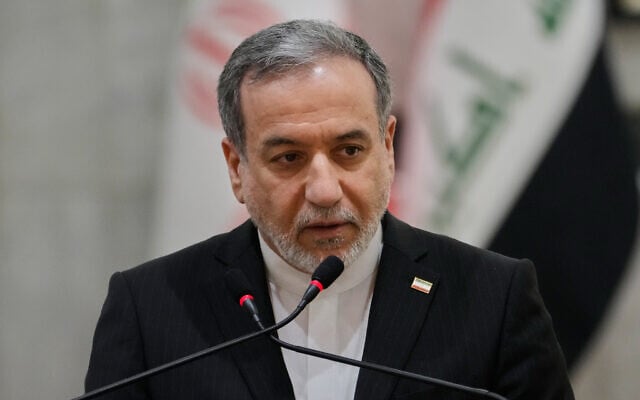
Araghchi and Omani Foreign Minister Badr Albusaidi met in Oman to exchange “views on appropriate mechanisms for the safe passage of ships through the Strait of Hormuz,” according to a statement from the Iranian foreign minister. Oman’s state news agency said Omani and Iranian negotiators would continue talks “at the technical and political levels.”
CNN reported on Saturday that Oman made a draft proposal for the strait, including free navigation through its southern corridor in Omani territorial waters. The plan called for vessels transiting the northern corridor through Iranian territorial waters to obtain prior approval from Iran, although no tolls would be imposed, CNN said.
The White House and State Department did not immediately respond to requests for comment on the CNN report.
Araghchi said before the new round of strikes that he met with his counterpart in Oman to discuss “appropriate mechanisms for ensuring the safe passage of ships.”
The world for decades has considered the strait an international waterway. Iran has insisted that the strait now remain under its control and that it be allowed to charge ships moving through it, a stance it took after the war began. The US urges mariners to transit on a southern route through Oman’s territorial waters.
About a fifth of all traded oil and natural gas passed through the strait before the war began. Iran’s grip on it during the war led to a global energy crisis, though oil prices have sharply dropped since wartime highs of $120 a barrel.
Iran’s top diplomat also accused the US of violating the interim deal by ending waivers allowing Iran to sell crude oil on the open market in US dollars. Washington ended them in response to the attacks on ships in the strait.
“Reality check: There can only be mutual compliance,” Araghchi wrote on social media.
US envoy confirms Israel conveyed intel on Iranian plan to kill Trump
Meanwhile Saturday, US Ambassador to Israel Mike Huckabee confirmed reports that Israel recently shared with the United States intelligence about an Iranian plot to assassinate Trump.
“This week, Israeli intelligence tipped off our side, the president and our officials, that there was a very specific plot that was designed to take out President Trump,” Huckabee said in an interview with Fox News.

Trump himself denied the reports, telling The New York Post in a phone interview Friday: “No, no. Israel came up with nothing. No, no. I’ve been number one [on Iran’s kill list] for a long time, and it’s the way life is.”
But Trump has said he’s personally been the target of an Iranian plot, and he said the US military would automatically retaliate if he was killed.
He wrote on social media early Saturday that “1000 Missiles are Locked and Loaded and aimed at the Islamic Republic of Iran, with thousands of more to immediately follow, should the Iranian Government act on its threat.”
However, such retaliation would have to be ordered by US Vice President JD Vance, who would become commander-in-chief if Trump were to be killed.
Trump said he was responding to threats “to assassinate, or attempt to assassinate” him.
The US president has declared the ceasefire over but said the US would continue negotiations.
US officials, speaking Friday on condition of anonymity about the current situation with Iran, said the resumption of strikes even before the latest round came as a result of what they described as a rogue faction of Iranian hardliners who were trying to sabotage the ceasefire.
Iran has insisted its theocracy is unified under the new supreme leader.
After the US wrapped up strikes on Thursday, more attacks reportedly hit Iran, raising questions about who else may be targeting the Islamic Republic.
Israel didn’t claim them, meaning the Gulf Arab states may have launched them, likely as a means to deter Iran from attacking them again. Iran on Thursday retaliated for US strikes by targeting Bahrain, Jordan, Kuwait and Qatar.
The strikes in Iran over two days — and prior to the Sunday ones — killed at least 17 people and wounded 115 others, Iranian Health Ministry spokesperson Hossein Kermanpour said.