World
US lawmaker detained by settlers says lack of punishment shows Israeli complicity

In his last interview with The Times of Israel four years ago, US Rep. Ro Khanna characterized himself as a “pro-Israel progressive,” expressing admiration for the Jewish state’s entrepreneurial prowess.
But the legislator refrained from taking on the label during a phone call on Monday, several days after returning from a trip to the West Bank where he said he was detained by IDF-backed settlers for over an hour.
Asked what led him to change the way he looks at Israel, Khanna faulted what he said has been the “genocide” in Gaza as well as unchecked settler violence in the West Bank.
“After seeing it firsthand, I now view Israel as an occupying power that is engaged in apartheid in the West Bank,” said the California congressman, who is weighing a long-shot run for president in 2028.
Israel rejects both the genocide and apartheid charges, insisting that it has taken steps to avoid civilian casualties and allow aid into Gaza and that it granted limited autonomy to the Palestinian Authority in the 1990s to govern areas of the West Bank where the majority of Palestinians in the territory live.
Khanna clarified that he still supports a two-state solution in which Israel can thrive as a secure, Jewish and democratic state, but he said that the first step toward that goal is reining in settlers like the ones who stopped his convoy from visiting the site of a Palestinian village depopulated by relentless attacks.
Israeli settlers, brandishing American made M4s, detained me & other Americans on my trip to Palestine.
When the IDF arrived, they sided with the settlers & continued our detention.
They made a huge mistake.
You will be hearing more soon. https://t.co/rZw8bRAn64 pic.twitter.com/4z50Ye4I7K
— Ro Khanna (@RoKhanna) July 11, 2026
No disciplinary actions against those involved in last week’s incident have been taken, though, and Khanna maintained that this demonstrates the Israeli government’s complicity in settler violence.
“Israel is capable of taking out [Hamas leader Yahya] Sinwar and Hezbollah leaders. The prime minister is out there saying they’re trying to get to ‘150 juvenile delinquents.’ Give me a break. The pictures of these violent settlers who were brandishing guns and harassing us are all over social media. They could get these folks arrested in 10 minutes,” Khanna said. “The fact that they’re not acting is a deliberate choice, and it’s offensive to the Americans who were detained.”
For their part, Israeli Ambassador to the US Yechiel Leiter and US Ambassador to Israel Mike Huckabee have suggested Khanna was engaging in a publicity stunt.
While some critics of Khanna claimed that his entourage had been trying to enter a closed military zone, the IDF’s own statement on the July 8 incident denied that was the case.
It said troops had been deployed to the area after receiving a report that foreign nationals had entered what the complaining settlers “believed” was a closed military zone.
The troops then extracted the settlers from the area and maintained the roadblock for several more minutes until they confirmed that the area was indeed not a closed military zone, at which point they allowed the foreigners to continue on their way, the IDF statement said.
The IDF is lying about the detention of Rep. Khanna.
I was on the ground with him that day, and my body camera captured us being detained by both settlers and Israeli soldiers. The IDF did not disperse the violent settlers, as they claim. They explicitly sided with them. pic.twitter.com/Ob4IA35dqh
— נדב וימן Nadav Weiman (@weimanadav) July 13, 2026
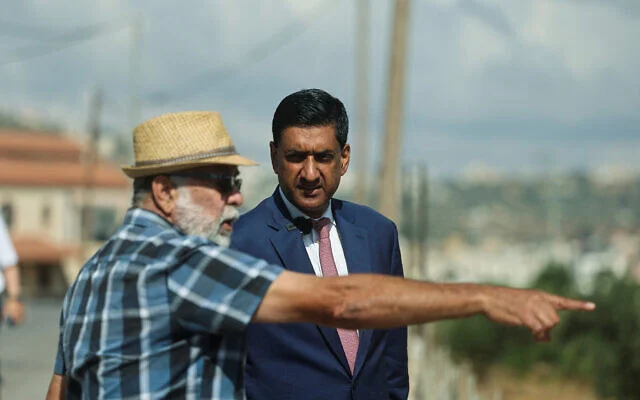
Khanna disputed elements of the army’s claim, insisting that the soldiers “took the side” of the settlers instead of arresting them after the Israelis — one of them armed with US-made M4 automatic rifle — had kicked his van’s tires and laughed at his delegation while preventing it from reaching the ruins of Khirbet Zanuta, a Bedouin hamlet in the southern West Bank whose residents fled in 2024 after coming under repeated attack by Israelis from nearby illegal outposts.
“This is a very serious matter that will deeply undermine Israel’s perception in the United States,” Khanna maintained. “If they do not take any action against these violent vigilantes and against these IDF soldiers, they would send a message that Israel is indifferent to American passport holders and American lives.”
Huckabee’s deputy to the rescue
Among his criticisms of Khanna, Leiter argued that the Democratic congressman refused to coordinate his trip with the Israeli Embassy in Washington and snubbed offers for him to meet with the families of former Hamas hostages and with Israelis living under the threat of Hezbollah rockets near the Lebanon border.
Khanna maintained that he did in fact inform the Israeli embassy of his visit, but that after traveling several times to Israel in recent years — meeting with senior officials in Jerusalem as well as hostage families — he wanted to take a Palestinian-led trip in the West Bank.
He stressed that the trip had been coordinated with the US Embassy in Jerusalem, and though Huckabee was quick to dismiss the incident in Khirbet Zanuta, his deputy David Brownstein was instrumental in deescalating the situation there, Khanna said.
“I don’t know if we would have gotten out unharmed if it weren’t for his intervention,” Khanna said, explaining that the deputy US ambassador had reached someone senior in the Israeli government who dispatched security forces to the scene to disperse the settlers who had held up his convoy.
Peace through sport.
Today in Herzliya, Chargé d’Affaires, a.i., David Brownstein hit the pitch with diplomatic counterparts for a “Mini Mondial” soccer match with Arab and Jewish youth, along with colleagues from the embassies of fellow World Cup co-hosts Canada and Mexico.… pic.twitter.com/nWu6SP8EdX
— U.S. Embassy Jerusalem (@usembassyjlm) June 24, 2026
Brownstein’s intervention also led the IDF to open a gate that it had closed, preventing Khanna’s group from leaving the Bedouin village of Umm al-Khair earlier in the day, the lawmaker recalled.
As for his decision to wait until Saturday to speak out about the incident that took place on Wednesday, Khanna explained that he didn’t want to go public while he was still in the West Bank, fearing that doing so would jeopardize the rest of his visit.
Khanna’s West Bank itinerary
Khanna’s itinerary during his three days in the West Bank took him to sites most impacted by settler violence and the apparent lack of enforcement against it.
In Umm al-Khair, he met with the brother of Palestinian activist Awdah Hathaleen, who was shot dead last year while trying to prevent Israeli settler Yinon Levi from trespassing on the village’s lands. Levi was briefly placed under house arrest but was subsequently freed and is only facing charges of manslaughter, rather than murder.
Former US president Joe Biden’s administration sanctioned Levi in 2024, saying his Meitarim farming outpost was behind the attacks that led Khirbet Zanuta residents to flee. US President Donald Trump lifted those sanctions upon his return to office the next year, but Levi remains under sanctions of the European Union and the United Kingdom.
Khanna also visited the town of al-Mughayyir where a 14-year-old boy and a 32-year-old man were shot dead outside a school by a settler in reserve duty. The soldier was suspended from service, but no other actions were taken against him by Israeli authorities.
In the Christian-majority town of Beit Sahour, Khanna met with Palestinians who said their water access has been limited, while Israelis in a neighboring outpost quickly legalized by the government face no such restrictions.
He met with the father of a 14-year-old Palestinian-American Amer Mohamad Saada Rabee, who was shot dead by the IDF last year. Khanna said the man acknowledged that his son had been throwing stones at cars on the street but asserted that didn’t justify soldiers firing 21 bullets into his body.
And in Hebron, Khanna walked through a small section of the city where settlers live and where Palestinian movement is consequently heavily restricted by the IDF, which says the steps are taken due to security concerns.
Khanna wasn’t the only potential Democratic presidential candidate in the region last week. Former Chicago mayor Rahm Emmanuel was also in town to give a speech at Tel Aviv University, warning that the US-Israel relationship would not be able to survive if the Israeli government continues with its hardline policies toward the Palestinians and the rest of the region.
Khanna said he’d position himself to the left of Emmanuel, but “right where the mainstream of the Democratic Party is.”
“I would describe myself as an underdog potential candidate, and I would say that I’m where more and more Americans — particularly those under 50 — are. And that is for justice and peace in the region,” Khanna said.