The proliferation of artificial intelligence models and the increasing parity in their performance suggest they are becoming a commodity. Soon, AI services will be priced by cost rather than the uniqueness of their model. With electricity the main cost of the services, the AI war between China and the United States is turning into a straightforward contest over electricity output and price.
Open-source AI models are sprouting up like bamboo shoots in China. The American AI community has argued that they are not as good as the closed-source models in the US. Yet recent releases by DeepSeek and Zhipu AI have eliminated the perceived gap. The American goal of making the world dependent on its AI and paying dearly for it now seems like a pipe dream.
This rapid proliferation reveals the true nature of AI, whether a large language model or specifically a generative pre-trained transformer. It turns out it is not that hard to create an AI model. Hence, the value of owning a model, whether frontier or not, isn’t so high any more. As more models join the market, they will become a commodity, like steel or aluminium. And the price of services, or tokens, will be driven by the dominant cost component: electricity.
As the AI contest turns into an electricity competition, it is becoming a race between China’s renewable energy path and America’s emphasis on hydrocarbons. The outcome will depend on which model can deliver cheaper and more reliable electricity.
China’s energy strategy is defined by self-reliance and carbon neutrality. Renewable energy, such as solar, wind and hydropower, has naturally become the preferred choice. The rapid drop in the price of solar and wind power has made them competitive against hydrocarbons.
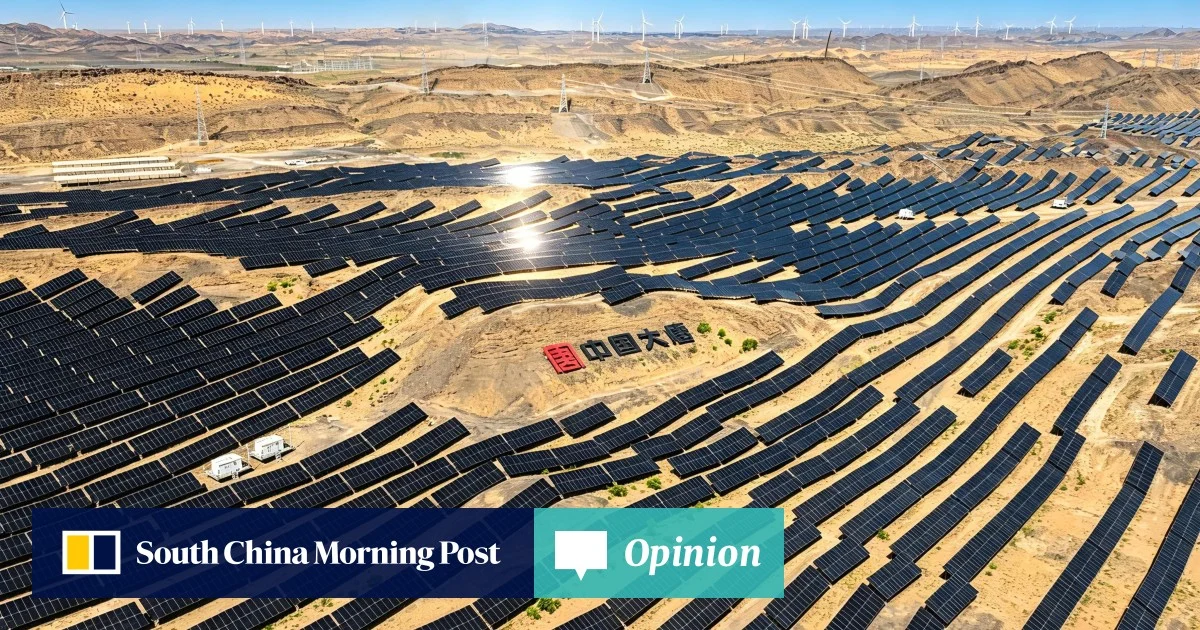
Last year, the levelised cost of solar power dropped to about two US cents per kWh. Given that transmission and delivery prices from the deserts in the west to the industrial belt in the east can easily double the electricity cost, the rational choice is to locate the data centres in the west, next to the solar farms.
Solar panels are seen at the Hongliuwa Photovoltaic Industrial Park in Jinta county in the Gobi desert, in China’s northwestern Gansu province, on February 1. Photo: AFP