World
COGAT says Gaza aid ‘significantly exceeded’ requirements during ceasefire

Israel’s Coordinator of Government Activities in the Territories, or COGAT, published a report Thursday detailing its efforts to transfer aid to Palestinians in the Gaza Strip, saying it “significantly exceeded” its humanitarian requirements since the ceasefire went into effect last October.
The 22-page report, which was cleared for publication Thursday, “presents a clear picture,” COGAT said, that humanitarian aid has entered the Gaza Strip in “quantities that significantly exceeded the needs identified by the United Nations and other members of the international community.”
COGAT is a Defense Ministry unit that oversees and coordinates humanitarian and civilian matters in the Gaza Strip, the West Bank, and more recently the areas of southern Syria under Israeli military control.
It said the report was based on data from the UN and other humanitarian groups, as well as “open-source reporting, and research conducted by humanitarian experts.”
During the course of the war, which was sparked by the Hamas-led invasion of southern Israel on October 7, 2023, Israel repeatedly restricted, and even completely halted, the flow of aid to Gaza’s devastated population, causing what several humanitarian organizations described as famine conditions in the Strip.
Following the October 2025 ceasefire, Israel resumed more substantial aid transfer, allowing hundreds of aid trucks to enter the territory each day, as required under the terms of the deal.
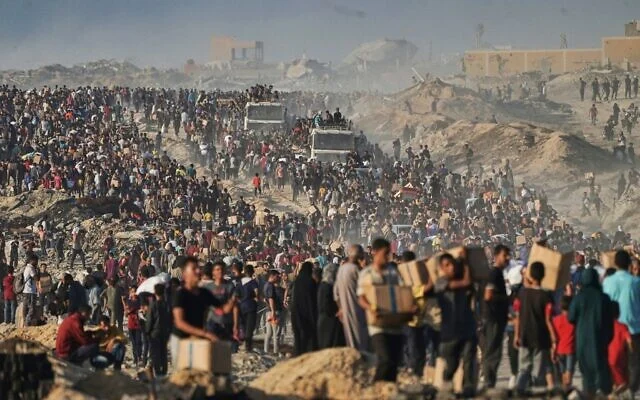
According to the report, some 1.78 million tons of food entered the Strip between October 2025 and June 2026, which it said is “three times greater than the requirements defined by the World Food Programme (WFP).”
It also pointed to “significant improvement in food availability across Gaza’s markets,” publishing a graph it says reflects price decreases for staple goods, such as flour, rice, lentils, vegetables, and eggs.
According to the report, prices for these staple goods declined by approximately 72 percent between September 2025 and May 2026.
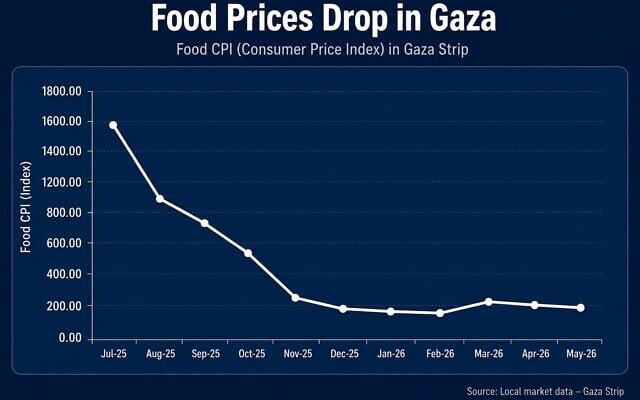
Such sharp decline in prices “reflects the direct impact of the large volume of food entering the Gaza Strip on market availability,” the report said, adding that price levels are now “influenced primarily by internal market conditions within Gaza, particularly taxes imposed by Hamas and its control over commercial distribution mechanisms.”
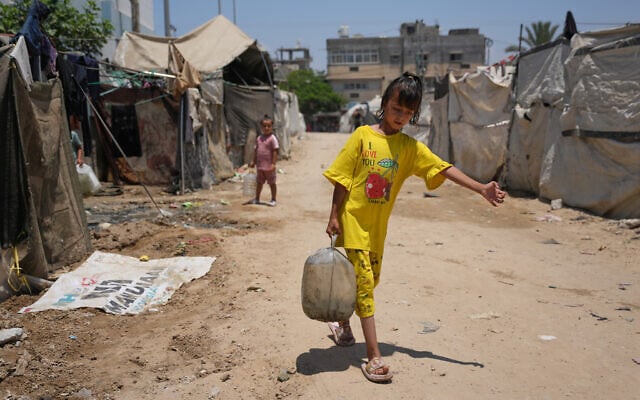
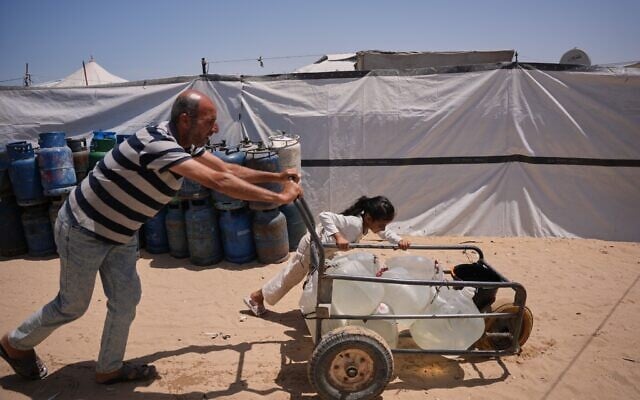
Regarding efforts to increase availability of water, sanitation and hygiene for Gaza’s 2 million residents, nearly all of whom have been displaced during the war, COGAT said current water availability “exceeds international humanitarian standards.”
“More than 70,000 cubic meters of water are supplied to the Gaza Strip every day through water pipelines, desalination facilities, and additional infrastructure,” the report said, adding that it is working with international organizations to “advance practical solutions for improving water supply, sanitation, and hygiene.”
Turning to Gaza’s decimated healthcare sector, COGAT said its report shows that the system in place “remains operational and that its medical capacity has expanded significantly,” adding that “more than 18,000 tons of medicines and medical supplies” have entered the Strip since the truce was reached.
Commenting on the report, COGAT chief Maj. Gen. Yoram Halevy said that his unit decided to publish it “in order to present the international community with the full factual picture” of Gaza’s humanitarian situation, in light of Hamas’s attempts to “distort” it.
“The data is clear and leaves no room for doubt: throughout the ceasefire, humanitarian stability was maintained in the Gaza Strip, and the volume of aid entering the territory significantly exceeded humanitarian requirements,” Halevy said.
“Anyone who ignores these facts is amplifying Hamas propaganda, which exploits the humanitarian space for its military and governing purposes,” he added.
COGAT busts cigarette smuggling attempt
One day before the aid report was published, COGAT said Israeli forces seized a Gaza-bound “private sector humanitarian aid” truck transporting hundreds of Costa Rican pineapples that were hollowed out to store thousands of illegal cigarettes.
The pineapples had been imported by an Israeli company that had a permit to sell certain goods in Gaza under the “private sector humanitarian aid mechanism,” it said.
Land Crossings Authority inspectors seized the truck with the cigarettes at the Lachish Crossing, also known as the Tarkumiya Crossing, between Israel and the West Bank, COGAT said, adding that the truck was headed toward the Kerem Shalom border crossing between Israel and Gaza, in the Strip’s south.
As a result of the smuggling attempt, COGAT chief Halevy suspended the unnamed company’s “authorization to deliver humanitarian aid into the Gaza Strip,” until further notice.
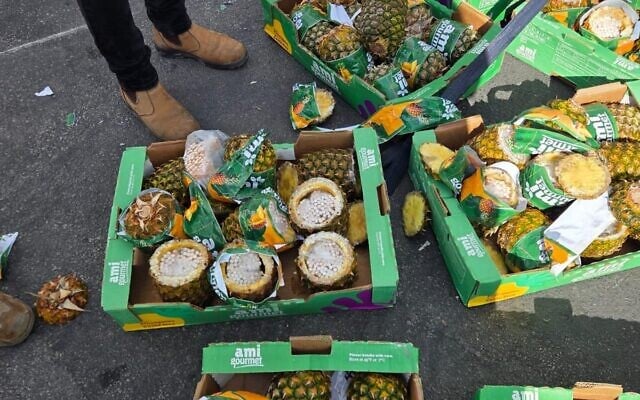
Footage published by COGAT showed multiple crates containing pineapples with their bottoms screwed off to reveal dozens of cigarettes inside each fruit.
The bottom of each pineapple was easily taken off once the brand-name sticker attached to the fruit’s body was removed, according to the footage.
Reports from Gaza indicate that because cigarettes are not included in aid shipments, and Hamas taxes those that do get in, single cigarettes are selling for more than NIS 15 ($5) each, making smuggling highly lucrative.
COGAT stressed that it “will continue to act decisively against any attempt to smuggle goods or exploit the humanitarian aid mechanism.”
State prosecutors had in February filed charges against 15 suspects, among them IDF reservists, accused of taking part in a major smuggling ring that trafficked goods into the Gaza Strip.
Emanuel Fabian and Noam Lehmann contributed to this report.