Politics
‘The Mathematics’ – APC Unveils Mobilization Structure To Help Tinubu Win 2027 Election

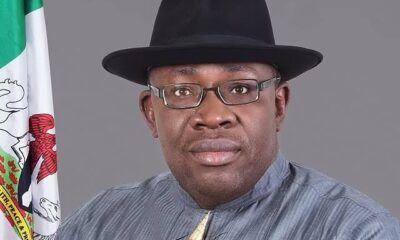
The Director-General of the Renewed Hope Ambassadors and Chairman of the Progressive Governors’ Forum, Hope Uzodimma, has said the ruling All Progressives Congress (APC) has recruited 4,421,150 canvassers across the country’s 176,846 polling units ahead of the 2027 general election.
Uzodimma, who is also the Governor of Imo State, said the mobilisation structure was part of efforts to strengthen grassroots engagement and secure victory for President Bola Tinubu in the next presidential election.
Naija News reports that Uzodinma spoke on Wednesday in Abuja while delivering the keynote address at the two-day Renewed Hope Ambassadors National Retreat held at the Transcorp Hilton Hotel.
The governor expressed confidence that Tinubu’s performance in office, especially in the areas of economic reforms, infrastructure, healthcare, student loans and social investment, would earn him a second term.
Uzodimma said the retreat was designed to build a united and effective grassroots mobilisation machinery that would take the achievements of the Tinubu administration to Nigerians at the ward and polling unit levels.
According to him, the RHA structure now reaches every part of the country, from the national coordinating centre to the six geopolitical zones, 36 states and the Federal Capital Territory, 774 local government areas, 8,809 wards and registration areas, and 176,846 polling units.
“At 25 canvassers to a polling unit, that is a lawful civic force of 4,421,150 people across the federation.
“That is the mathematics of serious mobilisation. That is the difference between hoping to win and organising to win,” he declared.
Uzodimma said the organisation had also created 17 directorates to coordinate its operations across different sectors.
He listed the directorates to include youth, organisation and mobilisation, media and publicity, digital and new media, finance, monitoring, compliance and legal, technology and data, support groups, intelligence, special duties, planning, welfare, administration, women affairs, diaspora, and research and innovation.
He added that the RHA had unveiled a digital platform in April, supported by a Data Communication Centre, to monitor public opinion and respond to misinformation in real time.
Describing the 2027 election as a defining moment for the country, Uzodimma said the poll would determine whether Nigeria would continue on what he called the path of reform, stability and shared prosperity.
He said, “2027 will be a referendum on a single question: does Nigeria stay on this hard but necessary road of reform, stability, and shared prosperity, or turn back?”
The Imo governor told coordinators drawn from the six geopolitical zones that the retreat should not be treated as a ceremonial gathering.
He said the meeting must produce key strategy documents, including a Declaration on National Mobilisation, a National Grassroots Mobilisation Blueprint, a Standard Messaging Manual, State-by-State Action Plans, a Polling Unit Deployment Doctrine, a Monitoring and Evaluation Framework, and an Election Readiness Checklist.
“Do not waste it on speeches. Build something that lasts,” he charged the participants.
He urged the delegates to serve as “the bridge between policy and the people at every ward, market and polling unit.”
Uzodimma said governments often suffer not because they have failed to perform, but because their achievements are not properly communicated to the people.
According to him, silence allows opponents and critics to misrepresent government policies and fill information gaps with rumours.
He said, “Very often, it is silence. When we do good work and nobody hears the story, someone else tells it for us, and they tell it wrong. When reform goes unexplained, rumour rushes in to fill the gap.”
Defending the Tinubu administration’s major economic policies, including the removal of fuel subsidy and foreign exchange reforms, Uzodimma said the decisions were difficult but necessary.
He said the President chose long-term national stability over short-term political convenience.
“The President chose the path of courage over convenience. Our responsibility is to explain these reforms to Nigerians and ensure that the benefits are clearly understood at the grassroots,” he stated.
The governor said the reforms were already producing results, citing Nigeria’s 3.89 per cent Gross Domestic Product growth in the first quarter of 2026.
He also listed major infrastructure projects of the Federal Government, including the Lagos-Calabar Coastal Highway, Sokoto-Badagry Road, Abuja-Kaduna-Zaria-Kano Road, Enugu-Onitsha Expressway and Bodo-Bonny Road.