World
The I Ching, Leibniz and AI: how old China-West links shaped modern science

Published on
The advent of artificial intelligence (AI) appears sudden and revolutionary, yet its origins stretch deep into history, revealing a profound and forgotten intellectual exchange between China and the West.
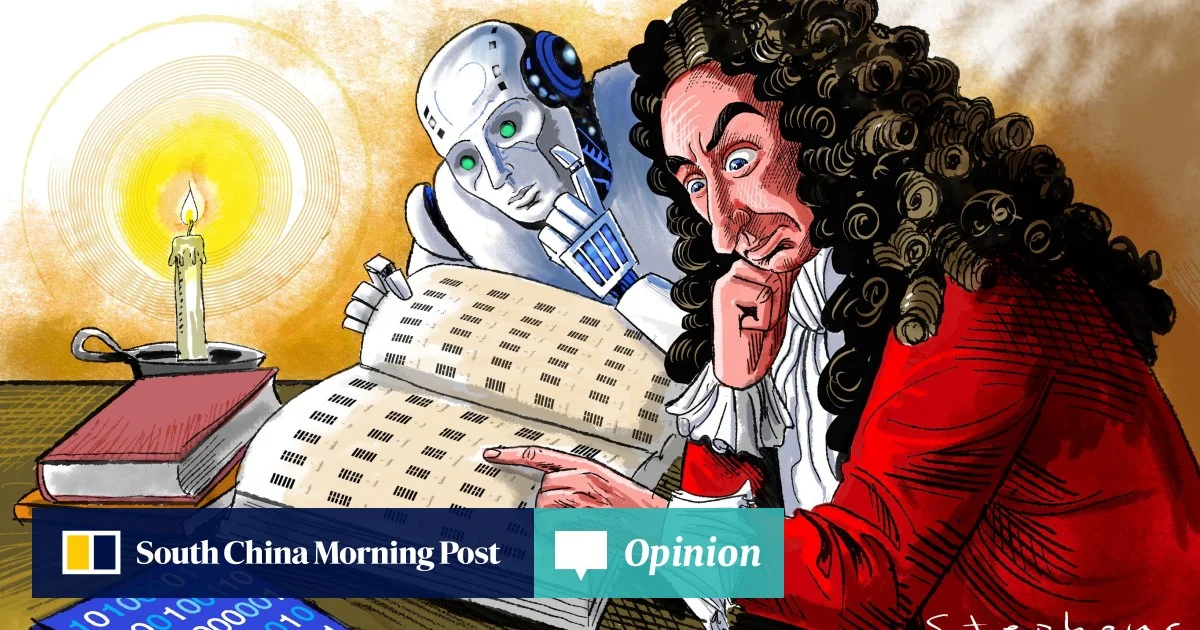
Long before Alan Turing, Claude Shannon, or even Charles Babbage and Ada Lovelace, there was Gottfried Wilhelm Leibniz – the German polymath born exactly 380 years ago next week. Among his monumental contributions to science is the binary numeral system, which serves as the bedrock of modern computing, AI and even DNA biology.
Leibniz developed a “new” form of mathematics that uses only the digits 0 and 1 while designing a mechanical calculator. However, he struggled to convince his European peers that a two-digit system held any deep significance.
In 1701, a frustrated Leibniz sent a letter describing his binary system to his friend, Father Joachim Bouvet, a Jesuit missionary working in Beijing. On reading it, Bouvet immediately recognised that Leibniz’s system perfectly matched the 64 hexagrams of the I Ching (Book of Changes) – arguably China’s oldest classical text, which shaped the core of East Asian civilisations.
Bouvet replied to Leibniz with a woodcut print of the 64 hexagrams, explaining that the Chinese had developed an identical binary system some 3,000 years earlier. Though they used different symbols – broken and unbroken lines instead of 0 and 1 – the underlying conceptual principles were exactly the same.
When Leibniz received the print in 1703, he was both thunderstruck and elated. He quickly penned a second paper on binary code whose title translates as “Explanation of the binary arithmetic, which uses only the characters 1 and 0, with some remarks on its usefulness, and on the light it throws on the ancient Chinese figure of Fu Xi” – the mythical Chinese sage credited with creating the hexagram system.