World
The end of ambiguity: How the Washington framework broke the post-Taif order

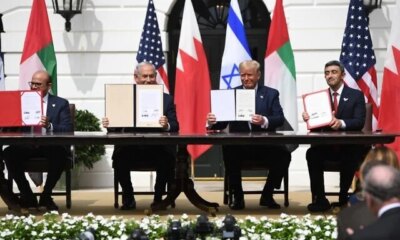
The framework agreement signed in Washington on June 26 between the United States, Israel, and Lebanon is being analyzed in most capitals as a diplomatic development. In Lebanon, it is being experienced as something closer to a political earthquake. Within hours of the signing, Hezbollah’s secretary-general called it “null and void.” Parliament Speaker Nabih Berri, the principal intermediary between Hezbollah and the state, called it “incitement to civil war.” Hezbollah supporters blocked roads in Beirut’s southern suburbs with burning tires. And Kataeb leader Samy Gemayel congratulated the president and prime minister on “an achievement accomplished by the Lebanese state.”
The post-Taif order was built on ambiguity. The Taif Accord of 1989 ended the civil war by distributing power across Lebanon’s confessional communities through a set of formal and informal arrangements that left the most dangerous questions deliberately unanswered. The most dangerous question of all, whether the Lebanese state was sovereign over its own territory or whether sovereignty was shared with Hezbollah, was resolved not by answering it but by agreeing never to ask.
The framework agreement ends the ambiguity.
The text commits Lebanon to a “sequenced process” in which the Lebanese Armed Forces will restore “effective sovereign authority over all Lebanese territory, pending the verified disarmament of non-state armed groups.” The language is precise. “Effective sovereign authority.” “All Lebanese territory.” “To the exclusion of all non-state actors.” “Verified disarmament.” Each phrase answers the question that the post-Taif order was designed to avoid. Is the state sovereign over the south? Yes, says the document. Does sovereignty include Hezbollah’s territory? Yes. Does sovereignty require Hezbollah’s disarmament? Yes. Is the disarmament subject to external verification? Yes.
The community was commemorating resistance while the state was signing its terms of resolution.
Netanyahu removed any ambiguity about what the agreement means for Israel: “We will maintain the buffer zone until Hezbollah disarms and as long as there is a threat to the State of Israel.” Since Israel defines the threat and controls the verification timeline, the agreement produces not a process for ending the occupation but a legal framework for extending it indefinitely, conditioned on a requirement, Hezbollah’s disarmament, that every actor involved knows will not be met.
The Lebanese domestic response to the agreement did not follow the usual pattern of managed disagreement within the confessional system. It followed a pattern that Lebanon has not seen since the years preceding the civil war: absolute rejection from one side, celebration from the other, and the language of existential conflict entering the political discourse within hours.
Berri’s statement is the most structurally significant. The Speaker of Parliament is not a commentator. He is the chairman of the legislative body of the state that signed the agreement. He is the leader of the Amal Movement, the Shia community’s state-aligned political organization. He is the intermediary who facilitated every round of the Washington talks.
Berri is not rejecting the agreement from outside the system. He is warning, from inside the system, that the system cannot survive what it has just signed.
His position reveals the impossible geometry of post-agreement Lebanese politics. Berri cannot endorse the framework without endorsing Hezbollah’s disarmament, which would destroy his communal base. He cannot reject it without breaking with the government his parliamentary bloc supports, which would destroy his institutional position. He cannot remain silent because the agreement forces a response from every actor in the political system. The result is the language of civil war, deployed not as a threat but as a diagnosis: this is where the agreement leads if it is implemented.
Hezbollah’s rejection went further than opposition. Qassem’s declaration that the agreement is “null and void” is not the language of political disagreement. It is the language of an organization that does not recognize the authority of the entity that signed the document. Mohammad Raad, head of Hezbollah’s parliamentary bloc, called the agreement “the Lebanese authority’s complete submission to America and the Zionist enemy.” The phrasing is deliberate: “the Lebanese authority,” not “the Lebanese government.” The distinction delegitimizes the state itself, not merely the officials who happen to occupy it.
On the other side, Gemayel’s congratulations framed the agreement as a national achievement, the state asserting its sovereignty over its own territory for the first time since Taif. This reading is shared, with varying degrees of enthusiasm, by the Lebanese Forces, segments of the Sunni establishment, and the Druze leadership. For these communities, the framework agreement is what they have demanded for three decades: the state reclaiming its monopoly on force. Their celebration is genuine. It is also premature. The agreement commits Lebanon to delivering an outcome, Hezbollah’s disarmament, that the Lebanese state has never had the capacity or the political consensus to deliver.
The fracture the agreement has produced runs along every fault line in Lebanese society simultaneously. Shia politics is split between Berri’s state track and Hezbollah’s rejection. The broader national divide between communities that have long demanded disarmament and communities that have long defended against the resistance has been formalized in an international document. The coexistence that held the system together, the deliberate ambiguity about sovereignty, about the resistance, about who controls what and who can see what, has been replaced by a text that answers every question the system was built to avoid.
Whether what follows is a new political settlement, a prolonged crisis, or something worse depends on whether the political class can construct a new form of coexistence to replace the one that just died. The history of Lebanese politics suggests that such reconstructions are possible. It also suggests that they are preceded by periods of intense instability, during which the language of civil war stops being a warning and becomes a description.