World
Syrian FM says Damascus open to meeting Hezbollah, after Trump said it should fight group

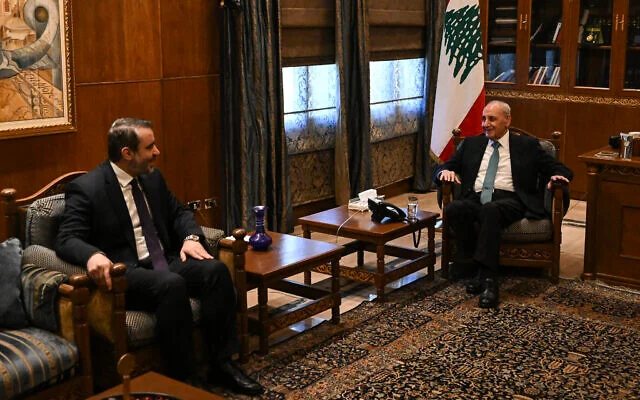
BEIRUT — Syria’s foreign minister said during a visit to Beirut on Thursday that Syria was open to meeting the Iran-backed Lebanese terror group Hezbollah “if interests require it,” Lebanon’s state news agency reported.
Asaad al-Shaibani met Lebanese government leaders, including President Joseph Aoun and parliament speaker Nabih Berri, a Hezbollah ally. It was his first visit there since US President Donald Trump last month raised the possibility of Syrian forces combating Hezbollah in Lebanon.
Syrian President Ahmed al-Sharaa has previously denied what he called rumors about any Syrian presence entering Lebanon. Beirut and Jerusalem have also ruled out the possibility.
The former rebels and commanders who now run Syria fought against Hezbollah for years while it deployed to Syria to support former president Bashar al-Assad.
Now that they are in power, they are having to calibrate alliances and military action carefully in efforts to maintain relative stability in Syria, which is still recovering from 14 years of civil war.
Shaibani said the “Hezbollah file” was not raised during his meetings in Lebanon on Thursday, but that Syria was open to meeting the group, the Lebanese state news agency cited him as saying.
In a later press conference, Shaibani said Lebanon and Syria had signed an agreement establishing a high-level cooperation committee to strengthen bilateral ties.
“All we bring to Lebanon is love and a commitment to overcoming the painful legacy in relations between the two countries,” he said.
A statement from Aoun said that neighbors Syria and Lebanon wanted each other’s stability and that Sharaa had assured him that Syria would not take sides in Lebanon’s internal issues.
Syria’s new government under former al-Qaeda commander Sharaa has emerged as a US ally since his forces toppled Assad in 2024, and has largely stayed out of the regional war between the US and Israel, and Iran.
Hezbollah dragged Lebanon into the war in March by attacking Israel in support of Iran, resulting in the destruction of large parts of southern Lebanon and the disruption of the lives of those living in northern Israel. US-sponsored efforts to halt fighting between the two sides have reduced hostilities, but are yet to achieve peace or bring the war to a definite end. Last week Israel and Lebanon signed a framework agreement aimed at paving the way for an eventual peace deal between them, but Hezbollah has rejected any such move.
Trump said last month he had spoken to Sharaa about combating Hezbollah, after criticizing Israel for killing too many civilians in Lebanon. “I suggested to Israel to let Syria take care of Hezbollah, because to be honest with you, I think they do a better job of doing it,” Trump said.
Damascus wary of being drawn into war
Sharaa has since said that “the rumors circulating about Syria entering Lebanon are completely unfounded,” according to Syrian state media.
Reuters reported in March that the US had encouraged Syria to consider sending forces into eastern Lebanon to help disarm Hezbollah, but that Damascus was reluctant to embark on such a mission for fear of being sucked into the war in the Middle East and inflaming sectarian tensions in Syria and Lebanon.
Trump’s special envoy to Syria, Tom Barrack, dismissed the report of the US encouraging Syria to send forces into Lebanon as “false and inaccurate.”
Syria long dominated Lebanon under the Assad family, sending in forces in 1976 during the 1975-90 civil war and controlling Lebanon’s postwar politics until its withdrawal in 2005.
Any Syrian intervention could fuel sectarian tensions in both Syria and Lebanon, home to a mosaic of sects including Sunni Muslims, Shi’ite Muslims, Christians and Druze.
Times of Israel staff contributed to this report.