World
Polish nationalists protest commemoration for Nazi-era Polish massacre of Jews

JEDWABNE, Poland (AFP) – Poland’s Jewish community, political leaders and ordinary citizens on Friday commemorated a massacre of hundreds of Jews killed by their Polish neighbors 85 years ago, as far-right activists protested nearby, denying Polish guilt.
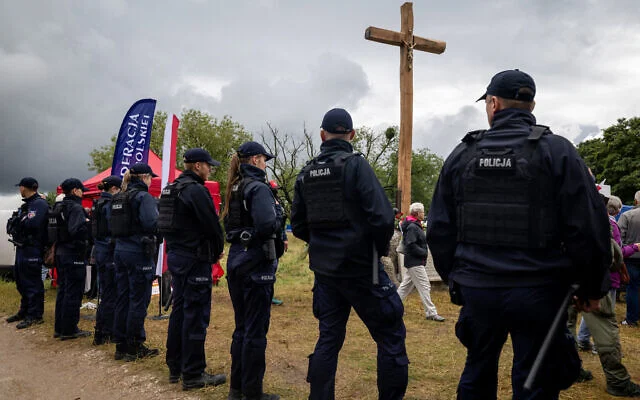
There was heavy police presence at the site of the 1941 Jedwabne massacre — a former barn in which local Polish farmers locked up around 300 Jews, including women and children, before setting it on fire.
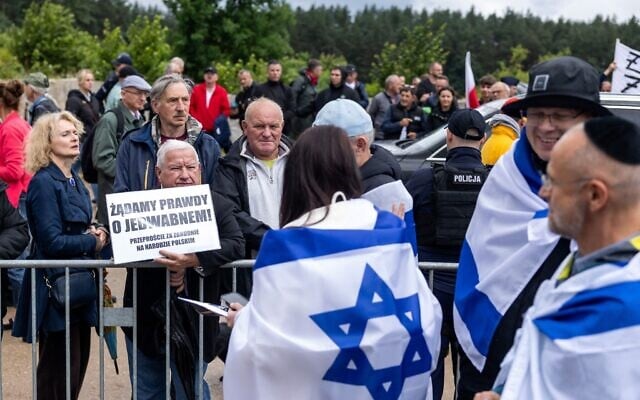
Right next to the ceremony, about 1,000 people attended demonstrations and a Catholic mass organized by far-right parties, who refuse to acknowledge the responsibility of Polish villagers for the killings.
Several participants in the commemoration were draped in Israeli and EU flags, as they paid their respects at a monument erected in 2001 to mark the site of the pogrom.
Chief Rabbi of Poland Michael Schudrich called for unity as demonstrations carried on outdoors, inviting participants in the ceremony to read out together the names and occupations of Jews murdered in Jedwabne.
An official investigation confirmed in 2003 that the massacre had been carried out by Poles from Jedwabne, rather than by Nazi German occupiers.
This stood in contrast to long-held historical narratives in Poland, and ultra-nationalist groups continue to challenge the investigation’s findings.
They argue that exhumations of the victims — halted in 2001 for religious reasons at the request of the Jewish community — must be resumed.
“As long as we do not know the truth, there will be divisions,” Elzbieta Rybarska, carrying a Polish flag, told AFP.
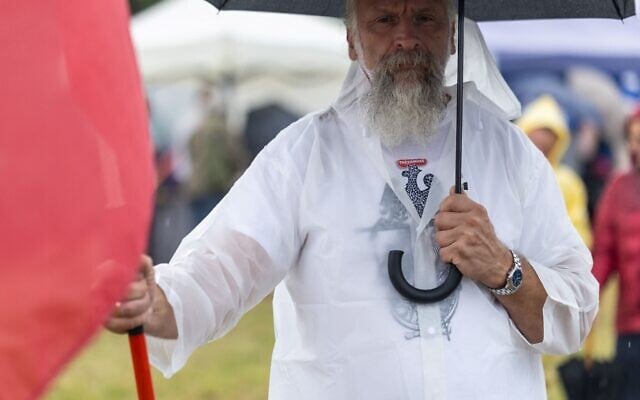
“If someone were not afraid of the truth, the exhumation would have been carried out long ago,” Rybarska, carrying a Polish flag, added.
Among the organizers of the protest was the far-right Confederation of the Polish Crown party, whose leader is Grzegorz Braun.
He once caused a scandal by using a fire extinguisher on a menorah, a ceremonial candleholder, to interrupt a Jewish religious ceremony in the Polish parliament.
Around 40 other Jews from Jedwabne were killed by the villagers in ways other than in the burning barn, and several other massacres of Jews took place in the region during the German occupation of Poland in World War II.
68-year-old Jerzy Orlos, who came to the commemoration draped in an EU flag, told AFP he attended “to experience the shock of how terrible the division of the nation is.”
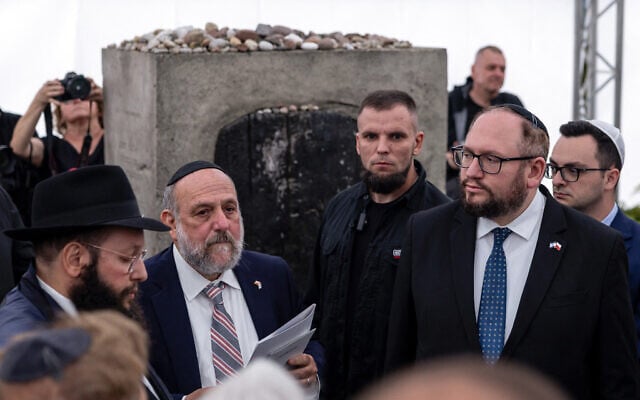
Yet, he added, “such a ceremony is of course proof that we remember the deceased.”
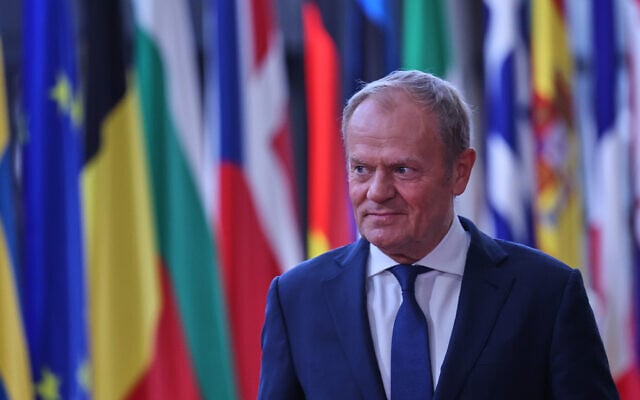
Centrist Prime Minister Donald Tusk, who was not at the ceremonies, said the 85th anniversary of the massacre should serve as “a lesson about (Poland’s) national conscience.”
“I would like all Poles to assume responsibility for what we are proud of… but also that we be capable… of assuming responsibility for what does not do us honor,” he added.
The history of the Jews of Jedwabne resurfaced in 2001, when Polish-American historian Jan T. Gross highlighted the role of Polish villagers in his book “Neighbors.”
Revelations about the history of the village sent shockwaves through the country and led to an official apology to the Jewish community from then-president Aleksander Kwasniewski.
“As a man, a citizen and president of the Republic of Poland, I ask their forgiveness in my own name and in the name of those Poles whose consciences are shaken by this crime,” he said.
Following the ceremony, Chief Rabbi Schudrich spoke out against divisive narratives surrounding the history of the massacre.
“This has nothing to do with an attack on Polish identity,” the Rabbi, a dual Polish-American citizen, told AFP.
“When you are honest about yourself, you can then be that much more honest going into the future,” he added.
In Poland, the center of the genocide of millions of Jews perpetrated by the Nazis, thousands of Jews were also killed by Poles, particularly in rural areas.
However, many in Poland also risked their lives to save Jews.
More than 7,000 Poles — more than any other nationality — have been recognised as “Righteous Among the Nations” by Israel.