Trends
Parents Appeal To FG Over Atiba Accreditation Issues

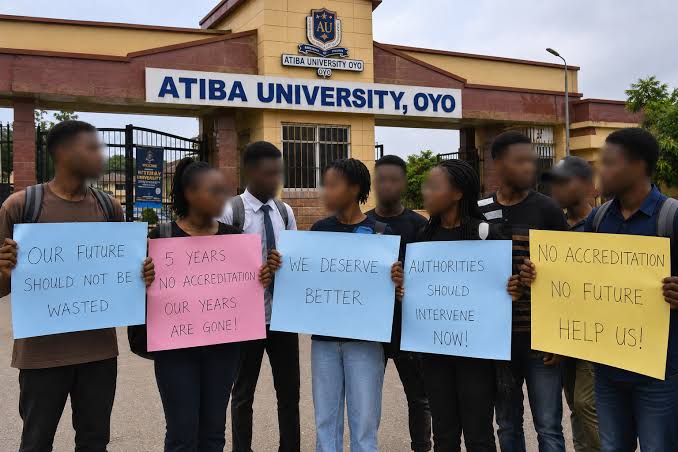
Parents of students of Atiba University, Oyo State, have called on the Federal Government to intervene in the crisis surrounding the institution’s law program, asking authorities to facilitate the transfer of affected students to accredited institutions and prevent their years of academic efforts from being lost.
The parents, represented by their lawyer, Victor Opatola, made the demand in Abuja, urging the National Universities Commission, the Minister of Education, and the Council of Legal Education to urgently resolve the matter before the commencement of the next academic session.
The parents’ call followed concerns over the accreditation status of the university’s law program and the implications of the Council of Legal Education’s decision on students who have progressed to 400-level and 500-level.
Opatola said some students had spent up to five years studying law, while their parents had invested substantially in their education, only to discover that the program was not accredited by the CLE, a requirement for graduates seeking admission to the Nigerian Law School.
He said, “Atiba University admitted students over the years, running to five or six years, and knowing full well that it is not accredited by the Council of Legal Education, knowing the implication that once you are not accredited by the Council of Legal Education, the students cannot go to law school.”
According to him, the CLE had placed the university on a 10-year moratorium, meaning that the institution could not admit students into the law program during the period, while students already enrolled face uncertainty over their progression to law school.
He said the parents had petitioned the NUC and other relevant authorities but were concerned about the delay in obtaining a response.
“We have written to the Nigerian University Commission. It is sad that we have written to NUC for almost two months, and our letter and series of follow-ups have been embroiled in the bureaucracy of NUC,” he said.
Opatola said the immediate priority was to protect the students’ academic progress and ensure their years of study and their parents’ financial investments did not go to waste.
“Our aim right now is to ensure that the years of this student do not go to waste as well as the investment of the parent on the student. So, the important thing right now is the resolution of this matter,” he said.
He called for the affected students to be transferred to accredited law faculties without restarting their studies.
“On a minimum, we are appealing on behalf of these students that their five years should not go to waste so that these students can feasibly be put into other universities. They can actualize their dream of becoming a lawyer,” he said.
The parents also asked the authorities to direct the release of the students’ academic records, facilitate their transfer to accredited law faculties, and suspend further fee demands while the matter was being resolved.
In a formal notice dated June 30, 2026, the parents’ lawyers demanded the release of the students’ academic transcripts and other records without charge.
They also requested that the university should facilitate and fund the transfer of affected students to accredited law programs and refund tuition and levies paid by the students.
The lawyers said the students had been admitted, paid fees, attended lectures, written examinations, and progressed through various academic levels “in the reasonable expectation that the program was duly accredited by the Council for Legal Education, as required by law.”
The parents subsequently petitioned the NUC on July 10, 2026, seeking an investigation and urgent intervention.
According to the petition, the CLE’s published list of accredited law faculties as of June 2026 did not include Atiba University.
The petition said students from 100-level to 500-level were affected, including some who had completed 500-level but could not proceed to law school.
Opatola urged the CLE to consider the years already spent by the students and work with the NUC to ensure their transfer before the next academic session.