Viral
Nigeria Has No Electricity, Has Resources That Can’t Be Drilled Due To Stupid Policy – Kemi Badenoch

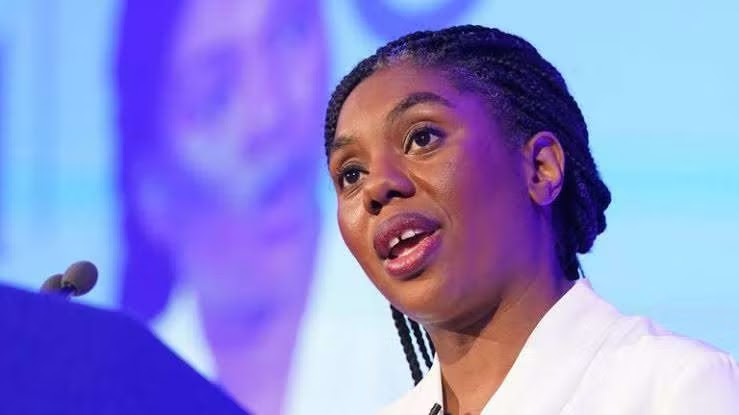
Leader of the United Kingdom’s Conservative Party, Kemi Badenoch, has criticized Nigeria’s long-standing inability to provide stable electricity despite being one of Africa’s largest oil-producing nations, attributing the problem to poor government policies rather than a lack of natural resources.
Badenoch, who spent part of her childhood in Nigeria before relocating to the United Kingdom as a teenager, said her experiences growing up in the country played a major role in shaping her views on governance, economic management, and energy policy.
Speaking during a recent interview with The Spectator, the British politician reflected on how witnessing Nigeria’s struggles despite its abundant natural resources influenced her political philosophy.
According to Badenoch, the mere presence of valuable resources does not guarantee prosperity if governments fail to implement policies that allow citizens to benefit from them.
“My belief that we need to drill our oil and gas comes from growing up in a country… Nigeria is an oil-producing country, never had electricity,” she said.
“It is very easy to have resources under the ground, but stupid public policy means that you can’t use it.”
Her remarks come against the backdrop of decades-long concerns over Nigeria’s electricity sector, which has continued to face challenges despite the country’s status as a major crude oil producer and one of Africa’s largest economies.
Badenoch also used the opportunity to criticize what she described as excessive government intervention in economic affairs, warning that policies centered on state control often fail to deliver their intended outcomes.
Drawing comparisons between current energy policies being pursued in the United Kingdom and governance approaches adopted by Nigerian military administrations in the 1980s and 1990s, she argued that excessive state control can weaken economic growth.
According to her, such policies are often introduced with promises of fairness, redistribution, and government-led solutions but eventually produce unintended economic consequences.
“And I see quite a lot of what Ed Miliband is doing as being very much like what the Nigerian military dictatorships were doing in the 80s and 90s ‘the government is going to take control, we know what’s best, we’re going to redistribute.’ Stupid ideas which eventually just bankrupt the country,” she said.
‘I Don’t Want Britain to Become Poor’
Badenoch further explained that her political convictions stem largely from witnessing the realities of life in a developing country.
She said growing up in Nigeria exposed her to the consequences of weak institutions, poor governance, and economic mismanagement, experiences that continue to shape her approach to policymaking.
“Fundamentally, my views about how we should run our country come from growing up in a place that was very poor. You grow up in a third-world country and you look at why it is termed ‘third world,’ and I don’t want that to happen here,” she stated.
The Conservative leader warned that no nation is immune to economic decline if leaders fail to protect the institutions and policies that underpin prosperity.
She also argued that many citizens in developed countries often take their economic stability, democratic institutions, and historical achievements for granted.
According to Badenoch, Britain’s success was built over generations through deliberate decisions and strong institutions, and it should not be undermined by policies that disregard economic realities.
Her comments have since sparked discussions both in the United Kingdom and Nigeria, particularly regarding the relationship between natural resources, governance, and sustainable economic development.