
World
Netanyahu says he has someone in mind to succeed him, ‘but I don’t want to designate a time’

Prime Minister Benjamin Netanyahu said in an interview released Thursday that he has a suitable person in mind to succeed him as premier, but refused to publicly name them.
“I think that there is someone to whom I am ready to give the keys to the country. I spoke to him about it, but I don’t want to designate a time,” Netanyahu said, without revealing the individual, on the Salon with Sharon podcast hosted by i24news’ Sharon Gal.
Netanyahu was apparently implying that he has decided which lawmaker would receive his backing to be premier — Israeli prime ministers do not formally designate their own successors.
Netanyahu, Israel’s longest-serving leader, who has held power nearly uninterrupted since 2009, has so far given no indication that he plans to step down, and is on a campaign footing even as the date of the election, which must take place by October 27, has yet to be officially set.
His leadership is set to be a major issue in the election, with many considering him the main culprit responsible for the strategic failures that preceded Hamas’s onslaught of October 7, 2023, as well as critics accusing him of divisive political conduct, corruption and undermining Israel’s democratic institutions.
Netanyahu also indicated in the interview that aired Thursday that plans to encourage Gazans to immigrate from the war-battered enclave, thought to be moribund, were still alive.
“I want Hamas to be demilitarized. I want to make it possible for Gazans who want to choose to live in another place to have that right,” Netanyahu said.
Israeli officials have repeatedly spoken in favor of advancing “voluntary emigration” of Gazans, even though the Gaza peace plan that US President Donald Trump presented in September pledges to “encourage people to stay and offer them the opportunity to build a better Gaza.” Some members of the government have also vowed to reestablish Jewish settlements in the Strip, though Netanyahu has disavowed that aim.
Defense Minister Israel Katz announced in February 2025 the establishment of a directorate dedicated to getting Gazans out of Gaza.
While there have been no indications that the directorate has taken any concrete steps, a report last month by Channel 13 said Israel is seeking to revive the plans, and Netanyahu’s new national security adviser, Shmuel Ben Ezra, reportedly convened an urgent meeting on “encouraging voluntary emigration” of Palestinians from the Gaza Strip.
Additionally, Netanyahu claimed in the interview that he had difficulty appointing figures to top security positions because the “system was closed” and filled with “groupthink” officials.
“You had to appoint people who came from inside the system,” he claimed.
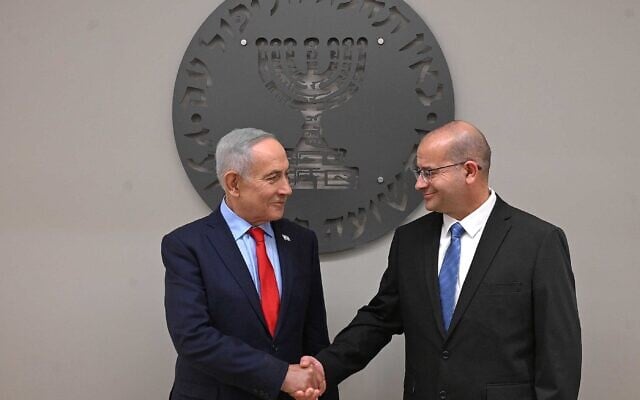
“To bring someone from the outside, it was a great struggle,” he said, noting he had to fight to appoint the new Mossad Director Roman Gofman, despite his heroism during the October 7, 2023, massacre.
During the massacre, while serving as the commander of the Tzeelim training base, Gofman rushed to the Gaza border and was seriously wounded while battling the Hamas-led terrorists in a firefight at Sha’ar Hanegev Junction just outside of Sderot.
But the tempestuous legal process over Gofman’s appointment arose over a controversial influence campaign carried out by the IDF in 2022, while he was the commander of the 210th “Bashan” Regional Division in the Golan Heights.
As commander, Gofman approved the use of a 17-year-old, Ori Elmakayes, for an Arabic-language influence campaign against Iran, Hezbollah and Hamas, leading to the teen’s prolonged detention by security authorities after he was accused of publishing classified information.
Gofman has claimed he did not know how old the teenager was, adding that he had ordered that only non-classified information be given to him for publication on social media.