World
Netanyahu hits new lows in his battle for survival; there will be a great deal of damage for better leaders to undo

An earlier version of this Editor’s Note was sent out earlier Wednesday in ToI’s weekly update email to members of the Times of Israel Community. To receive these Editor’s Notes as they’re released, join the ToI Community here.
In this column a week ago, I pleaded with the prime minister not to press ahead with his planned package of legislation to remake — or, rather, shatter — Israel’s democratic framework. I had issued a similar plea in March 2023. Unsurprisingly, he didn’t heed it then — barely half a year before the Hamas invasion — and he didn’t heed it now.
More to the point, then as now, he also ignored warnings from Israel’s defense establishment — led by then-defense minister Yoav Gallant and then-IDF chief of staff Herzi Halevi — that the judicial overhaul legislation he was advancing was deepening the rifts in Israeli society and consequently weakening its deterrent capability in the face of enemies salivating at the prospect of destroying us. At one memorable low point, in July 2023, he refused to meet with IDF chief Herzi Halevi until the day after the so-called “reasonableness” law had passed. A very worried Halevi reportedly told Netanyahu that slanderous attacks on soldiers, especially reservists, who were protesting against the judicial overhaul were harming “the competence and cohesion of the IDF.”
This week’s dire warnings from the military leadership, in the final hours before Netanyahu pressed insistently ahead with legislation to unprecedentedly legitimize the ongoing mass exemption from IDF service of the entire ultra-Orthodox community, were not leaked to the media. They were, rather, set out, in unmistakably forthright terms, by the current IDF chief of staff, Eyal Zamir, in a letter delivered to Netanyahu, his empty shell of a defense minister, Israel Katz, and other senior officials.
“As you know, the change in law seeks to establish a special arrangement for yeshiva students according to which arrests, investigations, or enforcement measures will not be taken against them for a period of seven months, which is expected to be extended in light of the coming election period,” wrote Zamir on Monday. “The bill was introduced in the midst of a multifront campaign, and at a time when the IDF is facing a severe manpower shortage, which directly influences its ability to fulfil operational missions.”
As the IDF had repeatedly clarified to the Knesset committee formulating the law, Zamir went on, “not only is the bill not expected to bring additional personnel to military service in the short term, but rather the opposite — it will provide an incentive to not report for military service, as, due to it, there will be an exemption from prosecution and criminal proceedings. As such, the bill does not match IDF needs, and that is quite clear and unequivocal.”
To summarize that part of Zamir’s letter, he was telling the prime minister: You are about to pass a law that will harm the IDF’s capacity to defend Israel. Please don’t do that.
The chief of staff — a Netanyahu appointee, it should be stressed — also went on to bluntly inform the prime minister that the IDF is simply incapable of carrying out the responsibility it is assigned in the law for determining whether ultra-Orthodox young men are eligible for service or not.
The legislation requires the IDF to set up a three-member committee that will examine whether ultra-Orthodox young men are genuine yeshiva students, who should not be recruited, or layabouts, who should. But, Zamir wrote, the IDF has no special skills in determining this, and no spare manpower to pore through the cases of the 70,000-90,000 theoretically currently eligible ultra-Orthodox recruits. Worse still, this task would place the IDF in the untenable position of issuing special exemptions from service to one part of Israel’s demographic — the ultra-Orthodox — even as it continues elsewhere to impose mandatory military duty and lengthy reservist service on the bulk of the population.
“It cannot be that the military system under my authority, which demands of those in its service unprecedented sacrifice, will simultaneously be entrusted with providing mass exemptions from prosecution,” wrote Zamir, in terms of profound anguish. “Such a process will create a deep rift with those who are serving, who have carried the burden of combat for some two and a half years, and will increase the disparity.”
Left unsaid was that the entire process of examining the case-by-case eligibility for service or exemption would also be pointless, since the law’s key operative clauses ban the arrest, investigation and prosecution of those in the ultra-Orthodox community who are called to serve but refuse to do so, and by extension may require the release from military jails of any draft dodgers who are currently detained.
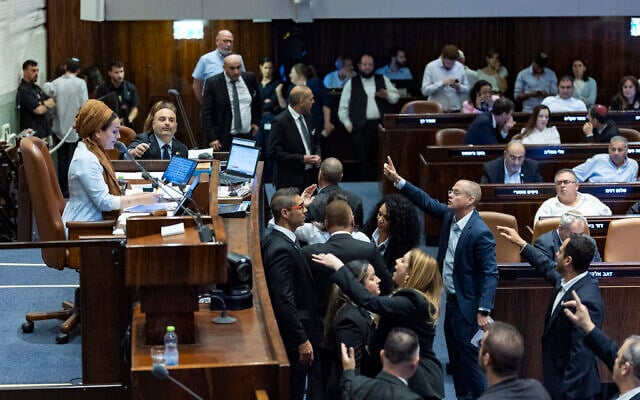
Entirely unmoved by the chief of staff’s plea, thoroughly unfazed by the drumbeat echoes of his own identical obduracy in the months preceding the Hamas invasion of October 2023, and evidently untroubled by the eerie Jewish historical calendrical non-coincidence that finds us today entering the nine days of mourning culminating in Tisha B’Av, when both the biblical Temples were destroyed, Netanyahu went ahead and strong-armed the legislation through the Knesset on Tuesday.
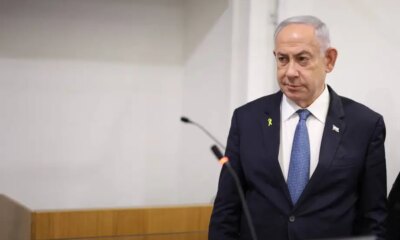
In the dismal scenes surrounding the vote, the prime minister briefly entered the Knesset chamber in the final minutes of debate, and took his seat between Katz and “Justice” Minister Yariv Levin, the chief architect of the ongoing package of legislation that is inexorably centering all power and authority in Israel in the hands of the governing coalition. Buffeted by opposition chants of “Shame” and “Go,” Netanyahu then got up and left the chamber shortly before the deed was done — absenting himself from the vote itself as the ultra-Orthodox parties got the law they wanted, enabled by the lemmings in Likud and the far-right parties.
Was Netanyahu indeed shamed by his political maneuver — repairing his partnership with the entirely self-interested, blackmailing ultra-Orthodox political leadership at the terrible price of both destroying the foundational democratic principle of equality before the law and weakening Israel’s capacity to defend itself against its enemies despite the horrific 2023 proof of the potential consequences?
Well, maybe.
More likely, though, he is betting that he can yet remake the electorate’s collective memory in the three months before polling day on October 27. He had stayed away, too, from Monday’s vote uniquely elevating Torah study to the status of a foundational Israeli and Jewish value — part of the Haredi-demanded legislative effort to enable ongoing mass non-enlistment.
In similar vein, he has scandalously resisted establishing the state commission of inquiry necessitated to help ensure no repeat of the Hamas massacre, instead advancing a commission that he and his coalition colleagues would select and task — betting, again, that the electorate, come October, will overlook the fact that he was the prime minister under whose watch Yahya Sinwar sent thousands of Hamas-led mass murderers across the border.
And it could well be that enough of the electorate will yet be persuaded that Netanyahu is peerlessly capable of leading and protecting this extraordinary and essential country, and that his critics are, as he tells it, all dangerous leftists conspiring in Israel’s demise.
It could also well be that Netanyahu, ready to ignore his own IDF chief of staff’s warnings, ready to destroy the existential Israeli imperative of a defense burden fairly shared by a “people’s army,” will also be ready to breach the rule of law when it comes to the elections — by (again) deterring Arab voters on the day, for instance, or refusing to accept a defeat if that’s what the certified vote count produces.
After all, this week has shown, perhaps more clearly than ever before, that he has few limits when it comes to retaining power.
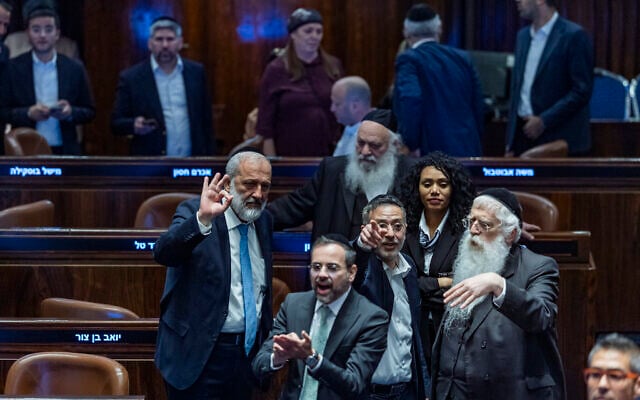
But what of the Israel he is now well on the way to creating here? A society no longer blessed with equality before the law. A society where “ultra-Orthodox” Judaism has deteriorated largely into a mindless cult, broadly ill-educated and non-contributing, dependent on financial subsidies extorted by its political leadership. A society descending toward an ironically Godless theocracy, where Divine guidance is risibly invoked to justify everything from gender discrimination in academia to Sabbath-day attacks on Palestinian civilians. With no independent media, no effective law enforcement — as per legislation this week — and no judicial authority to protect the people from their political masters.
The High Court will likely freeze and strike down much of this legislation — indeed, on Wednesday, it froze implementation of Tuesday’s “no arrests of draft dodgers” law, pending an urgent hearing. But Netanyahu’s coalition is increasingly declaring its intention to ignore the court, in these final months before it intends to redouble its longstanding legislative onslaught to subjugate the judiciary altogether.
What of that Israel’s future, its tenability, its capacity to retain the best of its people, to thrive, to protect itself?
There will, to put it mildly, be an immense amount of damage for hoped-for better leadership to undo. Speed the day.

“Prime Minister, you said you would pass consensual laws, [supported] by coalition and opposition,” a reporter called out to Netanyahu near his office in the Knesset shortly before Tuesday’s fateful vote. “But you are passing a law that the IDF chief of staff opposes. How do you explain this?”
Netanyahu kept walking and, by some accounts, was heard to laugh.