Trends
#NairaLife: The 33-Year-Old Trying to Unlearn Years of Money Trauma

Every week, ThePress seeks to understand how people move the Naira in and out of their lives. Some stories will be struggle-ish, others will be bougie. All the time, it’ll be revealing.
It was when I got into university in 2012. Actually, it was in my 300 level. I was living in the hostel with different kinds of people: people whose parents sent them allowances, and people who would deprive themselves to save up and buy things.
The concept of saving was alien to me, let alone the fact that they were getting actual allowances. It was really strange, considering how my family back home treated money.
Money wasn’t a priority in my house. In fact, it’s similar to this guy’s experience. You know the statement, “The love of money is the root of evil”? In my case, it wasn’t even the love of money; it was having it itself that was the evil.
I came from a Christian home, and that’s just how my parents brought all of us up. There was this idea that the rich were evil and the poor were good. My dad was a civil servant, and my mum was a trader who eventually had to stop working because my dad didn’t want us kids to mingle too much with people in our environment.
He lived in a different state and became the only one working, so each month he sent money strictly to cover basic needs like food and school fees. We could never get anything outside those without extensive explanations and justifications.
It was so bad that my parents even denied me a scholarship I had won to attend a Federal Government College after I did well in my common entrance exam. They felt that if I went there, I’d be exposed to rich people. So, they made me go to a nearby secondary school instead. Same thing for university. I wanted to go to a private university and applied for a scholarship, and they said, “No, go to your state university. At least it’s almost free for indigenes.”
Yes, and it was a lot to take in. My upbringing was all I knew, and it was my normal. Growing up, whenever I saw people with a lot of money, it felt like they were doing something shady. As a result, I tried as much as possible not to think about or hold on to money at all because I didn’t want it to corrupt me.
In fact, after secondary school, I spent a year at home before gaining admission to uni. During that time, I started hanging around a cybercafé because I loved doing things with my hands. I worked as an attendant for free, just to leave the house, until the owner started giving me ₦2k – ₦4k stipends here and there. Whenever it came, I’d just buy something random, like junk or food I didn’t need, just to finish the money. I knew I couldn’t just keep it with me. I wasn’t even doing it for the money in the first place.
But when I got into uni and moved into the hostel in 300 level, I realised I needed money to survive. I only got transport fare and foodstuffs whenever I visited home on weekends, and that wasn’t enough to sustain me.
I started doing graphic design for campus fellowships and student campaigns. I had learnt the skill while working at the cybercafé, from watching a guy who often bought internet time to design on the system and practising on my own.
The fellowships paid me about ₦1,500 per design. I also started inflating the prices of textbooks to my parents. I’m not proud of it, but it was the only way to get extra money from them. If a textbook cost ₦3k, I’d say it was ₦5k so that the ₦2k extra would be mine.
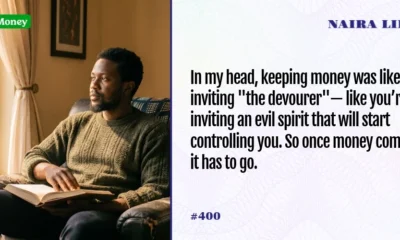
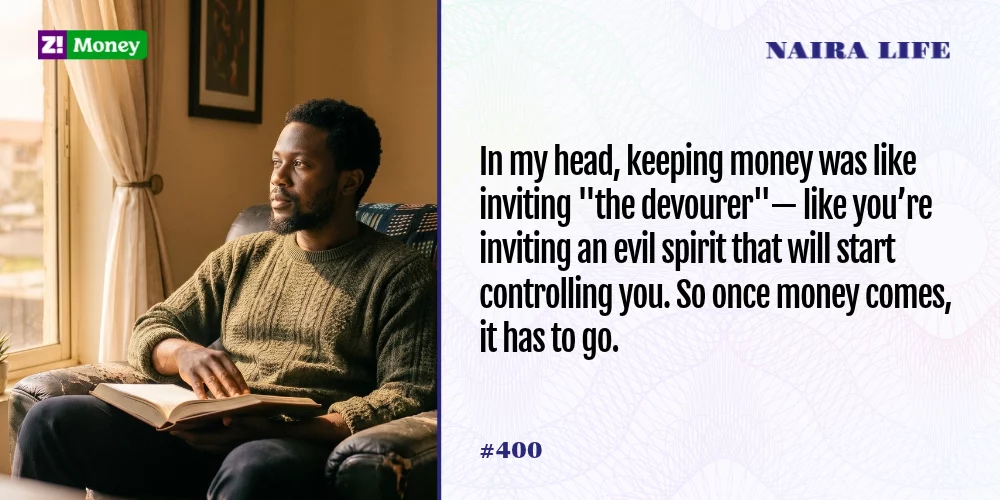
Even then, I wasn’t saving. I was just making enough to eat. In my head, keeping money was like inviting “the devourer”— like you’re inviting an evil spirit that will start controlling you. So once money comes, it has to go.
Fast forward to 2017. I was now in 500 level and decided to drop out.
My CGPA was really low, and I had lots of carryovers. I could tell I would have two or three extra years, so I just stopped going.
The thing is, I wasn’t taking my studies seriously because the course wasn’t what I wanted to do in the first place. I had wanted to leave in 200 level, but my parents said they’d already wasted two years of school fees and couldn’t waste another one. To them, the money was more important than what I wanted to study.
When I dropped out, I didn’t tell them for about a year. I gave them the impression that I was doing clearance. Instead, I was running a T-shirt printing business on campus. I would design shirts, take them to a printer, and sell them to students for money to survive. My parents eventually found out I’d left school through my sister.
She was also at my uni, and we’d entered at the same time. When she graduated, they started asking questions. They made their findings and discovered that no one in my department had seen me all year. Everything blew up at home. My parents told me they wouldn’t spend on me again. I was still living at home, but I was on my own.
We surveyed 5,000 workers across Nigeria’s formal and informal sectors to examine what Nigerians earn, where the money goes, and whether hard work actually translates to financial security. This is what we found. Download the ThePress State of Income Report.
The problem was that in my head, it wasn’t even meant to be a business; it was a survival method. I couldn’t count my profits or losses. I could spend ₦3,000 on production and make a profit of ₦200 or ₦500, and that was fine with me. Even as the business grew over time and I had two people working for me, I still applied that thinking.
Every time we made a profit, I was always looking for the next random thing to buy just to let the money go. My staff earned ₦25k each, and sometimes I couldn’t even pay them, so I was constantly owing loan apps, then clearing the loans when a job came in.
If I wanted to buy a shoe worth ₦50k, I couldn’t save ₦10k five times because I’d be restless until the money left my account. I had to wait until I got a single job that would pay me ₦50k at once to buy the shoe.
I did that for years until I began to rethink my money habits.
A little backstory: During the 2020 COVID lockdown, when I couldn’t sell shirts, I was making small cash teaching people how to design on their phones using Canva. One day, I stumbled across a three-month product design course for ₦10k.
Honestly, I didn’t even know what product design was. I thought it meant designing physical products like paper bags and backpacks. That ₦10k was the only money I had at the time, and I didn’t want it to stay with me, so I just paid for the course.
With my design background, I learnt quickly and finished in the top three. My instructor plugged me into a remote internship with the US-based company he worked for, paying ₦70k a month. By October 2020, they hired me full-time and doubled my salary to ₦140k. I resigned three months later, in December.
I felt like an imposter in a big place. Remember, I grew up not accepting to stay among “big people.” Once they doubled my salary, it became a problem for me. I’d never touched that kind of money before.
I kept asking myself, “Why am I earning ₦140k? What am I doing with ₦140k?” I wanted to go back to my survival business where I could justify earning little. So, I returned to selling shirts.
The wake-up call came in early 2021 when I lost my dad. As the only son, the responsibility of the burial fell on me, and I didn’t have the money. I had to speak with our tenants to have them pay their rent in advance so we could cover the burial costs. After we did, I sat down and thought about my whole childhood, and it dawned on me: if there’s an emergency right now, I’m stuck.
I shut down the business in May 2021, moved out of my father’s house for the first time into a ₦400k self-con, and went looking for a job.
I got one almost immediately, but it was an unpaid role. I handled projects and operations for a blockchain company. They had an online community, and I helped manage it. They only gave me transport stipends once in a while, and I just figured the job was a good way to stay busy. Also, I still had some money left over from my dad’s burial and pension, so that was a buffer.
I worked at this company for a year, then in 2022, I got a product design teaching role at a startup paying ₦150k. For the first time, I started saving about ₦80k out of my ₦150k every month. I only did it because I knew I had rent to pay. I still squandered the remaining salary on random things or gave it away because I felt guilty buying things for myself.
Six months. After that, I moved to another company that paid me ₦180k/month. I stayed at this one for over a year. I also got married around this time.
Then in June 2024, I landed an $800-a-month contract. With the exchange rate at the time, my income jumped from ₦180k to about ₦1.2 million. Instead of saving, my old mindset kicked in on a much bigger scale. I had “big money,” so I needed a bigger expense to exhaust it. My old rent had increased to ₦620k, so I moved into a bigger house costing ₦2 million a year.
Then in June 2024, I landed an $800-a-month contract. With the exchange rate at the time, my income jumped from ₦180k to about ₦1.2 million. Instead of saving, my old mindset kicked in on a much bigger scale. I had “big money,” so I needed a bigger expense to exhaust it. My old rent had increased to ₦620k, so I moved into a bigger house costing ₦2 million a year.
It was a huge mistake. Eight months later, in March 2025, the contract ended, and I was stuck with a ₦2 million rent bill.
I pivoted to freelancing, and right now my income isn’t stable; it ranges between ₦200k and ₦500k a month, mostly from long-term projects.
This year has been particularly tough. Last month, my rent wasn’t complete, so I had to drain my entire savings to raise the money. I’m still in the ₦2 million apartment because with current rent prices, even downsizing costs almost the same.
Getting married forced me to become self-aware. When there’s a responsibility attached — like paying rent or providing for my family — I know things will suffer if I don’t save.
I’ve also had to build systems to outsmart my own brain. When we first got married, we opened a joint account so my wife would get notified if I tried to make a transfer, forcing me to justify every spend. Now, whenever money enters my account and I feel that familiar itch to buy something random, I immediately transfer the money to my wife’s account so it’s out of my possession.
I also use a strict percentage system now: whenever income drops, I immediately split it in half. 50% goes straight into a locked account for rent. I treat the remaining 50% as my new 100%.