Trends
[EDITORIAL] Mayhem Continues: The Institutionalisation Of Violence

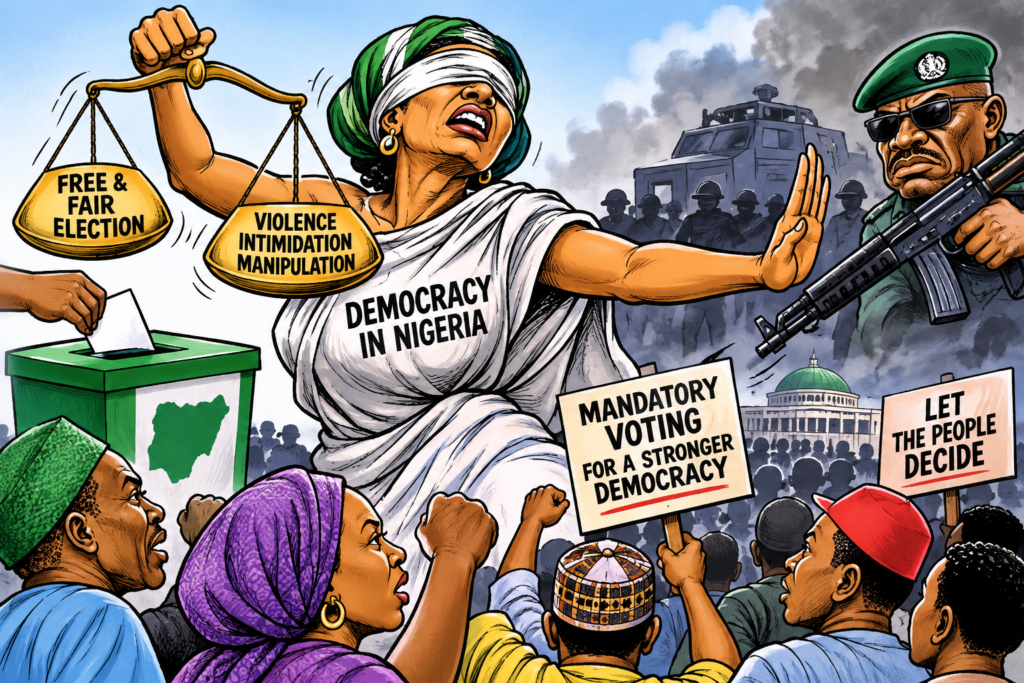
The democratic space in Nigeria has continued to shrink, increasingly constrained by what appears to be a deliberate strategy of weaponising state power against political opposition and dissenting voices. Those entrusted with the responsibility of protecting democracy are increasingly resorting to force and the deployment of so-called ‘federal might’ as subs00000000000000000000titutes for democratic persuasion, political engagement and the rule of law. This is not merely a troubling development; it is a crisis that threatens the very foundations of our democracy.
As the next general election approaches, cautious pessimism has become the prevailing sentiment among observers and citizens who fear that the country may be drifting towards an electoral contest defined more by intimidation, violence and institutional manipulation than by the free expression of the people’s will. The growing normalisation of political violence is particularly disturbing. When coercion becomes a political instrument and state institutions are deployed to intimidate opponents, democracy is reduced to an empty ritual.
Free, fair and credible elections cannot exist without strong, independent and impartial democratic institutions. The electoral umpire, security agencies, judiciary and other critical institutions must demonstrate the independence, courage and integrity required to protect the democratic process. Their loyalty must be to the Constitution and the Nigerian people, not to the political interests of those in power.
However, institutional independence alone may not be sufficient if citizens are discouraged, intimidated or prevented from exercising their constitutional rights. There must be a massive mobilisation of voters to ensure optimal participation and strengthen the legitimacy of the electoral process. Nigerians must not only turn out in their numbers to vote; they must also remain vigilant and resolute in defending their votes against manipulation, intimidation and every attempt to subvert their electoral choices.
It is against this background that we support the introduction of mandatory voting as part of a broader redefinition of the social contract between citizens and the state. Voting should be regarded not merely as a political privilege but as a civic responsibility. A system that encourages or requires eligible citizens to participate in elections, with reasonable exemptions, could help address voter apathy, improve turnout and make it more difficult for political actors to manipulate low participation to their advantage. Such a framework must, however, be supported by adequate safeguards to guarantee freedom of choice and protect citizens from coercion.
We also advocate the introduction of early voting arrangements for essential service workers whose professional responsibilities may prevent them from participating on election day. Security personnel, medical practitioners, electricity workers and other critical service providers should not be compelled to choose between fulfilling their professional obligations and exercising their democratic rights. A transparent and properly regulated early voting system would guarantee their participation while ensuring that essential services are not disrupted. It would also contribute to improved voter turnout and a more inclusive electoral process.
These proposals are particularly important in view of the growing concerns over voter suppression, which could assume unprecedented dimensions in the coming elections. From the intimidation of voters and opposition supporters to the possible misuse of security agencies and administrative bottlenecks, every avenue through which citizens could be denied their franchise must be anticipated and decisively addressed. The right to vote is meaningless if citizens cannot exercise it freely, safely and without fear.
Ultimately, democracy cannot defend itself. It requires citizens who are conscious of their rights, institutions that are prepared to uphold the law and political leaders who understand that the mandate to govern comes from the people. The growing institutionalisation of violence must not be allowed to become the defining feature of Nigeria’s political culture.
Defending democracy requires eternal vigilance against the entrenchment of anti-democratic forces. Nigerians must remain engaged, organised and steadfast in protecting the democratic space. No political ambition, no matter how powerful its sponsors, should be allowed to override the sovereign will of the people.