World
‘Loud and clear’ Iran won’t have nukes

Doubts swirled around the US‑Iran interim deal to end the war in the Middle East, although US President Donald Trump said yesterday the accord makes clear that Tehran would never be allowed to develop a nuclear weapon.
“The only thing that really matters to me is Iran will never have a nuclear weapon, and it says it loud and clear,” he told reporters on the sidelines of the G7 summit in France, warning that “all hell will rain down” on Iran if it sought to acquire one.
He added that the text would be made public soon. The interim deal would extend a tenuous ceasefire announced in April by another 60 days and reopen the Strait of Hormuz, which Iran has effectively blocked since the US and Israel attacked Iran in February.
An Iranian deputy foreign minister yesterday said the two-month US naval blockade on Iranian ports had been “lifted ahead of the planned formal signing of the deal”. Three Iranian tankers and two vessels carrying essential goods are currently sailing toward Iranian southern ports from the Indian Ocean, Iranian state TV said.
Speaking at the G7 meetings, Trump also said that he liked the idea of sending the Iran deal to Congress for review, a request by some Republican lawmakers.
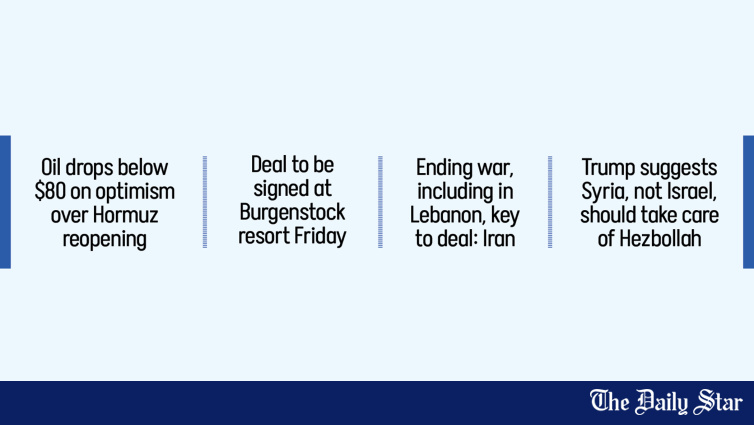
Negotiators would address difficult issues like the future of Iran’s nuclear programme during the next phase of talks, which Iranian Foreign Minister Abbas Araqchi said would start in Switzerland on Friday after the formal signing of the framework deal.
“Likely on Friday… a new round of negotiations between Iran and the United States to reach a final agreement will begin,” Araghchi said. “In the final agreement, decisions will be made on the nuclear issues and the lifting of sanctions.”
Araghchi also said that ending the war on all fronts including Lebanon was “the most important” issue in the peace deal announced with the US. Qatar, a key negotiator in the deal, said it believed the agreement could deliver security to the Middle East, reports Reuters.
“We are cautiously optimistic that the signing of the memorandum of understanding will lead to the next phase of regional security through the talks that will take place on the nuclear programme and on other issues,” foreign ministry spokesman Majed Al Ansari told reporters at a regular press briefing.
The deal will be signed at Switzerland’s mountainside Burgenstock resort on Friday, the Swiss foreign ministry confirmed to AFP. The site, located near Lucerne in central Switzerland, is difficult to access and therefore easily secured. It “was proposed by the Pakistani and Qatari mediators, as well as by the US and Iran”, Switzerland’s foreign ministry said.
Two other issues that Trump and Israeli Prime Minister Benjamin Netanyahu used to justify the war – ending Iran’s support for regional armed proxies and curbing its missile programme – are not thought to be on the agenda for those negotiations.
“Iran wants to get it done,” Trump told reporters about the next phase of negotiations with Iran. “They have to get back to business, and the relationship is now normalised, so I think it’s going to go pretty quickly.” Earlier he described the deal as “a wall to a nuclear weapon” for Iran.
Vice President JD Vance and Iran’s top negotiator Mohammad Baqer Qalibaf are expected to attend Friday’s formal signing.
Oil prices dropped below $80 a barrel yesterday on optimism over the promised reopening of the Strait of Hormuz, easing inflation pressures on global economies even though traders are eyeing the risk of Iranian “service fees” on ships transiting the strait.
Earlier in the day at the G7 summit, Trump appeared critical of Israel’s strategy in Lebanon and also suggested that neighbouring Syria – which under President Ahmed al-Sharaa is struggling to stabilise the country after years of civil war – could be best placed to intervene.
“I suggested to Israel to let Syria take care of Hezbollah because to be honest, I think they do a better job of doing it,” he said.
Lebanon’s president and prime minister yesterday discussed preparations for a new round of talks with Israel next week.
Lebanon and Israel have been holding direct talks in Washington since April, seeking to end hostilities and separate the Israel-Hezbollah conflict from the wider regional war.