World
Likely next British PM: UK must ‘put more pressure’ on the Israeli government

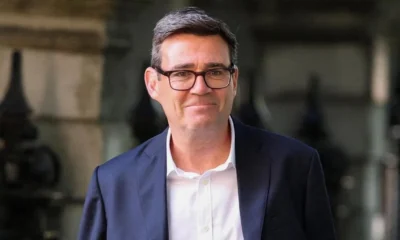
Britain’s likely next prime minister Andy Burnham said London must put more pressure on Israel over its actions in the Gaza war, in a newspaper interview published Thursday.
Burnham told the Guardian that many people thought the government of outgoing leader Keir Starmer “didn’t get it right” in its response to Israel’s war on Hamas in Gaza following the terror group’s October 7 invasion and massacre in southern Israel.
“I am sorry about that. The response has too often not been good enough. We need to do better,” he told the newspaper.
The former mayor of Manchester, Burnham is tipped to succeed Starmer, who announced his resignation on June 22, under a nomination process that got under way on Thursday.
Burnham later posted a video of his remarks in the interview.
Since Starmer took office in July 2024, his Labour government has sanctioned Israeli ministers accused of fueling settler violence in the West Bank, suspended free-trade negotiations with Israel and formally recognized a State of Palestine. But supporters of the Palestinians say he has not gone far enough and a poll indicated some voters have abandoned Labour for the Green Party, whose leader has accused Israel of committing genocide.
Labour’s initial response to the treatment of Gaza caused huge hurt. We got it wrong and I am sorry for that. pic.twitter.com/MtQxhp71J3
— Andy Burnham (@andyburnham) July 9, 2026
“We’ve got to do more to put pressure on the Israeli government,” Burnham said. “Yes, we have taken some important steps… But let’s be honest, the UK was too slow to call for a ceasefire. And we must now do more to strengthen our approach.”
Starmer initially resisted calls from within his party, including from Burnham, who was a regional mayor at the time, to demand a ceasefire, instead backing a humanitarian pause in the fighting. He later called for a ceasefire and has since criticized the Israeli government’s conduct in Gaza.
In the interview, Burnham stopped short of using the word genocide to describe the war in Gaza, but said “there’s increasing evidence that war crimes appear to have been committed… Ultimately, however, it must be for the international courts to determine, rather than politicians.” Israel has strongly denied allegations of genocide and said it took measures to minimize civilian casualties while fighting Hamas, accusing the terror group of embedding itself among the general population.
Burnham said “further sanctions” on Israel should be considered, and that measures should be examined “to ban trade in goods with illegal settlements.”
Amid a rise in violent antisemitic attacks in Britain in recent months, he added: “There is no contradiction between a zero-tolerance approach to antisemitism and holding the Netanyahu government to account. I will always take a fair and balanced approach and stand up for what is right.”
Burnham was on track Thursday to become Britain’s next prime minister with dozens of Labour lawmakers set to formally nominate him to succeed Starmer as party leader.
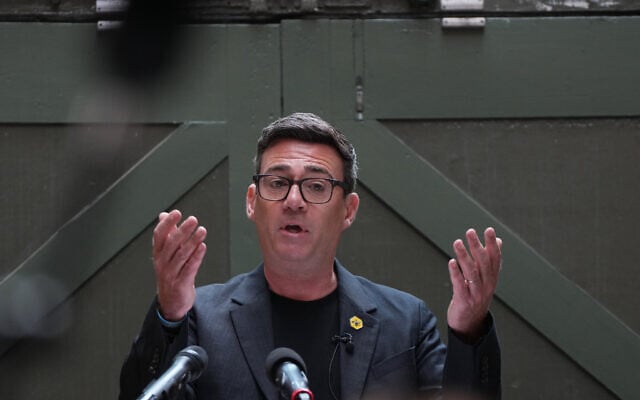
The 56-year-old is the only member of parliament from the UK’s ruling party to publicly declare themselves a candidate to replace Starmer, who announced he was quitting last month.
Burnham appeared on course to be crowned Labour leader unchallenged as the first day of nominations got underway.
If he reaches at least 322 nominations, then it would no longer be mathematically possible for another challenger to get the 81 signatures required to join the race out of the total of 402 Labour MPs.
Nominations close on July 16. In the absence of a contest, Burnham will be crowned Labour leader — and prime minister in waiting — at a special conference the following day.
He would then replace Starmer at 10 Downing Street on July 20 after meeting King Charles III, becoming Britain’s seventh prime minister in a decade.