World
Life of detained Gaza hospital chief/Hamas officer at immediate risk, lawyer says

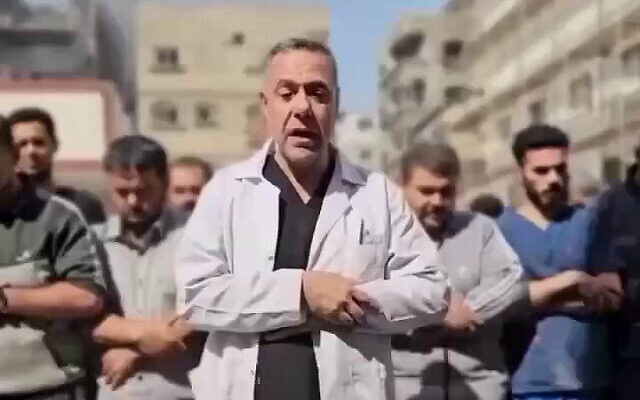
The health of Gaza hospital chief Hussam Abu Safiya, a Hamas officer, has recently deteriorated sharply in Israeli detention, to the point of danger to his life, the Physicians for Human Rights group claimed on Saturday.
The assessment was made after a visit on Thursday by Abu Safiya’s lawyer, Nasser Odeh, to the underground Rakefet interrogation facility in Nitzan Prison, to which the director of Kamal Adwan Hospital was transferred on June 24, the group said in a statement.
It said Odeh claimed in his affidavit that Abu Safiya “bore fresh, severe injuries to his head, around his eyes, and on his ears and neck — to the extent that his lawyer initially struggled to recognize him.”
Abu Safiya “experienced difficulty breathing,” appeared “extremely weak, struggled to sit upright without falling, and on several occasions seemed on the verge of losing consciousness,” and seemed “frightened” and “reluctant to speak freely due to fear of being targeted,” the attorney wrote.
“Based on these direct observations, Attorney Odeh concluded that Dr. Abu Safiya’s life is in immediate danger,” Physicians for Human Rights said, alleging that since being transferred to Rakefet, “he has been subjected to daily beatings, resulting in several instances of loss of consciousness, but without receiving appropriate medical treatment.”
He was quoted as saying during the meeting with his lawyer: “This is the last time you will see me… They brought me here to kill me. I don’t see myself surviving. This is the end.”
The group called for Abu Safiya’s immediate transfer to a different facility, an urgent visit by authorities to assess his condition, and “an urgent independent medical examination.”
The Israel Prisons Service commented, according to the Haaretz newspaper, that it “operates in accordance with the law and under constant judicial review,” adding: “Every complaint received is examined and treated in accordance with protocol and in accordance with the law.”
Multiple reports have indicated that Palestinian security prisoners have faced systematic abuse in Israeli jails under the orders of far-right National Security Minister Itamar Ben Gvir, who has repeatedly boasted about the harsh conditions he imposes.
Abu Safiya was arrested by Israeli forces during the war against Hamas in Gaza in December 2024 and is one of the most prominent Gazan detainees. He is being held in solitary confinement, and rights groups have called for his release.
He holds the rank of colonel in the Hamas Military Medical Services, according to the service itself and Palestinian media reports. A photograph from 2016 showing him wearing a Hamas uniform and sitting next to senior members of the terror group emerged after his arrest.
Last month, the Supreme Court rejected Abu Safiya’s appeal against his ongoing detention, ruling that he can continue to be held under Israel’s law for unlawful combatants despite criminal charges not having been brought against him. The text of the decision and its reasoning have yet to be released.
Israel currently holds over 1,300 Palestinian detainees under the terms of the law for unlawful combatants, in a practice known as administrative detention.
Such detainees include those arrested by the IDF and security services inside Gaza during military operations but who have not been charged with a crime.
The measure sees individuals held without charge for up to six months at a time, under limited court review. The detentions can be renewed indefinitely while allowing military prosecutors to keep suspects from being able to see the evidence against them.
The tool is typically used when authorities have intelligence tying a suspect to a crime but do not wish to reveal the source of the information.
Jeremy Sharon contributed to this report.