World
At site where Iran’s slain leader lies, some see a symbol of his failures

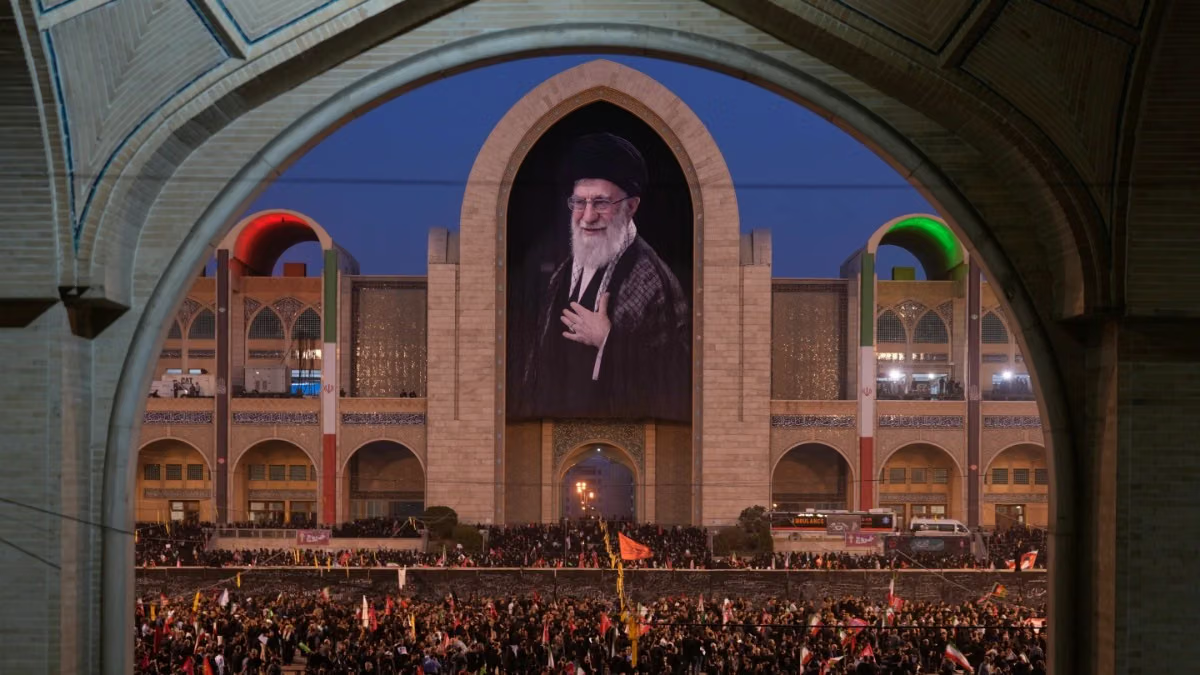
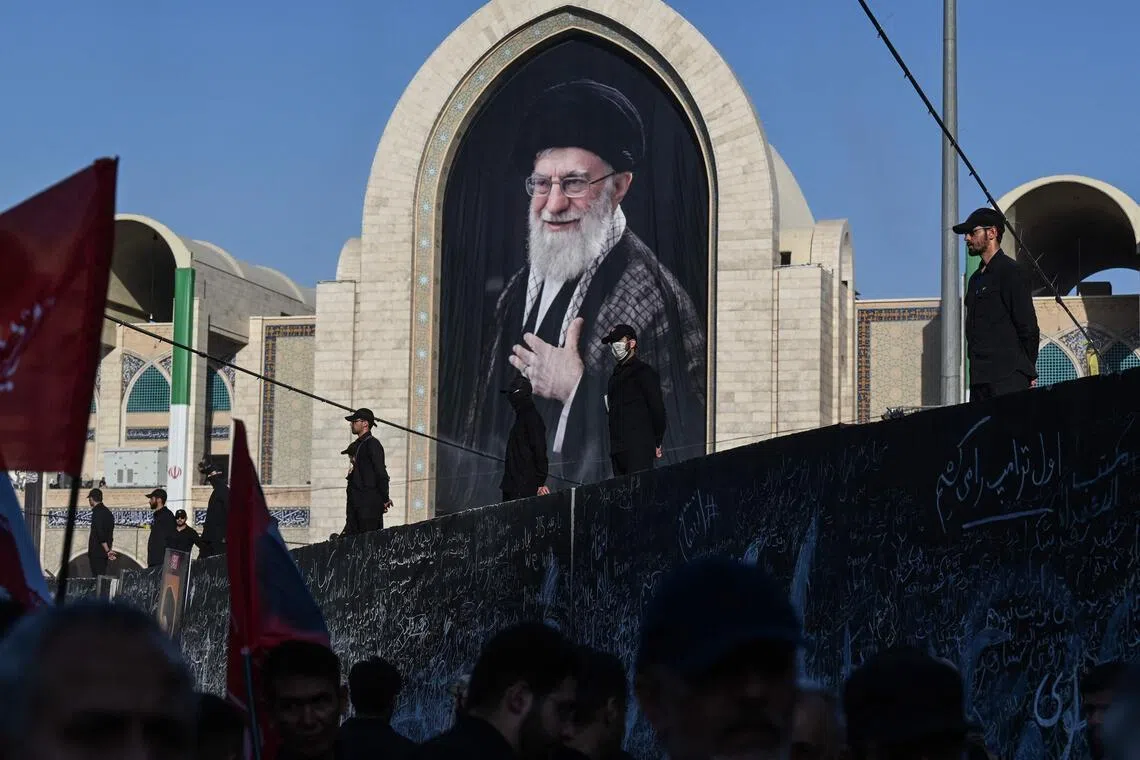
TEHRAN – The masses of mourners who came to bid a final farewell to Iran’s former supreme leader, Ayatollah Ali Khamenei, this past weekend in Tehran did so at a mosque and prayer complex with unfinished minarets, cracked and missing tiles, and a crumbling parking lot.
Nearly 40 years after planning and construction for the complex, the Grand Mosalla, began in earnest, it is still incomplete, and has even become shabby, with parts of it in obvious need of repair.
The status of the site is in stark contrast with how Iran’s government was hoping to present itself during Khamenei’s weeklong funeral services – as a strong, capable state that has endured through the US-Israeli war.
Instead, the saga of the Mosalla, a sprawling megaproject in the works for almost as long as the Islamic Republic of Iran has existed, symbolizes, to the slain supreme leader’s critics, the unfulfilled promises of the state he ruled. Despite its obvious problems, for the state the site was an appropriate place for a send-off to Khamenei, who gave important addresses there, as it had enough space to accommodate the large crowds expected for his funeral services.
The idea for the Mosalla was proposed shortly after the 1979 revolution, which ushered in the system of clerical rule. It was meant to be a new, larger site for important weekly prayers delivered by prominent clerics in the capital.
In 1988, Khamenei, who was Iran’s president then, co-wrote a letter to Ayatollah Khomeini, the founder of the Islamic government and its first supreme leader, asking him to dedicate almost 11 million square feet of land in north-central Tehran to the Mosalla project. Khomeini approved, but warned that the mosque should be simple, without the “glamour” of American mosques. The letters were published on Khamenei’s official website.
ُُThe government chose a design by architect Parviz Moayed Ahd that was inspired by Persian-Islamic traditions. He died in 2016 without seeing his project come to fruition.
Construction began in the mid-1990s, and over time the project took shape. It now boasts a 236-foot-tall portico, a 207-foot-tall dome, 443-foot-tall minarets, and a courtyard that can accommodate around 65,000 people.
As public mourning began at the Mosalla this past weekend, its two minarets were still not fully completed, with exposed metal rods protruding from them as though construction had been halted midway. The minarets also showed uneven patches of white paint, underscoring the sense of incompletion.
Near the mosque’s large green dome, a tower crane hung over the structure, a reminder of ongoing construction amid the scale of the gathering.
Inside, the conditions remained similarly unfinished. In one of the Mosalla’s parking lots, where journalists gathered, the asphalt surface had deteriorated into dust and gravel. A long staircase leading into the grounds – where crowds prayed and paid respects – was broken and worn in places.
Tiles were cracked or missing altogether. There was scaffolding throughout many parts of the complex. Security personnel, visibly exhausted from managing the crowds and the heat, were seen sleeping beneath staircases on thin, makeshift mattresses.
Publicly announced deadlines for completion of construction came and went over the years, and the building work continued. By 2011, nearly US$1 billion (S$1.3 billion) had been spent on the Mosalla, and project managers announced another US$2 billion would be required to finish it within five years, the independent Financial Tribune newspaper in Iran reported in 2017.
The contract for the Mosalla’s construction was eventually given to an arm of Iran’s Revolutionary Guard, the ideological military force that expanded its economic reach and political power during Khamenei’s reign.
Economists and experts on Iranian business say the Revolutionary Guard has taken control of much of the private sector by using its connections and military power to intimidate and hobble competitors.
Over the years, officials have pointed the finger at other government agencies for the delays in completing the building work.
In 2015, at what he said was Khamenei’s urging, then mayor of Tehran, Mohammad Bagher Qalibaf, announced that the municipality would take charge of the project. In a statement in response to Qalibaf reported by Iranian state media, the Mosalla complex blamed the municipality for delays. Qalibaf is now the speaker of Iran’s parliament and Iran’s lead negotiator in peace talks with the United States.
Even in its unfinished state, the complex has played host to major events, including cultural exhibitions. But never has this much global attention been focused on it as this past weekend.
As the government engaged in a mad dash in recent days to prepare for the influx of visitors, an emergency management official in Tehran said the authorities had identified 235 safety problems at the complex.
For some watching the official mourning ceremonies, the complex’s state was an apt metaphor for Khamenei’s failures.
“No matter what they do, they cannot remove those two half-finished and asymmetrical minarets from the frame,” Mahdieh Golroo, an Iranian journalist and activist who lives in Sweden, wrote on social media. “A symbol of the inefficiency and corruption of the era of Khamenei.”
This article originally appeared in The New York Times.