World
Israel-Lebanon talks said close to yielding lasting ceasefire deal

Israel and Lebanon are nearing a US-mediated lasting ceasefire agreement, a report said Tuesday, as Israel and American officials insisted that the US-Iran deal signed Sunday does not mandate an IDF withdrawal from the areas of southern Lebanon it currently controls.
Significant progress has been made in recent talks between Jerusalem and Beirut in Washington, Channel 12 news reported.
According to the report, details of the agreement are being finalized, and the Lebanese Armed Forces have begun deploying on the ground as part of the emerging deal.
The framework is also expected to allow residents of southern Lebanon who evacuated amid Israeli strikes on the Hezbollah terror group to return to their homes, the network said.
The talks, which Israel has said are ultimately aimed at securing a full peace deal while Lebanon has said they are only focused on de-escalation, have faced an uphill battle since the Iran-backed Hezbollah has vowed not to recognize or abide by any deal they yield, raising the prospect of a renewed civil war.
Meanwhile, US Ambassador to Israel Mike Huckabee reiterated Tuesday that Hezbollah is not included in the deal between the US and Iran, as Tehran continued to insist that Israel was required to halt its offensive in Lebanon under the terms of the agreement. Multiple leaks Tuesday night of the deal’s terms, including its purported full text, appeared to indicate it includes a full halt to hostilities in Lebanon.
But in response to Hezbollah claiming that the terror group received assurances from Iran that there will be no nuclear deal without Israel’s withdrawal from Lebanon, Huckabee said that US Secretary of State Marco Rubio “made clear” that the two issues aren’t connected.
“Israel doesn’t need Iran permission to defend itself,” he wrote on X. “The tether of terror must end.”
Israeli Ambassador to the US Yechiel Leiter voiced a similar sentiment.
“We’re not going to withdraw from south Lebanon, and the madmen of Tehran have no business poking their nose into this,” Leiter told NPR, asserting that it was “crystal clear” that any deal with Tehran “has nothing to do with our withdrawal from south Lebanon.”
But on Tuesday evening, Iran’s Top Joint Military Command, Khatam al-Anbiya Central Headquarters, threatened Israel with a strong response from the Iranian armed forces if it did not stop its attacks in southern Lebanon.
Israeli troops are currently stationed deep within southern Lebanon, and the Israeli military has struck targets throughout the country, ever since Hezbollah attacked Israel on March 2 in support of Tehran.
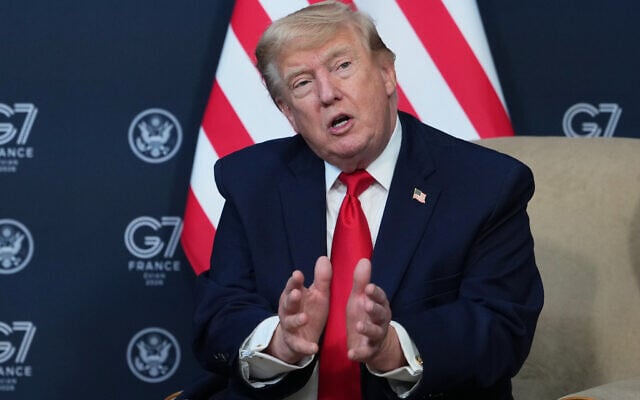
US President Donald Trump said Tuesday that Syria should take over from Israel in the fight against Hezbollah, arguing that the Jewish state’s war on the Iran-backed terror group has been too prolonged and indiscriminate.
“Israel is fighting Hezbollah too long and too many people are being killed,” he said. “I’m not happy with the way Israel has handled themselves with Lebanon and with Hezbollah. They should have been able to do the job faster. It just goes on forever.”
“I suggested to Israel to let Syria take care of Hezbollah,” Trump added. “Because to be honest with you, I think they’d do a better job of doing it.”
Those remarks were reportedly met with pushback from both Israeli and Syrian officials, with the Ynet news site quoting an unnamed Israeli official saying they sounded like “virtual reality,” and the Kan public broadcaster quoting a senior Syrian official as saying Damascus is unwilling to intervene for fear of alienating Arab states, especially without an Israeli pullout from a buffer zone held by the IDF in Syrian territory.
Meanwhile, some hostilities continued Tuesday, with the IDF saying it intercepted several rockets launched by Hezbollah at troops in southern Lebanon in the morning.
A short while later, the Israeli Air Force struck and destroyed the launcher, the IDF said.
Additionally, the IDF said it spotted a suspicious vehicle in an area of southern Lebanon where troops were operating. The soldiers fired warning shots, and a strike was later carried out “to remove the threat,” the army said.
צה”ל תקף את המשגר ממנו נורו רקטות לעבר כוחותינו בדרום לבנון
מוקדם יותר היום, חיל האוויר יירט מספר רקטות ששוגרו על ידי ארגון הטרור חיזבאללה לעבר המרחב בו פועלים כוחות צה”ל בדרום לבנון. על פי מדיניות, לא הופעלו התרעות.
תוך זמן קצר, חיל האוויר תקף והשמיד את המשגר ממנו נורו חלק… pic.twitter.com/6haA3LkRzV
— צבא ההגנה לישראל (@idfonline) June 16, 2026
Lebanese media reported four dead in Israeli airstrikes near Nabatieh in southern Lebanon.
Initially, a car was targeted in a drone strike in Mayfadoun, before a second strike hit the area after locals gathered there, Lebanon’s National News Agency reported.
NNA said a third strike hit another car in the town, and a fourth strike hit a car in the adjacent town of Shoukine.
There was no immediate comment from the IDF.
A senior US official told reporters on Monday that the memorandum of understanding signed a day earlier with Iran is not conditioned on Israel withdrawing from Lebanon. However, the deal still envisions a ceasefire that covers Lebanon, as well as Iran, the US official said in a briefing with reporters.
According to a Monday report in Channel 13 news, Prime Minister Benjamin Netanyahu recently held a tense phone call with US Vice President JD Vance in which the latter asked for Israel to scale back the IDF’s presence in Lebanon, but Netanyahu refused.
“The IDF won’t withdraw, but from now on, every action will be scrutinized,” a source was quoted by the network as saying.
Holding a press conference Monday evening, Netanyahu said Israeli troops would remain in the buffer zone in southern Lebanon “for as long as necessary.”
Defense Minister Israel Katz said earlier in the day that Israel would not withdraw from southern Lebanon “despite all the existing pressures and those that will yet come.”