World
Israel and Lebanon ink framework deal for minor IDF withdrawal, after 4 days of DC talks

Israel, Lebanon and the US reached an agreement Friday that will see the Israel Defense Forces begin to withdraw from small parts of southern Lebanon, amid the ongoing fighting between the Jewish state and the Iran-backed Hezbollah terror group.
The framework deal was reached on the fourth day of the fifth round of talks that the US has mediated between Israel and Lebanon in Washington, beginning in April. The latest round of fighting in the country kicked off when Hezbollah attacked Israel on March 2, in support of Iran, with several truces declared since then quickly unraveling.
The areas to be withdrawn from have already been cleared by the IDF of Hezbollah infrastructure. In some cases, this has included Israel razing entire Lebanese villages to the ground on the border, with the IDF arguing that Hezbollah was using much of them to plan and carry out attacks against Israel.
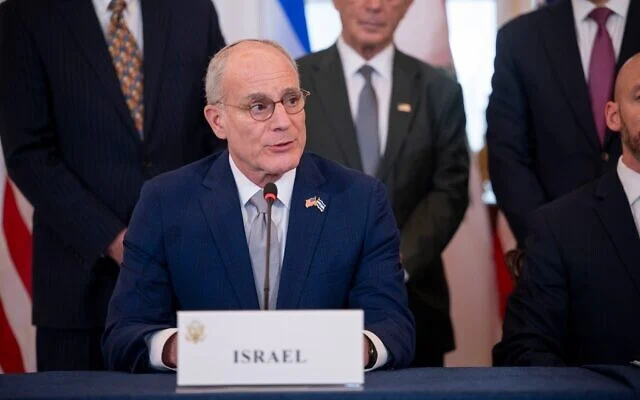
Israeli Ambassador to the US Yechiel Leither said Israel will maintain its buffer zone in southern Lebanon until the Lebanese Armed Forces demonstrate that they can dismantle Hezbollah and assume responsibility for security.
Leiter stressed that the deal will not be based on a fixed timetable, but on measurable progress by the Lebanese army in disarming Hezbollah.
Additional “pilot” handovers from the IDF to the LAF will take place as benchmarks are met, he said.
Asked whether Gulf states, France, Italy or other international partners will be used to help secure southern Lebanon, Leiter said it was too early to discuss that idea.
He said other countries could take part in Lebanon’s reconstruction but only after Hezbollah has been disarmed.
Rubio: Framework is ‘beginning of the beginning’
US Secretary of State Marco Rubio, in a statement declaring the creation of a “trilateral Military Coordination Group for Lebanon (MCG4L), facilitated by the United States” that will implement the agreement, also announced an “immediate” $100 million donation by the US toward humanitarian assistance in coordination with the UN.
He also said the US Defense Department was “prepared to reimburse the Lebanese Armed Forces with more than $30 million under existing authorities and appropriations to support the president’s vision for an enduring peace in Lebanon.”
At the signing ceremony at the State Department in Washington, Rubio appeared to acknowledge the limited scope of the agreement, calling it, “The beginning of the beginning.”
“There’s a lot of work ahead. We don’t in any way underestimate the difficulty of the task ahead, but we understand the importance of it, how vital it is, and we are honored to have played a part in bringing this together,” he said, before going on to praise the Israeli and Lebanese ambassadors to the US, who headed their countries’ respective negotiating teams.
Lebanese Ambassador Nada Hamadeh called the “trilateral framework…the first step on the road to restoring Lebanese sovereignty and territorial integrity, securing a permanent and final cessation of hostilities, enabling our people to go back to their land and allowing all Lebanese to live in peace, security and prosperity.”
“This was a long and difficult meeting. We are grateful to the host and to the two delegations for their cooperation during these talks,” she added, in an apparent nod to Israel.
‘Lioness’: Israel’s Leiter praises Lebanese diplomat
Israeli Ambassador to the US Yechiel Leiter gave longer remarks, but made a point of thanking Hamadeh by name “for being a very tough negotiator,” telling her: “You and your team set an example for patriotism to your country. You fight like a lioness, madam ambassador.”
Leiter recalled that he began talks on Tuesday warning of an impending “trainwreck,” after the US decided to include a ceasefire in Lebanon as part of the memorandum of understanding it reached last week with Iran.
The decision appeared to undercut Washington’s own efforts to prevent Iran from maintaining an influence over developments in Lebanon. The US had established the direct talks between Israel and Lebanon in April, specifically in order to ensure that Iran would not be involved in future discussions about Israel’s continued presence in Lebanon.
But either because of Iran’s significant leverage in the Strait of Hormuz or because Washington believed that Iran was needed to rein in Hezbollah, the US agreed to Tehran’s demands that the memorandum of understanding inked last week include a ceasefire in Lebanon and then agreed to allow Iran to be part of the deconfliction mechanism that was established to ensure that ceasefire — both moves infuriating Jerusalem and Beirut.
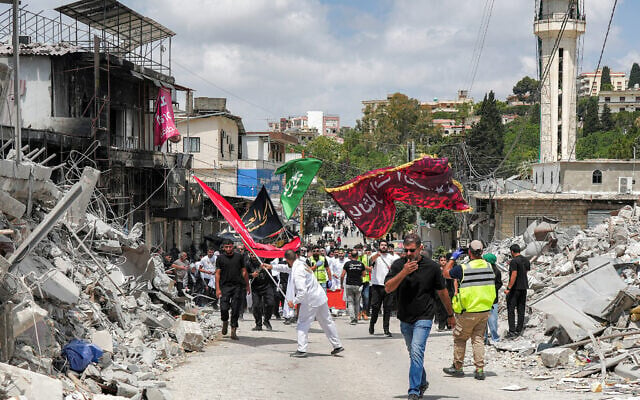
“Iran and its proxies wanted a trainwreck,” Leiter said at the signing ceremony, before arguing that such a result was prevented thanks to Rubio’s leadership. Rubio has not been a part of the talks with Iran, which have been led by US Vice President JD Vance.
“We’ve put the train back on the tracks, and it’s running in the right direction. Final destination: peace between our two countries,” Leiter said. “In this performance-based, trilateral framework agreement, Iran is out, Hezbollah is out, and the road to peace between Israel and Lebanon is in.”
He went on to maintain the agreement would not have been possible without the resilience of Israel’s northern residents, the IDF and Prime Minister Benjamin Netanyahu’s government.
Netanyahu: We’ll maintain buffer as long as needed
Netanyahu issued a video statement shortly after the agreement was announced, touting the framework and stressing it will allow Israel to remain in the buffer zone it created in southern Lebanon.
“We will maintain (the buffer zone) until Hezbollah disarms and as long as there is a threat to the State of Israel,” Netanyahu said.
“This is also a major blow to Iran. Iran is trying to coax us to withdraw from southern Lebanon by force. And in essence, Israel, Lebanon and the United States are telling Iran – it is none of your business. You have no role in Lebanon. Neither you, nor Hezbollah nor any terrorist organization,” he continued.
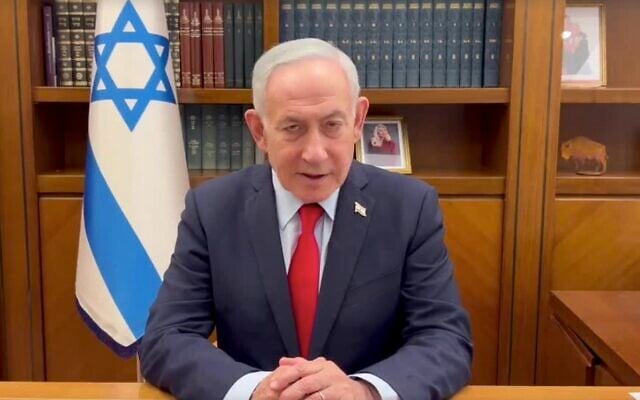
“We are also allowing the Lebanese army to start preparing to seize territory. We are creating two pilot zones — both recommended by the IDF.”
“One is south of the Litani River and outside the (original) security zone altogether and and the other is north of the Litani — a small area in the expanded security zone that we conquered in the last two weeks, and which the IDF says it does not need,” Netanyahu claimed.
“We are maintaining the original security zone, which covers the range of (Hezbollah) anti-tank missiles. We are not allowing Hezbollah, nor the Lebanese population to enter that area. The most important thing is that Israel says: ‘Our security comes first,’” the prime minister said.
His office issued a separate statement on the framework, explaining that it paved the way for future agreements between Israel and Lebanon.
“The IDF’s freedom of military action will be maintained throughout the security zone to eliminate threats of any kind,” the prime minister’s office said.
Withdrawal is from areas that are beyond buffer zone
Explaining just how minor the planned IDF withdrawal from south Lebanon will be, an Israeli official said troops will only be pulling back from two areas that are located beyond the original borders of the buffer zone that was established in April.
In the two-plus months that followed, the IDF pushed further north, adding additional territory to the buffer zone. It is from two of those areas that Israel has agreed to withdraw in today’s agreement with Lebanon; they do not include the Beaufort Castle, which Israel recaptured in May.
That lookout point was seen as a symbol of Israel’s previous military occupation in south Lebanon, which lasted for 18 years until the government withdrew troops in 2000, deciding they were not significantly enhancing the security of residents of the north even while suffering regular casualties.

Israel, in this week’s talks, insisted on maintaining the original borders of the buffer zone, arguing it needs that amount of territory within Lebanon to ensure northern border towns are not within the range of Hezbollah missiles.
It appears unlikely, though, that such a limited withdrawal will satisfy Iran or its Hezbollah proxy, who argue that Israel is violating the memorandum of understanding signed last week, which required a permanent end to military operations in Lebanon.
Both Israel and Lebanon came into what was the fifth round of negotiations furious at the US for the latter’s decision to sign the MOU, a source told The Times of Israel.
The US conduct led Israel to initially harden its position in talks with Lebanon this week, significantly limiting the areas from southern Lebanon from which it said it was prepared to withdraw, the source said.
Lebanon, meanwhile, felt that it had to take a harder line in negotiations with Israel to counter the notion that Iran wields greater influence over affairs in Lebanese territory than it does.
Accordingly, Lebanese negotiators presented maps for a proposed IDF withdrawal that were more expansive than what Israel was willing to accept at this stage, which was already very little due to the political pressures Netanyahu’s government is facing, according to the source.
Hezbollah MP: Lebanon can’t enforce agreement
Hezbollah itself is not a party to the agreement.
Lawmaker Hassan Fadlallah, a representative of the terrorist group’s political wing, said Lebanese authorities would not be able to enforce the framework agreement unless, with US support, “they go to civil war,” Al Mayadeen reported.
Fadlallah said Hezbollah would confront any measure taken by Lebanese authorities and would hold on to its weapons even more, adding that the group’s opposition is “serious” and would not allow authorities to implement their commitments on the ground.
Reuters contributed to this report.