World
Iran deal averted economic disaster

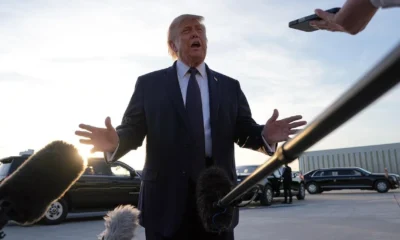
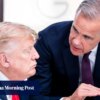
US President Donald Trump yesterday defended his interim agreement with Iran, saying it had averted a global economic catastrophe, while warning he could launch fresh attacks if Tehran failed to honour its commitments.
Speaking at the close of a G7 summit in France, Trump also said maritime traffic in the Strait of Hormuz had risen sharply since the truce was announced three days ago and expressed hope it could mark the start of a wider peace across the Middle East.
“We’re going to bomb the hell out of them [Iran] if they violate the agreement. I don’t want them to. I want them to honour the agreement,” Trump told a press conference, adding that the Iranians were “smart people”.
He later said he expected the accord with Iran to end the Middle East war “maybe signed
tomorrow (Thursday), maybe the next day (Friday)”.
“We are going to most likely sign a deal,” he added.
The war, which began with US and Israeli strikes on Iran on February 28 and spiraled into a broader regional conflict, has driven up energy prices, renewed inflationary pressures and sparked concerns about a major food supply crisis in developing countries.
“So the one thing I didn’t want to see is, I didn’t want to see economic catastrophe. If you kept this going, that could have happened,” Trump said. He thanked Chinese President Xi Jinping and Russian President Vladimir Putin for being “neutral” during the conflict, saying they had not thwarted his efforts to curb Tehran’s nuclear ambitions.
Oil prices fell again on Wednesday on prospects for the reopening of the Strait of Hormuz, with Brent crude futuresLCOc1 below $80, at their lowest level since the opening salvos of the US-Iran conflict.
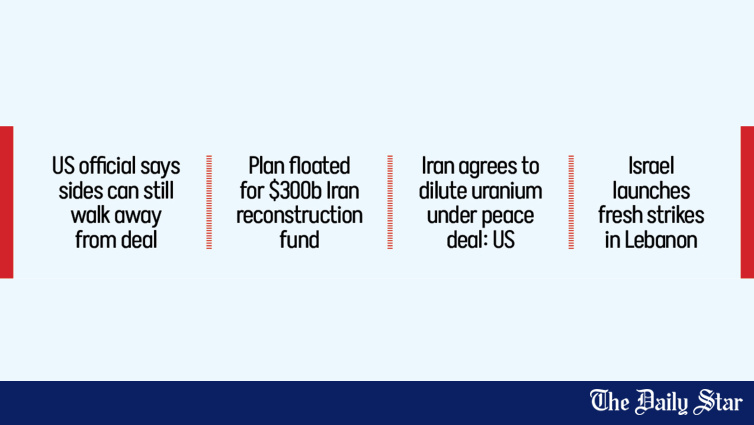
Speaking to reporters, a senior US official read out the text of the signed memorandum of understanding with Tehran but said the parties could still walk away until a binding deal is reached.
The 14-point draft, which had already circulated widely before its contents were published, extends a ceasefire announced in April by another 60 days to allow the two sides to negotiate a permanent truce.
The memorandum includes an immediate end to the war on all fronts, including Lebanon, the full resumption of maritime traffic in the Strait of Hormuz, the lifting of a US blockade of Iranian ports, the waiving of international sanctions on Iran, and a plan worth $300 billion for the economic rehabilitation of the Islamic Republic.
The text says that Washington “undertakes with regional partners to develop a definitive mutually agreed plan with at least $300 billion for the reconstruction and economic development of the Islamic Republic of Iran.”
The mechanism for that would also be part of the 60-day talks.
Iran also undertakes not to build nuclear weapons, reaffirming a vow it had made for decades. Senior US administration officials said Iran has agreed to dilute its enriched uranium stocks under the interim deal.
Despite his typically combative rhetoric, Trump appears to have achieved little of what he said he wanted at the outset of the war.
Iran’s theocratic government remains in place, its stockpile of highly enriched uranium has not been surrendered, its ballistic missile capabilities have not been destroyed and it has not ended its support for anti-Israel militias like Hezbollah in Lebanon.
However, G7 leaders hailed the agreement at their summit. They also demanded an immediate ceasefire in Lebanon.
Lebanese state media reported fresh Israeli air strikes and artillery fire in several southern towns throughout yesterday. Lebanese security sources said Hezbollah had also launched two drone attacks on Israeli forces in the south. The group did not publicly claim the attacks.