World
How Ankara rewired Syria’s future

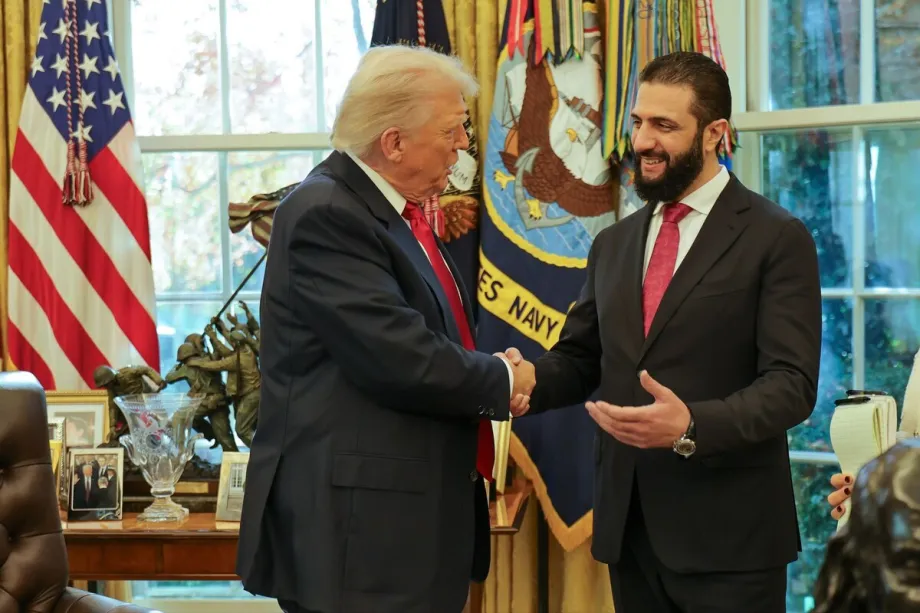
The Trump–al‑Sharaa summit in Ankara was not diplomacy. It was a structural detonation—one that has dragged Syria out of humanitarian paralysis and into a NATO‑designed reconstruction matrix where sanctions relief, refugee repatriation, militia demobilisation, Gulf capital and digitised property courts fuse into a single Western‑Turkish governance engine. Ankara has become the Middle East’s new diplomatic capital.
The Levant’s future is no longer negotiated in Brussels, Washington or Damascus.
It is being co‑authored in Ankara’s corridors—where the West, Turkey and Syria are assembling a post‑Assad order that is part security pact, part reconstruction consortium and part epistemic trusteeship.
The numbers alone demand attention. More than 90 per cent of Syrians now live below the poverty line. The World Bank estimates reconstruction will cost US$216 billion—nearly ten times Syria’s projected GDP. Infrastructure accounts for US$82 billion of that total, residential housing US$75 billion. Yet the UN’s 2026 appeals remain barely 20 per cent funded. This is not a recovery. This is a society on life support.
The American president described al‑Sharaa as “tough” but effective: “He’s done an amazing job in a year and a half; he’s pulled the whole country together”.
This was not a handshake. It was a handover. Consider what the Ankara framework actually delivers. Sanctions relief—already accelerated by the repeal of the Caesar Act—now flows through a phased “sanctions‑for‑security” timeline. Refugee returns, involving over 1.4 million Syrians who have come back from Turkey since 2017, are being organised under a structured quota system prioritising cities with active reconstruction programmes.
Militia demobilisation is proceeding under joint Turkish‑Syrian monitoring. Gulf capital—led by Saudi Arabia and Qatar with investment packages worth US$11.7 billion and US$11 billion respectively—is flowing into Damascus real estate, Aleppo airports and a 4,500‑kilometre fibre‑optic backbone.
This is governance by consortium. And it represents a fundamental break with the Westphalian order. Historically, sovereignty was binary: a state either possessed it or it did not. The Ankara summit introduces something else: epistemic statehood—a condition where sovereignty is validated not through the monopoly on legitimate violence but through the production and submission to external knowledge regimes.
The property courts rely on digitised registries rebuilt with Western technical assistance. Refugee returns are governed by a joint Turkish‑Syrian committee that pre‑screens claims against databases maintained by UNHCR and Turkish ministries. Civil society funding flows through compliance‑checked banking channels overseen by the Central Bank of Syria but shaped by EU and US anti‑terror financing regulations. SIGINT and drone surveillance integrate Syrian security apparatus into NATO‑standard intelligence protocols.
The state becomes a platform for multi‑stakeholder governance. Sovereignty is distributed across nodes in Ankara, Brussels and Washington.
When those demands conflict—on curbing Islamist elements versus respecting a pluralistic mandate—the epistemic architecture can force the state to prioritise external validation over internal legitimacy.
Charm offensives cannot erase ideological realities. Syria risks becoming trapped in permanent limbo—neither fully sovereign nor truly free.
READ: Syria makes major achievement with US sanctions lift, support from Turkiye, Gulf nations: President
Turkey’s role in this transformation cannot be overstated. Ankara has evolved from a sometimes troublesome NATO flank into the alliance’s primary gateway for Middle Eastern stabilisation, refugee governance and sanctions diplomacy. No other NATO ally can broker deals between the West and an Islamist‑rooted Syrian government. Turkey’s own political culture—a blend of Sunni nationalism, Ottoman nostalgia and selective Westernisation—provides a discursive bridge between incompatible worldviews.