World
Hezbollah fires multiple rockets and drones at north as IDF expands south Lebanon op

Hezbollah fired several rockets and drones at Israel on Saturday afternoon, as the Israeli military said it was preparing for a likely increase in attacks by the terror group due to the army’s expanded operations in southern Lebanon.
According to the Israel Defense Forces, two rockets were fired by Hezbollah from Lebanon at the Safed area, with one intercepted and the other striking an open area. Another rocket fired at the Upper Galilee was intercepted by air defenses, the military said. Additionally, some rockets launched at the Western Galilee were intercepted, while others struck open areas.
Meanwhile, Hezbollah also launched several drones, with one striking a military zone near the border community of Shomera, while two others were intercepted, the military said.
Another apparent drone did not cross the border, the IDF stated.
No injuries were caused in the attacks on Saturday afternoon.
The continued attacks on Saturday came after local residents described a long night with repeated siren warnings and explosions and expressed frustration with the government for failing to end the threat from the Iran-backed Lebanese terror group.
The IDF said on Saturday it was prepared for the possibility of increased Hezbollah rocket fire on northern Israel as troops push deeper into southern Lebanon, but that at this stage, there were no changes to the Home Front Command’s guidelines for civilians.
“Following the expansion of IDF operations in southern Lebanon, and in accordance with the situational assessment, the IDF is preparing for the possibility of fire from Lebanese territory, focused on the northern region,” the military said in a statement.
Netanyahu confirmed Friday that troops of the IDF’s 36th Division had crossed Lebanon’s Litani River, beyond the military’s defensive line, amid Hezbollah’s ongoing attacks.
The defense line, which the IDF announced last month, demarcates the military’s declared security zone in southern Lebanon. The line lies mostly south of the Litani, which runs about 30 kilometers (20 miles) from the Israeli border and has long been Israel’s benchmark in the bid to push Hezbollah northward.
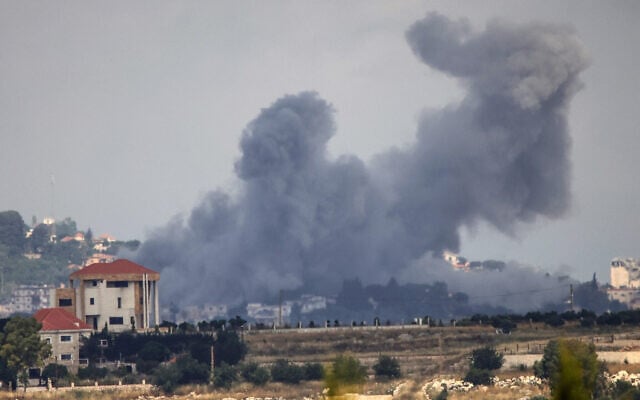
Separately, the IDF said Saturday it struck a manned Hezbollah artillery command center in southern Lebanon a day earlier.
Following Friday’s strike in the Burj al-Shamali area, “secondary explosions were identified, indicating the presence of weapons inside the structure,” the military said.
The IDF said it struck the site after identifying Hezbollah operatives in the area.
צפו בתיעוד: צה”ל השמיד מפקדת ארטילריה מאוישת של ארגון הטרור חיזבאללה
אתמול, צה”ל תקף והשמיד מפקדת ארטילריה של ארגון הטרור חיזבאללה במרחב א-שמעאלי שבדרום לבנון.
לאחר התקיפה, זוהו פיצוצי משנה המעידים על הימצאות של אמצעי לחימה בתוך המבנה.
המפקדה הותקפה לאחר שזוהה כי מחבלי… pic.twitter.com/bw2XxtgFoU
— צבא ההגנה לישראל (@idfonline) May 30, 2026
Lebanon’s state-run National News Agency reported Israeli airstrikes and artillery shelling near the Crusader-built Beaufort Castle, which is located about 15 kilometers (9 miles) from the Israeli border and overlooks wide parts of southern Lebanon. The strategic castle was held by Israeli troops for 18 years until they withdrew from Lebanon in May 2000.
NNA also reported airstrikes on different parts of southern Lebanon, including in the village of Ansar, that killed three people. A drone strike on a road linking the village of Ebba with Nabatieh wounded two Lebanese soldiers, the Lebanese army said in a statement.
Meanwhile, Lebanese officials cited in Arabic media expressed disappointment in Friday’s US-brokered security talks with Israel at the Pentagon.
Officials cited by London-based outlet Al-Araby Al-Jadeed on Saturday said: “The meeting at the Pentagon achieved no progress, particularly with regard to a comprehensive ceasefire.”
A Lebanese military source cited by Saudi outlet Al-Hadath said the meeting “did not yield practical results as desired by Lebanon.”
Pentagon second-in-command Elbridge Colby had hailed the talks on Friday as “productive military-to-military discussions which will inform the Department of State-led political track next week.”
It was the first strictly military meeting in the US-brokered negotiations since the sides agreed to split the talks into diplomatic and security tracks. Accordingly, Israeli Ambassador to the US Yechiel Leiter did not attend the talks on Friday, an embassy official said.
The first meeting of the diplomatic track will be held on Tuesday and Wednesday next week at the US State Department.
Friday’s meeting had not been expected to lead to any major announcements, and the sides still face an uphill battle to reach a deal that would normalize Israeli-Lebanese relations and disarm Hezbollah, the embassy official said.
The Lebanese government demands that the deal ensure an IDF withdrawal from Lebanon, while the Iran-backed terror group is adamantly opposed to disarmament and has slammed the government for engaging with Israel on the issue.
Israeli and Lebanese negotiators previously held three rounds of talks at the State Department starting last month. The first round was followed days later by US President Donald Trump’s announcement of a ceasefire in Lebanon on April 16, eight days into the ceasefire in Iran.
That truce has not been felt in southern Lebanon, though, where Israel carries out daily strikes against what it says are Hezbollah operatives and infrastructure, and the Iran-backed terror group targets Israeli troops that have established an increasingly large buffer zone, which Jerusalem claims is for protecting its northern communities from enemy fire. It has also regularly attacked northern Israel with rockets and drones.
While the US has okayed Israeli strikes in Lebanon against targets that Jerusalem deems a threat, it has reportedly drawn a line on strikes in Beirut.