Latest
FIFA defend controversial red card in Argentina World Cup clash against Switzerland despite its lawmakers confirming decision was wrong

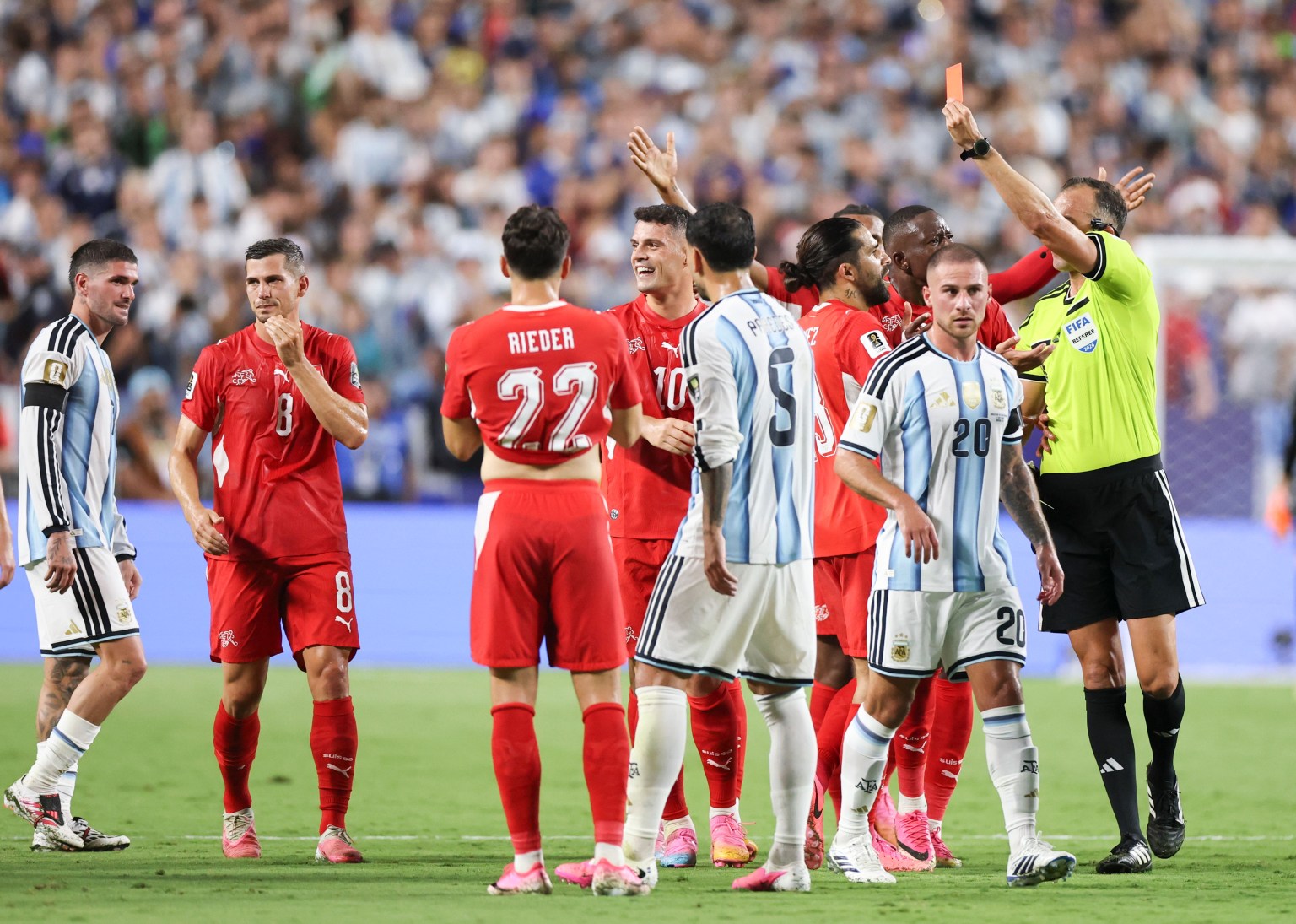
FIFA has defended the controversial decision to send off Switzerland striker Breel Embolo during his side’s 3-1 FIFA World Cup quarter-final defeat to Argentina, despite the International Football Association Board (IFAB) later stating that the dismissal resulted from an incorrect application of the VAR protocol.
The incident occurred after Embolo appeared to win a free-kick on the edge of the penalty area following a challenge from Argentina midfielder Leandro Paredes. However, Video Assistant Referee (VAR) officials advised referee João Pinheiro to conduct an on-field review under the “mistaken identity” provision. After reviewing the footage, Pinheiro overturned the free-kick decision and issued Embolo a second yellow card for simulation, reducing Switzerland to 10 men.
IFAB has since clarified that the “mistaken identity” protocol applies only when there is uncertainty over the identity of the player who committed an offence and should not be used to review the incident itself. Under the Laws of the Game, the intervention should not have led to a reassessment of whether Embolo had simulated, meaning the original free-kick should have remained and the Swiss forward should not have been sent off.

Despite IFAB’s clarification, FIFA insisted the referee’s decision was correctly applied under its interpretation of the protocol used during the tournament. In a statement, FIFA said its interpretation of the “mistaken identity” rule had been applied consistently throughout the World Cup.
“There were two instances in which a player was mistakenly identified as having committed a yellow card offence and the VAR advised the referee to correct the factual error caused by the opponent’s simulation,” the governing body said.
“The simulation itself cannot be disputed and it should not result in a disciplinary sanction against an opponent that may then lead to further consequences, such as a sending off for a second yellow card or a match suspension for accumulated cautions.
“We do not consider this to have been a referee or VAR error and the decision restored justice.” FIFA acknowledged IFAB’s subsequent comments but maintained that discussions between the two bodies had supported its interpretation.
“We note IFAB’s comments in its Circular. We have been in contact with them throughout and they confirmed that this interpretation is valid, that it was well received and that it will form part of the discussion on revisions to the VAR Protocol, as discussed at the last AGM,” FIFA said.
The Embolo incident was one of several contentious refereeing decisions involving Argentina during the tournament. Switzerland defender Manuel Akanji criticised the officiating after the match, describing it as “one-sided” and claiming that “every dive and every foul by the Argentinians went unpunished.”
Egypt also questioned officiating decisions following its 3-2 defeat to Argentina, arguing that a goal by Mostafa Zico was incorrectly ruled out for a foul in the build-up, while Mohamed Salah was denied a penalty before Enzo Fernández scored the winning goal.
Earlier in the tournament, Argentina captain Lionel Messi also escaped a red card after stepping on Algeria defender Aïssa Mandi during their group-stage encounter, prompting further debate over officiating standards at the competition.
The disagreement between FIFA and IFAB over Embolo’s dismissal has renewed scrutiny of the application of VAR and may influence future discussions on amendments to the protocol governing video reviews.