Topnews
FG Moves To Scrap 270 Oil And Gas Taxes To Attract Investors

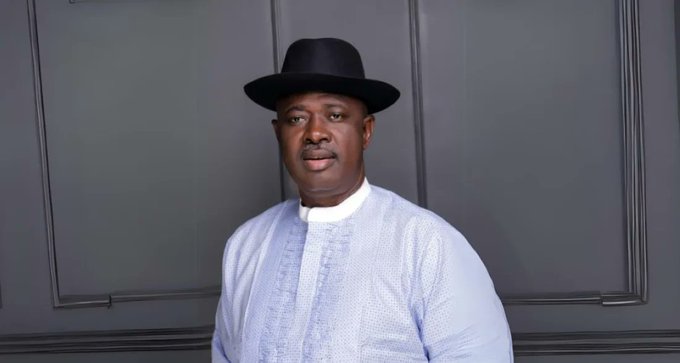
(Senator Heineken Lokpobiri. Photo by Leadership News)
The federal government has assured investors that it will soon put an end to the long-standing problem of more than 270 taxes, levies and regulatory charges weighing down Nigeria’s oil and gas industry, insisting that the country remains committed to becoming globally competitive.
The Minister of State for Petroleum Resources (Oil), Senator Heineken Lokpobiri, gave this assurance while declaring open the 2026 Nigeria Oil and Gas Energy Week on Tuesday in Abuja.
He disclosed that the federal government had engaged PricewaterhouseCoopers, working alongside the Nigerian Upstream Petroleum Regulatory Commission, to benchmark Nigeria’s fiscal charges against those of rival oil-producing nations.
He said the exercise forms part of the Tinubu administration’s broader push to make Nigeria’s petroleum sector more competitive and draw in fresh investment.
Lokpobiri noted that operators currently grapple with about 270 different taxes, fees and regulatory charges, many of which yield little revenue on their own but create considerable administrative bottlenecks.
He explained that while some of these charges amount to mere cents, the sheer number forces companies to process hundreds of invoices, and suggested that consolidating them would be a more sensible approach, expressing confidence that the forthcoming report would resolve the issue permanently.
He added that the initiative is part of wider reforms aimed at improving the ease of doing business, noting that the government has continued to respond to concerns raised by stakeholders within the industry.
Earlier at the event, the chairman of the Independent Petroleum Producers Group, Adegbite Falade, described Nigeria’s oil and gas sector as one of the most heavily taxed anywhere in the world, burdened by more than 270 taxes, fees and levies.
He warned that the accumulated weight of these multiple charges was eroding the incentives established under the Petroleum Industry Act and undermining Nigeria’s competitiveness.
Falade said the situation posed a direct threat to smaller producers and operators managing mature assets with slimmer profit margins, warning that it could lead to reduced investment and the abandonment of assets.
He urged the government to harmonise charges across regulatory agencies, remove duplication, and build a transparent and predictable fiscal system capable of supporting investment, boosting production and creating jobs.
He also called for a thorough review of the Petroleum Industry Act to tackle implementation challenges and incorporate presidential directives that have already improved the investment climate.
Also speaking at the event, the Minister of State for Petroleum Resources (Gas), Ekperikpe Ekpo, declared that Nigeria is open for business, stating that ongoing reforms, fiscal incentives and strategic infrastructure projects are positioning the country as a globally competitive destination for gas investment.
He said the government’s message to the global investment community was unified and firm: that Nigeria has built a stable, competitive and highly predictable investment environment.
He said the federal government was working to transform Nigeria from a nation with vast gas reserves into one that actively uses gas to drive industrialisation, energy security and economic growth.
Ekpo noted that Nigeria’s 215 trillion cubic feet of proven gas reserves, the largest in Africa, would support domestic industries, fertiliser and petrochemical plants, transportation, and clean cooking initiatives under the Decade of Gas programme.
He pointed to ongoing projects such as the Ajaokuta-Kaduna-Kano and OB3 gas pipelines, along with new gas processing facilities designed to expand domestic supply, cut down gas flaring and boost the availability of liquefied petroleum gas.
The minister also reaffirmed the government’s commitment to growing Nigeria’s liquefied natural gas export capacity through the NLNG Train 7 project, which is expected to raise production from 22 million to 30 million tonnes per annum once completed.
He added that the government was speeding up the National Clean Cooking Programme, which targets five million households by 2030, alongside the Presidential Compressed Natural Gas Initiative aimed at lowering transportation costs and expanding domestic gas use.
Reinforcing the reform agenda, the Special Adviser to the President on Energy, Olu Verheijen, said Nigeria was now competing for investment based on the strength of its policy credibility rather than merely the size of its hydrocarbon reserves, stressing that the competition today is no longer geology against geology, but government against government, rules against rules, and delivery against delivery.
Verheijen disclosed that reforms introduced by the Tinubu administration had already attracted more than $10 billion in Final Investment Decisions, with projects worth over $50 billion currently in the pipeline.
She added that Nigeria’s crude oil and condensate production had risen by more than 400,000 barrels per day, while external reserves had crossed $50 billion, noting that investors now prioritise bankable projects offering predictable returns.
Meanwhile, Lokpobiri reaffirmed his support for the Nigerian National Petroleum Company Limited’s renewed push to rehabilitate the country’s refineries.
He recalled that NNPC Ltd had recently signed a Memorandum of Understanding with two Chinese firms, Sanjiang Chemical Company Limited and Xinganchen (Fuzhou) Industrial Park Operation and Management Co. Ltd, for a possible technical equity partnership to support the completion and operation of the Port Harcourt and Warri refineries.