
World
External audit finds PA no longer rewarding security prisoners — diplomats

RAMALLAH, West Bank — Preliminary results from an external audit have determined that the Palestinian Authority’s reform of its welfare program is being properly implemented to ensure recipients are no longer being awarded based on whether their relative carried out an attack against Israel, two Western diplomats briefed on the audit told The Times of Israel.
The Alvarez and Marsal (A&M) global consulting firm has been carrying out an audit of the PA’s welfare program for much of the past year, as Ramallah seeks to prove that its properly implementing a reform announced by President Mahmoud Abbas in February 2025.
The announcement came after years of US pressure to scrap a program that rewarded the families of prisoners based on the length of one’s sentence, in addition to the families of those wounded or killed while carrying out attacks against Israelis. Critics dubbed the policy “pay-to-slay” and say it incentivized terrorism.
But while US President Donald Trump’s administration initially welcomed Abbas’s decree canceling all legislation enshrining the old welfare policy, it has since raised questions over whether the reform has actually been implemented.
In late April, the State Department publicly informed Congress that the PA has not halted payments to the families of prisoners based on the length of their sentence, despite announcing otherwise.
The State Department report appeared to rely exclusively on information from the Israeli government and NGOs highly antagonistic to the PA, with definitive evidence of the reform’s roll-back not included.
Internal documents from the PA obtained last year by The Times of Israel indicated the reform was in fact implemented and that the welfare program moved to a strictly needs-based system in which recipients were only eligible based on their socioeconomic status, as opposed to their involvement in the conflict against Israel.
Seeking to back up its position on such a controversial issue, the PA commissioned A&M to carry out an external audit, hoping such a review would put to bed questions about the reform’s legitimacy. Ramallah is in an uphill battle after the April State Department report and Abbas’s decision in November to fire his finance minister, who was fingered as responsible for continued payments to security prisoners in accordance with the old criteria — an ouster that was first revealed by The Times of Israel.
The A&M audit is supposed to conclude at the end of June, though the firm has provided several preliminary reports to the PA updating it on the findings thus far, the two Western diplomats said.
The diplomats said the latest review found that the new system does not condition payments on whether a family member has served time in prison or was deemed by the PA to be a “martyr” — a casualty of the conflict in some manner. Instead, the audit has found that payments are made strictly based on recipients meeting criteria based on their financial situation.

One of the diplomats clarified the audit did identify some smaller issues that could violate the reform, though A&M did not deem them systemic and the PA has assured stakeholders that it is working to address the abnormalities.
“We’ll wait until we get the final audit, but initial findings are encouraging,” the diplomat said.
“And it means more coming from an independent firm, as opposed to Israeli or Palestinian officials.”
An Israeli official briefed on the audit was less convinced, insisting that A&M has no way of reviewing all possible methods by which the families of prisoners and slain attackers can receive compensation from the PA.

“If the Tamkeen is not paying terrorists, there are other bodies tied to the PA that will be tasked with paying them,” the Israeli official said, referring to the Palestinian organization rebranded in February 2025 to take charge of the needs-based welfare payments.
Pressed for evidence, the Israeli official pointed to what he said was intelligence from the Shin Bet security service, which is classified.
For its part, the PA declined to comment on the audit, with a Palestinian official saying Ramallah is contractually barred from discussing its contents before they are finalized.
A&M did not respond to requests for comment.

PA tries to reset the narrative
With final results of the audit still weeks away and as Israel officials in the meantime highlight the State Department report, the head of Tamkeen — former PA social development minister Ahmad Majdalani — held a briefing for foreign press in Ramallah last week to try and shift the narrative.
He presented attendees with figures that purported to show 1,638 Palestinians who were rejected from the new welfare program for failing to meet the necessary criteria, while 6,359 were approved.
“We have faced some technical and procedural problems and issues that have been dealt with in a timely manner,” Majdalani said, appearing to acknowledge the issues that the Western diplomat said were identified in the A&M audit.
However, he stressed the PA is serious about implementing the reform and pointed to the protest taking place outside the prime minister’s office consisting of relatives of prisoners who are upset over the loss of stipends.
Majdalani noted a Ramallah court ruling against the reform, while insisting that it was not binding and that the PA has already filed an appeal in any case.
The head of Tamkeen also referenced statements made by various Palestinian officials that would suggest payments to prisoners will continue, which Israeli officials have cited to argue the PA reform is not genuine.
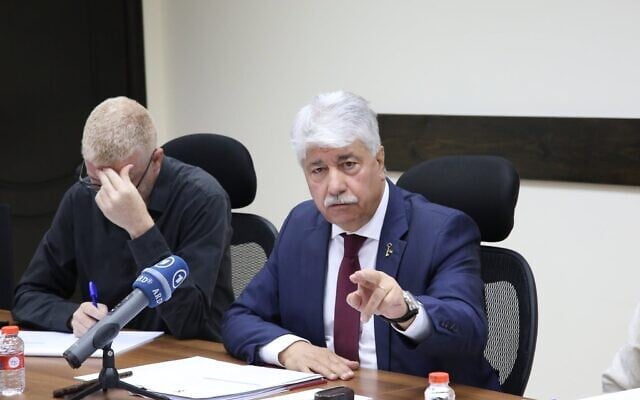
Majdalani said no officials may make politically-motivated statements, but none of them are qualified to speak about the issue other than those heading Tamkeen.
Moreover, he stressed the success of the reform will require both a political horizon for Palestinians, international support as well as the release of the billions of dollars in PA funds that are currently withheld by Israel.
Israel has used the prisoner payments to justify withholding a portion of the PA’s tax revenues in the past but for over a year, Finance Minister Bezalel Smotrich has refused to transfer any portion of the funds that Jerusalem collects on Ramallah’s behalf, as part of the Oslo Accords.
The policy has prevented the PA from paying public employees and pushed it toward potential collapse.