World
‘Digging Deep’ for legacies, author finds missing Jewish soccer players killed in Holocaust

LONDON — David Bolchover immediately issues a challenge upon sitting down for this interview: Ask a group of Jews to name great Jewish soccer players.
“They’ll laugh at you,” says the British writer and lifelong Manchester United fan. “Even if they’re huge football fans with a deep knowledge of modern Jewish history, they think football is not a Jewish forte.”
There may be a complete dearth of Jewish players in the 2026 World Cup, which is being held in North America through July 19, but that was not always the case, says Bolchover, 59.
In his new book, “Digging Deep,” Bolchover sets the record straight on the many Jews who contributed to the so-called beautiful game before they were murdered in the Holocaust.
The book follows Bolchover’s “The Greatest Comeback,” in which he told the remarkable story of Béla Guttmann, a Hungarian Holocaust survivor who started his career on the pitch before the war and later became a hugely successful coach and manager. The critically acclaimed 2017 title was shortlisted for the William Hill Sports Book of the Year and translated into several languages.
Now, Bolchover is razor-focused on resurrecting the memory of 11 Jewish soccer professionals who have long been forgotten. Determined to pay tribute to the group he describes as his “team,” he brings their heartbreaking stories to life in his new, meticulously researched book.
The Times of Israel spoke with Bolchover in a video call from his home in north London. He discussed what inspired him to embark on this dark detective journey, what he uncovered along the way, whether he can envisage a revival of Jewish soccer — and who he thinks will emerge victorious in the World Cup.
The Times of Israel: What led to your discovery of this forgotten world of Jewish football?
David Bolchover: I had always believed, like many Jews, that Jews were not great football players or coaches. That was until I read an article, years ago, about Béla Guttmann, who was a great Jewish football coach. He won the European Cup as a coach in 1961 and in 1962 with his team Benfica.
Everything I went on to read about him glossed over his Holocaust years and said that he went to neutral Switzerland, and that’s how he survived. I wrote to the Swiss authorities, and they said, “There was nobody called Béla Guttmann who came to our country.” I subsequently discovered he was actually a Holocaust survivor — that he’d escaped from a slave labor camp, that he was in hiding, that his family was murdered. I thought, “This is a great story and I’m going to write about it.” Europe wanted to murder him and murdered his father and sister. And then, a few years later, he won the premier sporting competition in Europe.
When I was writing that book, I discovered a whole world of Jewish football coaches and great Jewish footballers that had been buried with the ashes of European Jewry.
I get the impression that Holocaust memorialization focuses on survivors. I think the reason is twofold. Firstly, because the dead can’t speak, it’s easier to research survivors. The second reason is, I think, because people find the story of survivors more comforting. They offer more hope, particularly when survivors like Béla Guttmann were saved by non-Jews.
But I think while we recognize the heroism, we’ve got to be brutally honest about its rarity. Béla Guttmann’s story was about the exception — the exception of survival, the exception of a non-Jewish hero. This book is about the rule.
How did you choose which athletes to write about?
To qualify for my team, you must have represented a country in international football. I selected 11 men based on their respective footballing greatness and how much their stories grabbed me. I also wanted a balanced team (goalkeeper, defenders, midfielders, forwards) and a blend of different types of Jews. Some were religious, one had converted to Christianity, another had converted their children to Christianity, one was a socialist, one was a Zionist, several fought for their countries in World War I. They were different, too, as people — from staunch family men and patriots to wayward playboys. No matter, they all got murdered anyway, and often not by German Nazis, but by their former neighbors and supposed compatriots.
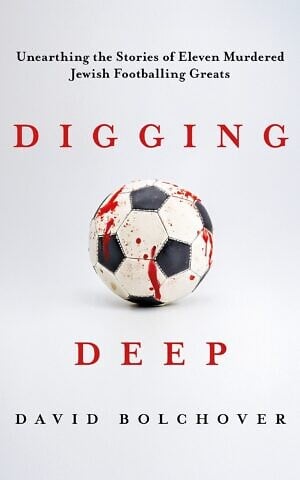
My players hail from Central Europe, but their talent made them mobile, and they often ended up far away from their birthplaces. Their stories take the reader throughout Europe, from Norway to Italy, from France to Latvia. As such, “Digging Deep” recounts the story of Jewish Europe and its destruction through the vehicle of the magnificent game of football, the most talked-about pastime in the world.
How did you go about your research? There are some pretty detailed accounts of matches from a century or so ago, but you have really brought them to life.
When I started out, all I had for the most part was a couple of paragraphs from foreign language Wikipedia sites. Most of the details on these pages, it later turned out, were completely false.
I have spent an unhealthy amount of time plowing through Polish, Hungarian and German match reports and player profiles from the interwar period to get a deep understanding of what type of players they were.
I also gathered a large amount of biographical information on each player, putting in requests with local authorities throughout Europe for birth certificates, evidence of marriage and children, etc. I contacted and made friends with any of the few surviving family members who could provide further information.
Getting genealogical information was hugely challenging and frustrating, as so many records were destroyed. The players’ eventual murder was sometimes even more difficult to establish. If they were sent from Western Europe to be gassed, there were records of transports. In Eastern Europe, they were shot into ditches with no records made. I sifted through any post-war testimonies that I could find to arrive at the most probable scenarios.
How long did it take you to write, and was there a lot of travel involved?
It took me six years to write this book — it’s been an obsession. Obviously, I couldn’t get to some places like Ukraine, but I tried to go to all the places where they were brought up.
There were a lot of triumphs, a lot of great feelings of satisfaction along the way, but there were a lot of frustrations where I couldn’t find out certain things. Unfortunately, some remain frustrations, like the daughter of Jozef Klotz, who scored the first ever goal for Poland in international football in 1922. I’ve got a photo of her on my computer. Nobody knows her name, nobody knows what happened to her or her mother. I’m very keen to find that out, not least because Klotz’s nephew Danny Dekel, who lives in Israel, helped me a great deal. He still doesn’t know his cousin’s name and would very much like to find that out.
Do you have any favorite players among the 11 you include in the book?
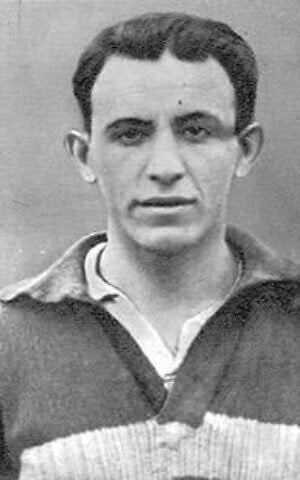
Jozsef Braun was the best Jewish player who ever lived, but it’s a tragic story, made more tragic by the fact that very few fans have ever heard his name. He was a brilliant player. He made his debut for Hungary aged 17, and no younger player has pulled on the Hungary shirt since, so he still holds that record. Every description of him reminded me of Cristiano Ronaldo, so that’s why I called the chapter “The Hebrew Ronaldo.”
However, every football fan will understand when I say that the best player is not necessarily your favorite player, so although I loved Jozsef Braun, I have two absolute favorites. One was Zygmunt Steuermann, who was this larger-than-life playboy character. He was always in trouble, always in debt, but was an unbelievable talent.
Kazimierz Górski, a former coach of the Polish national team, wrote in his memoir that he was told about a game in Janowska, a slave labor camp for Jews in Lviv. He’d heard the Jews played the Ukrainian guards and won three to one, with Steuermann scoring two goals. I love this story about Steuermann’s last act on the football pitch being these two goals against his oppressors. It’s a secondhand story, so we have to question it, but I do want to believe it.
Max Scheuer had not a fraction of the talent that Steuermann or Braun possessed, but he had passion and determination and played for the greatest Zionist football team of all time: Hakoah Vienna. He spent his spare time campaigning for Zionist politicians, raising money for Zionist causes, and wore the blue and white shirt of his team with a huge Star of David on the chest. Remarkably, Hakoah Vienna won the Austrian League. He was their longest-serving player and played more than 600 times for them. I loved him because he was a trier, a fighter, he never gave in, and he made the absolute most of his abilities.
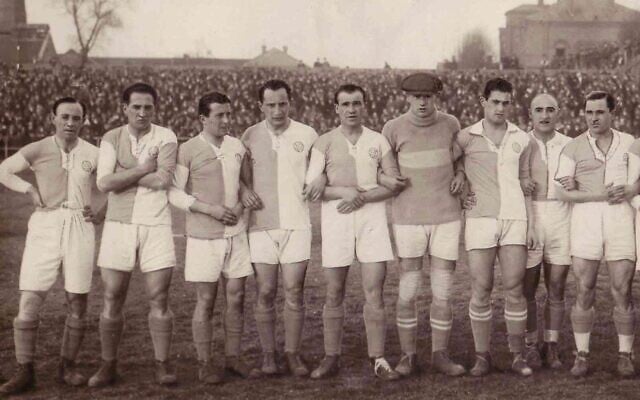
Scheuer got out of Vienna on Kristallnacht and traveled to Marseille. He ended up in a labor camp, but I concluded that he probably escaped from there. According to post-war testimony, he and a friend agreed to try and escape over the border to Switzerland. But apparently his friend turned up with his bride and a large extended family. Scheuer would not abandon his friend, but the party was too conspicuous, so they were caught. They were sent to Drancy, and then from there to Auschwitz-Birkenau, where Scheuer was gassed on arrival.
Do you have to be a soccer fan to read your book?
I wrote this and the last book for non-football fans, so I tried, as much as possible, not to retreat into jargon. A lot of the chapters are about things unrelated to football: the players’ personal lives, their backgrounds. I think that through the prism of football, the most popular sport in the world, these stories offer a different perspective on what happened to these Jews and what happened in the cities where they lived.
Your mission to preserve these players’ memories feels personal at times — did you have family in the Holocaust?
My grandfather’s family was murdered. They lived in Lyubcha in what is now Belarus. But that is not my motivation for writing this book, at least not directly. Ninety-five percent of British Jews are from Europe, and two-thirds of European Jewry was exterminated. We were all affected, some very closely, some more distant; some are knowledgeable about what happened to their families, others not so interested. But we are all the remnants of what once was.

The scale of the destruction — almost total obliteration in many regions — shattered Jewish collective memory. That is why Jews laugh at the idea of great Jewish footballers, for example. My aim is to restore one small part of the collective memory that was wiped out with the Jews of Europe.
Can you envision a revival of Jewish soccer?
People often ask that. We are 0.3% of the population in Britain — we are nothing. We’re very, very small in number, so therefore it’s unlikely that we’re going to produce too many great footballers, although I think there’s going to be two or three breaking through in the next few years, because I hear there’s a lot of young Jewish footballers playing for academies.
In Vienna and in Budapest, which were hotbeds of football in the interwar period, [Jews comprised] 10 or 20% of the population. So the main reason why European Jews and British Jews do not excel in football anymore is because we’re so small in number, and in Europe’s case, because of the Holocaust.
Today, 90% of world Jewry lives in America or Israel. In America, football — or soccer — hasn’t been such a big thing, and I think Israel has underperformed. You could say Israel is disadvantaged by the fact that it was expelled from the Asian Football Confederation in 1974 and therefore has to compete in the European qualification rounds for major tournaments, so the standard is much higher and it’s more difficult to qualify for major tournaments.
Having said that, countries with smaller populations, like Slovenia, Slovakia and Latvia, have appeared in major tournaments. So I’d say Israel’s performance is disappointing. I’d like to see an analysis of why that is the case.
Given the reception Israeli soccer players have received in some countries, is soccer still a beautiful game?
Whenever it’s the World Cup, you always get commentators and journalists saying, “What a carnival atmosphere.” You see pictures of fans from very different cultures dancing, laughing and drinking together, wearing national costumes and waving their flags.
One abiding image of this World Cup for me is of a fan carrying a sole Israeli flag in a stadium in Los Angeles and having it confiscated — arguably, they said, to protect him. There were several fans carrying Palestinian flags who didn’t have those confiscated.
All this carnival atmosphere and brotherhood of nations that they love talking about at the World Cup and the Olympics, what if Israel had qualified? Would it have been welcomed into this family of nations? Would their fun-loving fans have been accepted? Would they have been able to wave their flags in public without fear of violence?
I think Europe and the world engage in a lot of Holocaust memorialization: museums, plaques, Holocaust memorial days. But have they really learned the lessons? I don’t think they have.
Who do you think will win the World Cup?
I think France will take some beating, but anything can happen in a knockout tournament. Over a league season, the best team finishes at the top, but in a cup competition, the best team doesn’t automatically win. France is the best team, but looking at the history of the World Cup, the best team hasn’t always won. I’d like to see a rank outsider at least get to the semifinals, so it’s just not the same France, Argentina, Brazil.