World
Cori Bush tells fellow US progressives: My reelection would be ‘knockout’ punch to AIPAC

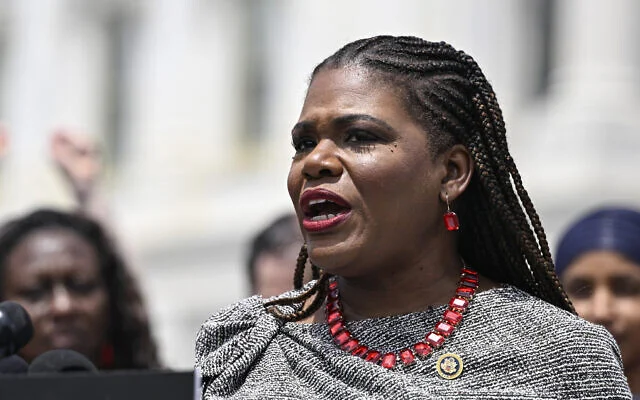
JTA — Cori Bush told fellow US progressives during a virtual rally on Monday night that she intends to deliver a “knockout” punch to AIPAC, the pro-Israel lobby, by winning her congressional primary next month.
When Bush, the two-term progressive Democratic congresswoman, was defeated in a bruising primary two years ago, both she and her adversaries attributed the loss in part to AIPAC.
The group’s PAC spent more than $4 million to defeat Bush, who was one of two members of Congress to vote against a measure to deny entry to the United States to Hamas terrorists who perpetrated the October 7, 2023, onslaught, and declined to call Hamas a terror group on the campaign trail.
Now, as AIPAC has rapidly transformed into a radioactive bogeyman among Democrats and Bush’s fellow progressives have mounted an ascent across the party, Bush is out for revenge.
“Jamaal Bowman says it best: He said that Chris Rabb gave a jab to AIPAC. He says that Darializa and Claire … they gave uppercuts to AIPAC,” Bush said. “But then when I win, that will be the knockout.”
Bush is currently running against Missouri incumbent Rep. Wesley Bell in a field with three other candidates. In 2024, Bell defeated Bush 51.1 percent to 45.6% in a field of four candidates. A February poll sponsored by Bush’s campaign had Bell and Bush tied, with Bush receiving 44% of the votes, while Bell had 40%. (The survey had a margin of error of 5.4%.)
Bush was referring to a list of prominent progressives, including one, Bowman, who, like her, was primaried out of Congress in 2024, and three who won primaries decisively in Pennsylvania and New York this year. She was speaking at an online rally organized by Our Revolution, the group formed by Senator Bernie Sanders to advance the progressive movement.
The rally came as the movement tries to move past a setback in Maine, where Graham Platner, a progressive and staunch critic of Israel, withdrew after winning the Democratic Senate primary amid allegations of sexual assault. One of the candidates vying to replace Platner on the ticket, Troy Jackson, joined other leading progressives, including Michigan Senate candidate Abdul El-Sayed and California congressman Ro Khanna in taking the virtual stage.
Jackson did not mention Israel or AIPAC in his comments, even after announcing in recent days that he believes Israel committed genocide in Gaza. Instead, he listed an array of other issues animating left-wing voters.
“I know that there’s real pain, anger and disappointment, and I’m not going to try and minimize that. But look, this movement has always been bigger than one person,” he said, alluding to Platner’s exit. “It’s about taking on a system rigged against working people, fighting for Medicare for all, strong unions, higher wages, reproductive freedom, and an economy where billionaires and corporations finally pay their fair share.”
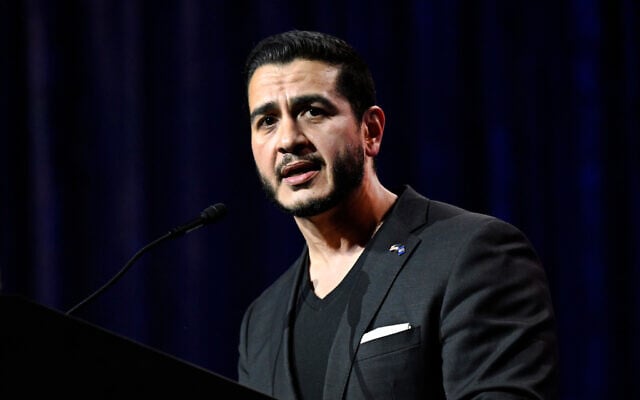
Other candidates took aim more squarely at Israel and its supporters. El-Sayed, who in recent days has taken to calling Israel a “rogue state,” noted that AIPAC and its allies have spent more than $40 million to defeat him. (AIPAC has spent nearly $15 million on the race to date.)
“Donald Trump is not himself the disease in our politics; he’s the worst symptom of the disease of our politics,” El-Sayed said. “The disease is the system that allows big corporations, billionaires, special interest groups like AIPAC, to buy and sell politicians in ways that leave them rigging the system against us.”
El-Sayed also took aim at foreign military aid in his remarks, telling those gathered, “It shouldn’t be this hard to pay your taxes and know that that money is going to be spent on you and your kids rather than to annihilate somebody else and their kids.”
Minnesota congressional candidate Kaela Berg similarly cast her refusal to accept AIPAC money as part of a broader rejection of corporate influence in politics.
“We are the revolution, we are bringing that working class voice, that lived experience, two and a half decades of fighting the bosses, being people in Congress who cannot be bought, being the antidote to corporate Democrats and to Republicans,” Berg said. “I do not take AIPAC money. I do not take corporate money.”
Khanna, fresh off a trip to the Middle East during which he claimed that Israeli soldiers took the side of armed settlers who detained him in the West Bank, used his remarks during the town hall to shift attention from his detention to the treatment of Palestinians.
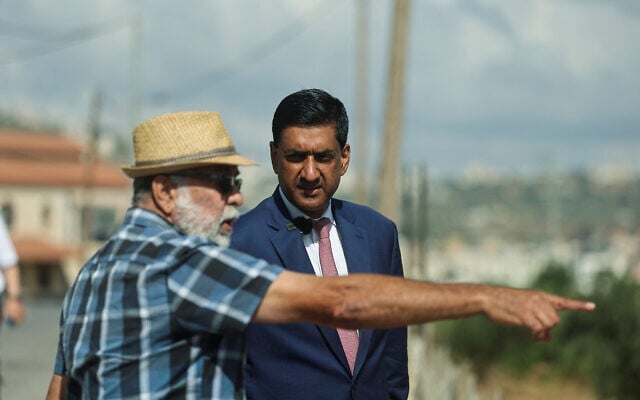
“Yes, people know I was detained, but if there’s one obligation, I feel I want to tell in every part of this country the story of apartheid in the West Bank,” Khanna said. “The story of these Palestinians who are being treated in an inhumane, undignified way, and if we can tell that story, I believe we will finally get change.”
Khanna, who has emerged as one of Israel’s fiercest critics in Congress since October 7, also told attendees that the progressive wins across the country reflected growing support for the movement’s policy positions, including its opposition to Israel.
“We are winning, and we’re winning not because of candidates,” Khanna said. “We’re winning because we stand for Medicare for all. We stand against the genocide. We stand against foreign wars.”