World
‘A train wreck’: As Jerusalem and Beirut hold talks, Israeli envoy pans linkage to US-Iran deal

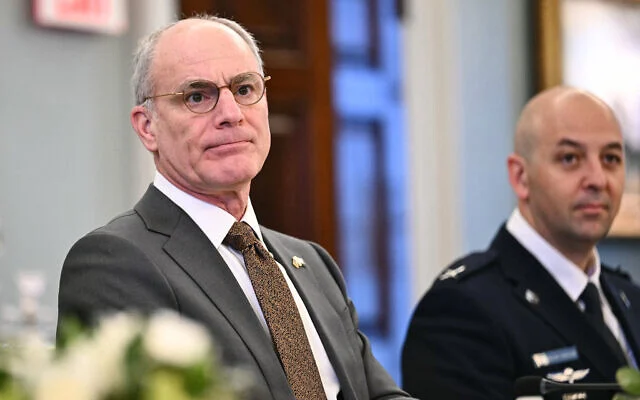
Israeli Ambassador to the United States Yechiel Leiter laid into US President Donald Trump’s administration over its willingness to include the ceasefire in Lebanon as part of a memorandum of understanding Washington inked last week with Tehran, as Beirut and Jerusalem kicked off a fifth round of negotiations at the US State Department in Washington on Tuesday.
The session, the first held after Iran and the US signed their MOU, was set to focus on both political and security issues before splitting off into separate sessions on Wednesday and Thursday, respectively. According to Channel 13, an issue being discussed at Tuesday’s meeting was a planned partial Israeli withdrawal from southern Lebanon.
An unnamed senior official was quoted by the network as saying the IDF “captured territory in recent days for the purpose of negotiations, to then withdraw from them.”
Under a planned pilot program agreed to by Jerusalem and Beirut earlier this month, the IDF would leave certain areas of southern Lebanon and hand them over to the control of the Lebanese army.
Israel and Lebanon were represented at the talks by their respective ambassadors in Washington, while State Department Counselor Dan Holler and Assistant Secretary of Defense for International Security Affairs Dan Zimmerman represented the US.
But Leiter was highly critical of the negotiations under the current context, declaring in a Hebrew statement as the talks began that “we are in a train wreck.”
The talks were set up by the Trump administration specifically to detach Lebanon from the ongoing Iran conflict, as Tehran sought to secure an agreement with the US that also protected its Hezbollah proxy.
The direct Israel-Lebanon channel has been used to negotiate several ceasefires in Lebanon in recent months. But those truces barely held at all, as Beirut has been unable to rein in the terror group, and as Israel’s efforts to disarm it exclusively through military means have failed as well.
And as the US sought an end to the Iran war that was wreaking havoc on the global economy, it found itself accepting Tehran’s demands that a ceasefire between the US and Iran also extend to Lebanon — terms to which Israel says it is not beholden.
In his Hebrew statement, Leiter said that when the direct talks between Israel and Lebanon began, “we all got on the same train.”
“We sat in the same car and traveled to the same destination, with the United States serving as the locomotive. The train was heading in a very clear direction: full peace between the countries, Iran and its malign influence out of Lebanon, the disarmament of Hezbollah, and peace and security for Lebanon and Israel.
“Today, this train is in danger of derailing. I hope we can get it back on track,” Leiter said.
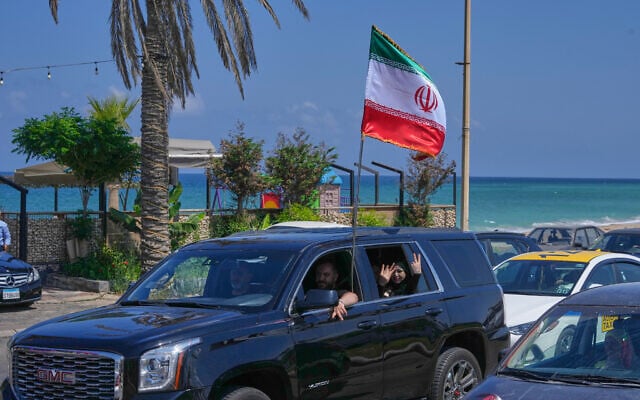
“The basic premise [of these talks] was that Iran was not involved, and the main discussion is about Lebanon and Hezbollah — not about the extent to which Iran can restrain Hezbollah,” the Israeli envoy continued. “That is not Iran’s role. Its role is to get out of Lebanon. The role of the Lebanese government is to exercise its sovereignty. Sovereignty means that Iran will no longer be involved… in Lebanon.”
Leiter said he’ll be seeking “clarity” in today’s talks — ostensibly from the US regarding what its position is on Lebanon.
The apparent disconnect in the US position may have to do with the fact that US Vice President JD Vance leads the talks with Iran, as US Secretary of State Marco Rubio has spearheaded the talks between Israel and Lebanon while largely staying out of the Iran talks.
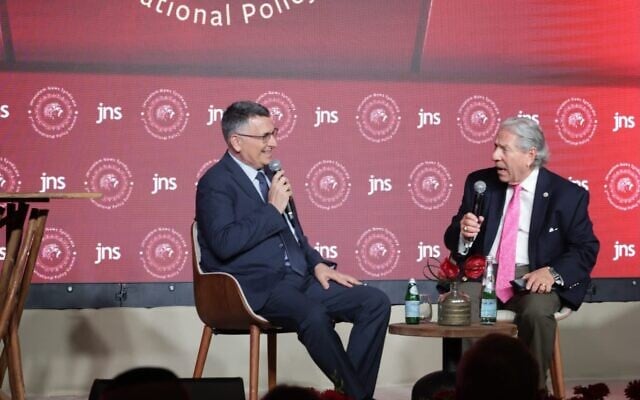
Additionally, Foreign Minister Gideon Sa’ar on Tuesday accused Iran of indirectly occupying Lebanon through its proxy Hezbollah, and defended Israel’s self-proclaimed security zone in southern Lebanon amid increasing concerns in Jerusalem of potential US limitations on its freedom of action there.
“I hear statements in the international community that Israel is breaching Lebanon’s sovereignty [by occupying a security zone]. This is not the truth. Hezbollah is breaching Lebanon’s sovereignty,” Sa’ar said in an interview at the JNS International Policy Summit in Jerusalem.
“Lebanon is under Iranian occupation — indirect by Hezbollah, but under an occupation. On the soil of Lebanon, there is a stronger army than the Lebanese Army, which is Hezbollah. And this is the core problem” with improving Israel-Lebanon ties, he said, adding he hopes talks between Beirut and Jerusalem lead to “a common future” with Lebanon.
Defending Israel’s security zone, Sa’ar said: “I don’t think there is any other country in the world that would accept attacks from neighboring territory on its citizens, and we cannot as well.”
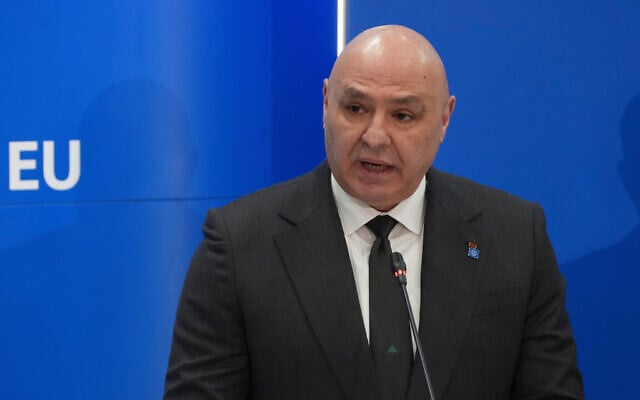
Meanwhile, Lebanese President Joseph Aoun on Tuesday rejected Israel’s presence in south Lebanon and other foreign interference — an allusion to Iran — as the talks began.
“We accept nothing less than an end to the Israeli occupation and at the same time, the fall of foreign tutelage, because our only option is our national sovereignty and our sole wager is on the Lebanese state,” Aoun said, according to his office.
He also expressed hope that the new round of talks will be “decisive along the path of achieving what we seek for the good of our nation and people,” namely, “the full restoration of Lebanon’s sovereignty over every grain of its soil.”
Lebanese authorities have also been eager to keep their negotiations with Israel separate from the wider talks between the US and Iran, as Beirut continues to try to minimize the influence of Hezbollah and, by extension, its Iranian backers.
Also on Tuesday, Hezbollah chief Naim Qassem demanded a full, scheduled withdrawal of Israeli troops from Lebanon to make way for a Lebanese army deployment in the south following the US-Iran deal to end the Middle East war.
“We now have a ceasefire. The withdrawal must take place according to a timetable. Israel has no choice but to fully withdraw from all Lebanese territory, without retaining an inch,” Qassem said in a televised address. “Israel withdraws and the Lebanese army deploys exclusively south of the Litani River.”
Lebanon announced last year that it had completed its deployment in southern Lebanon after disarming Hezbollah in the area as part of a ceasefire deal, but Israel had expressed heavy skepticism toward the claim, and the Iran-backed terror group later continued to attack Israel from the area.
Israel currently controls a security zone in southern Lebanon that stretches across the entire length of the shared border, and extends up to 10 kilometers (six miles) into Lebanese territory, in some areas crossing the Litani River and reaching the outskirts of Nabatieh.
Israeli leaders have vowed to maintain a presence in southern Lebanon, at least until the Hezbollah threat has ended.