Breaking
2027: INEC’s mock poll reveals strength, gaps

• INEC chairman says exercise “very impressive”
• Poor sensitisation results in empty polling units
• Officials absent for hours in Kaduna, late materials in Enugu, Imo
•Voters missing from registers in Nasarawa, Bayelsa
From Fred Itua, Romanus Ugwu, Juliana Taiwo-Obalonye, Abuja; Jude Owuamanam, Jos; Emmanuel Adeyemi, Lokoja; Desmond Mgboh, Kano; Stanley Uzoaru, Owerri; Jude Chinedu, Enugu; Okey Sampson, Umuahia; Obinna Odogwu, Awka; Aniekan Aniekan, Calabar; Scholastica Hir, Makurdi; Noah Ebije, Kaduna; Laide Raheem, Abeokuta; Ighomuaye Lucky, Benin; Ola Muhammad, Birnin Kebbi; Femi Folaranmi, Yenagoa; Tony John, Port Harcourt; Abel Leonard, Lafia; Joe Obukata Ogbodu, Warri;
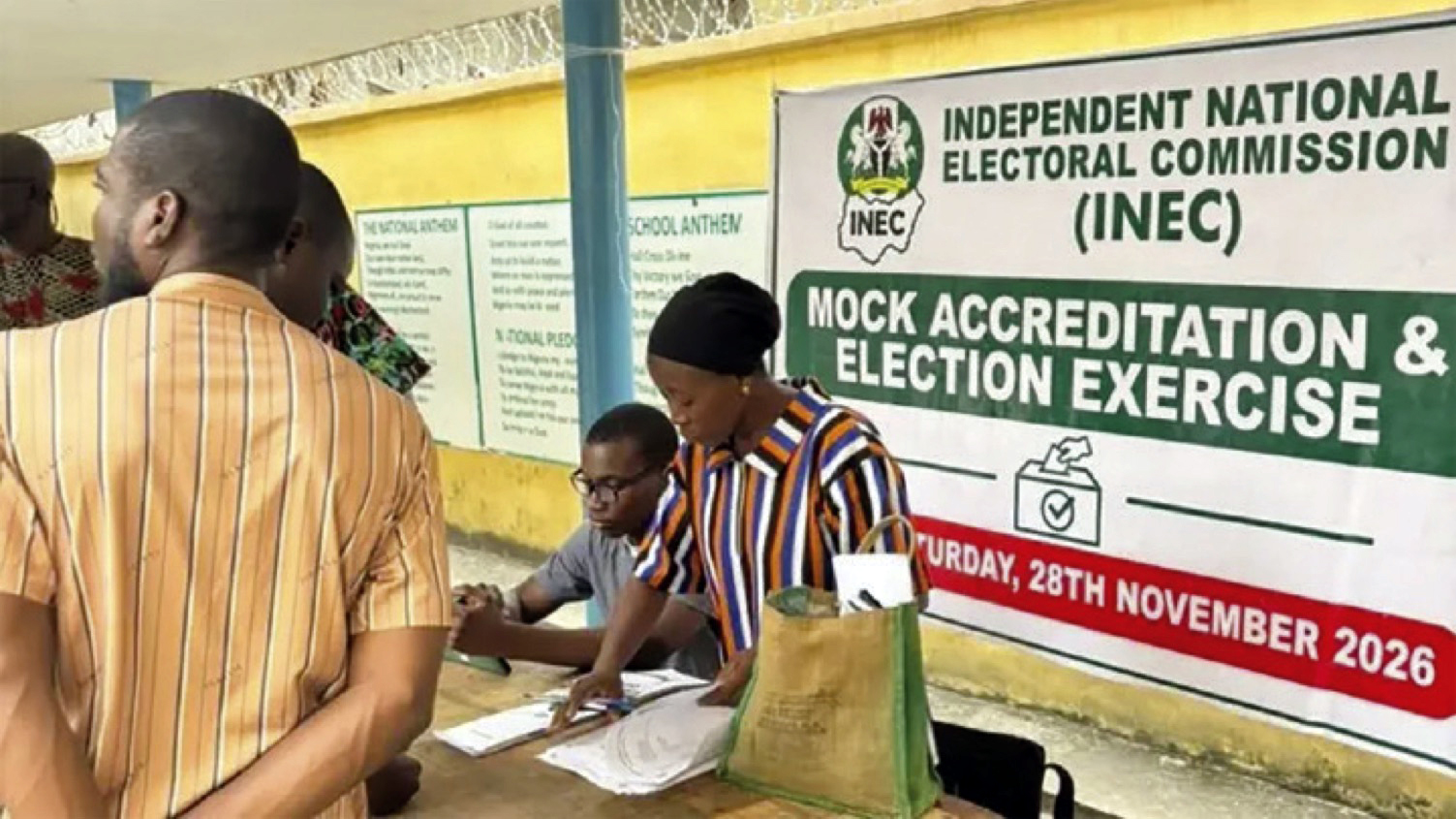
The Independent National Electoral Commission (INEC) on Saturday staged a nationwide mock accreditation and result upload exercise across selected polling units in the 36 states and the Federal Capital Territory.
Reports from correspondents reveal a consistent pattern across the country. The Bimodal Voter Accreditation System (BVAS) and the INEC Result Viewing Portal (IReV) largely performed well, but turnout was poor in most states, public awareness was thin, and officials or materials arrived late in several places.
Jos: Amupitan assures Nigerians of credible polls
The Chairman of INEC, Prof. Joash Ojo Amupitan, assured Nigerians that the commission is committed to conducting free, fair, inclusive, credible and transparent elections in 2027. He gave the assurance in Jos, Plateau State, while monitoring the mock exercise.

At the Obasanjo Model School in Jos South Local Government Area, where he assessed the preparedness of electoral officials and the performance of the technology, Amupitan described the exercise as impressive and the turnout as very good.
He also visited the National Science High School. According to him, voters were accredited within seconds while the process remained orderly, and he cited the successful accreditation and voting of an elderly woman as proof that the system could serve voters of all ages.
He explained that the exercise was designed to test the functionality of BVAS and to identify technical and operational challenges so that they could be corrected before election day.
On concerns about low turnout in some locations, he said the figures should not necessarily be read as a failure of mobilisation, noting that the monthly sanitation exercise could have kept people at home. He added that the Plateau State office of INEC had publicised the exercise.
The chairman confirmed that the presidential and National Assembly elections will hold on 16 January 2027, while the governorship and State Houses of Assembly elections are scheduled for 6 February 2027.
On security, he disclosed that the commission recently held a strategic election security conference with the military, the police, the Nigeria Security and Civil Defence Corps and other paramilitary agencies.
The aim, he said, was to identify possible threats and develop strategies to protect voters, electoral officials and National Youth Service Corps members. The commission is also using its Election Risk Management framework to identify vulnerable polling units and potential flashpoints.
“The information gathered through the assessment has been shared with relevant law enforcement agencies to enable them to take necessary preventive measures,” he said.
Amupitan added that INEC would continue to work with stakeholders to strengthen public confidence in the electoral process, and he commended the people of Plateau State for their support.
Kogi: Apathy, ignorance of exercise leave polling units empty
The mock election in Kogi State was marred by voter apathy, with several polling units recording little or no participation. Our correspondent who monitored the exercise in Lokoja and parts of the state found that most residents did not even know it was taking place. Some attributed this to inadequate public awareness and to economic hardship.
The exercise covered 478 polling units across 239 wards in the 21 local government areas. INEC staff delivered sensitive materials promptly, with items arriving at Adankolo Primary School I, Crowder Memorial College, UBE Primary School and Ganaja Primary School in Lokoja by 7.20am, and the machines worked in most units visited.
The Resident Electoral Commissioner, Shehu Wahab, said sufficient sensitisation had been carried out and expressed satisfaction with preparedness. Reports from Kabba, Okene, Idah and Ankpa, however, suggested widespread apathy, with some residents voicing concern about declining public confidence in the electoral process.
Kano: Officials declare success as polling units remain quiet
Voter apathy marked the exercise in Kano State, where investigations across several polling units found very low turnout of registered voters. Small crowds gathered at some locations, but few were actual voters of the units concerned.
At Chediyya Uku polling unit in Gwagwaruwa Ward, an INEC official, Dan Sarkin Yahaya, said voters were still expected and that the logistics had been tested. He admitted that one BVAS machine had been returned to headquarters for replacement after it kept reporting a wrong password during the test run.
At Kankorofi Quranic School, no one had voted by 10am out of 2,148 registered voters. At Konar Goje, only eight of 736 voters had voted at Unit 35, and four of 546 at Unit 34. Awareness of the exercise was poor, and the situation was worsened by the monthly sanitation exercise, which the state government cancelled a few hours before dawn.
The Resident Electoral Commissioner, Zango Abdu, nonetheless called the exercise a success, saying it had been supposed to be a mock accreditation but resembled a real election. “We are very delighted that citizens turned out,” he said.
Imo: Residents shun polling units as materials arrive late
The mock election in Imo State was a disappointment, as most residents claimed ignorance of it. Rather than turn out to vote, many took part in the monthly clean up exercise. Election materials also failed to arrive on time at most polling booths, even though the exercise was reported to have ended ahead of schedule.
A resident, Ikechukwu Alimno, blamed the poor turnout on INEC for failing to sensitise the public. He said he and other traders in the market had come out purely for the clean up and did not know a mock election was being held.
Enugu: Late officials, scarce voters, presidential rally
The exercise recorded low turnout in most Enugu centres, with as few as two voters accredited by BVAS in some. A correspondent observed that poor awareness, late arrival of INEC ad hoc staff and difficulty in locating designated polling units contributed to the poor showing.
At centres in Igbariam, Idaw River and Obiagu, staff arrived between 9.30am and 10am. The exercise also coincided with the All Progressives Congress presidential campaign rally in the state. A community leader at Obiagu, who gave his name as Friday, said many residents had gone to welcome President Bola Tinubu at Okpara Square, and that those who did so came from across party lines.
A resident of Achara Layout, Arinze Madu, said he visited two centres without finding his polling unit. The Resident Electoral Commissioner, Dr Chukwuemeka Chukwu, did not respond to calls.
Abia: Poor publicity blamed as officials wait endlessly
Low turnout, which participants blamed on poor publicity, marred the mock exercise in Abia State. Several designated polling units recorded little or no participation.
At School Road Primary School and Ugba Primary School, INEC officials were present but voters were virtually absent. At Ibeku High School, no voter had been sighted by noon. At Amuzukwu Civic Centre in Umuahia, only two voters had been captured by 1.30pm, and both were accredited successfully.
At St. Stephen’s Primary School, residents expressed frustration after discovering that their unit had not been selected. One of them, Kalu Eke, urged INEC to intensify sensitisation through radio, community engagement and street level outreach.
INEC staff at some centres declined to answer questions, saying only the Resident Electoral Commissioner, Prof. Sylvia Agu, could speak, but she could not be reached. Reports from Aba indicated the same low turnout.
Anambra: One voter in hours at some units as staff lack seats
INEC deployed staff across the 326 wards in Anambra State, with two polling units selected in each ward, making 652 in all. Turnout was very low.
At Agu Awka ward, only three people had voted at Units 008 and 009 at Aroma Junction by 1.30pm. At Nkwo Amaenyi Market Square, only one person had voted after accreditation by 1.46pm. At Amaezike in Mgbakwu, Awka North, ad hoc staff arrived around 9am but the first voter came at 1.45pm, and the figure was unchanged at 2pm.
Staff said many people came to vote but were turned away because their polling units had not been selected. The only challenge they reported was the absence of seats and desks, which the commission had not provided. No security agents were seen at any of the units monitored.
Ondo: Two voters out of 470 as BVAS malfunctions
The mock election in Akure suffered low turnout and technical difficulty, as the BVAS malfunctioned in some locations. At Tipper Garage, Ward 2, Unit 046, only two persons voted out of 470 registered voters. At Champion Junction, Ward 03, Unit 15, six voters took part, and at High Court, Ward 5, Unit 11, eleven people voted out of 940.
The picture was different at Ajipowo, Ward 2, Unit 17, where a large turnout was observed.
Cross River: Smooth process, sarse participation
The mock election in Calabar South and Calabar Municipality recorded poor turnout despite a smooth process. The exercise coincided with the monthly Sanitation Day, but the state government relaxed the usual restriction on movement for the purpose of the exercise.
Officials were seated by about 8am, and no malfunctioning devices or late arrival of materials were observed. At Open Space, Lagos Street, Ward 5, Unit 12, only 17 of 155 registered voters had voted by 11am. At Government School, Hawkins, Unit 001, only 18 of 677 had voted by noon, and in Ward 6, Unit 13, ten of 354 had been accredited and voted.
INEC officials also distributed Permanent Voter Cards to people who had registered or transferred to the units. Imam Kabir, Chairman of the Muslim Pilgrims Welfare Board, who voted at Open Space, called the exercise satisfactory and said prayers and proper sensitisation could help Nigeria do better in its elections.
Benue: Handful turn out across Makurdi
Low turnout greeted the exercise across the 23 local government areas of Benue State. At Madikpo Tokumbo Market polling unit in Makurdi, only 11 of 745 registered voters took part. At LGEA Primary School, Wurukum, six of 833 were accredited, and at Mbajuku One in Agan Ward only three had turned up, although the unit usually serves people from nearby camps for internally displaced persons.
INEC staff said the BVAS worked properly. Mrs Salamatu Idris explained that voters were checked against the register, their cards verified and their six digit identification numbers entered, before facial verification and fingerprint capture.
Some residents who registered in June and July could not find their names because their cards were not yet ready. She said card distribution would run from 1 to 7 December.
The state INEC spokesperson, Peace Ogoyi, said the Resident Electoral Commissioner, Aminu Idris, was monitoring the exercise in Otukpo. Results were to be uploaded to IReV after the exercise closed at 2.30pm.
Katsina: Few voters at test unit
The mock process in Katsina held as scheduled, but only a handful of voters turned out at the Wakilin Kudu 1 polling unit in Rafin Dadi, Katsina metropolis. Accreditation was successful for those who came, and the exercise was meant to test the accreditation system and the readiness of officials.
Kaduna: Voters wait hours as INEC officials fail to show
Voters and party agents in Chikun Local Government Area expressed disappointment over the absence of INEC officials at designated polling units. The exercise was meant to start at 8.30am, but at Narayi LGEA Primary School and Ungwan Yelwa Primary School it had not begun by late morning.
A voter, Rebecca Oladipo, said she had waited about two hours, and described the situation as disheartening. She said some voters who came early had left.
Obadiah Bako, who arrived at 7.30am at Ungwan Yelwa, said the unit was empty of officials and wondered how the main election would be handled if a mock exercise could not be organised. Friday John, a National Democratic Congress agent, said he saw no officials by about 11am, while security personnel had arrived early.
The complainants urged INEC to address logistical and administrative problems before the general election. They said delays were a recurring experience in the area. INEC had not commented at the time of filing.
Ogun: BVAS accredits voters
The exercise was carried out in designated centres across Ogun State, where polling centres were randomly selected. At Polling Unit 04, Town Hall, Obada Community, Ewekoro Local Government Area, an INEC official, Ojerinde Abiodun, arrived about 8am with two BVAS machines, a ballot box and ballot papers. The papers carried names of objects and colours instead of real party names and logos.
The machines worked perfectly, taking less than 60 seconds to accredit each voter, and results were transmitted efficiently to IReV.
An All Progressives Congress stalwart, Abiodun Yorioso, said it showed INEC was ready for credible polls in 2027, while a Peoples Democratic Party leader, Mrs Adunola Memunat, urged the commission to keep the same transparency during the real election.
Most voters who turned out could not take part because they were registered at Polling Unit 07, which was not selected. The Resident Electoral Commissioner, Feyijimi Saseyi, expressed satisfaction and commended the turnout in areas she visited.
Edo: Residents turn out in large numbers
Residents of Benin City turned out in large numbers to test the BVAS. At Ward 7, Unit 42, New Benin, in Oredo Local Government Area, an All Progressives Congress agent, Daniel Odenigbo, described the exercise as peaceful and orderly.
The party’s Ward 6 chairman in Oredo, Christopher Ize, called the turnout impressive, and said the materials and equipment were effective, though overall performance would be better judged as the day progressed.
Hon. Benedict Omordon, a Senior Special Assistant to the Speaker of the Edo State House of Assembly, who spoke at Ward 2, which has 88 polling units, commended INEC for introducing the mock election as a necessary innovation.
Kebbi: BVAS works ad Governor votes
The exercise in Kebbi State recorded effective use of BVAS, though turnout was low in some selected units. Governor Nasir Idris cast his vote at Makera Gwandu Science College a few minutes before noon.
At some units in Birnin Kebbi, women outnumbered men, and a large turnout of women was seen at the Justice Ibrahim Umar polling unit in GRA, where ad hoc staff said both BVAS machines worked from 9am without malfunction.
Security personnel were present. At Nagari Science College, the Presiding Officer, Bashar Nasir, said staff had been trained and that 33 voters had been accredited by the time of the visit.
The process was generally smooth and orderly.
Bayelsa: Mixed reactions as names go missing
Residents reacted differently to the exercise across 217 selected polling units in the state’s eight local government areas. At Epie III, Central Kpansia Hall, Yenagoa, officials arrived on time, the BVAS worked well and results were uploaded to IReV after voting.
Voting was seamless at Okutukutu Primary School and hitch free at Amassoma in Southern Ijaw, while residents of Peretorugbene in Ekeremor commended the conduct.
However, some registered voters could not find their names. Madam Irene Rhuona said she had voted at Central Kpansia Hall in 2015, 2019 and 2023. At Community Primary School, Opolo II, Eric Inegite and Brain Idigo also found their names missing, though they voted there in the last governorship election in November 2023. They urged INEC to correct the register.
Rivers: EEC8A raises hope as late materials threaten gains
INEC’s introduction of the electronic EC8A (eEC8A) could strengthen the integrity of results, but logistical lapses remain a threat, according to an observer who monitored the exercise in Ward 14, Obio Akpor Local Government Area.
The EEC8A is built into BVAS and records the number of accredited voters as a digital counterpart to the physical result sheet. It is meant to ensure the accredited figure matches the figure on the form before transmission to IReV, which the observer said could limit manipulation at polling units. At one unit, the 25 dummy ballots were exhausted in under an hour.
The observer also noted good BVAS performance, improved network connectivity and careful handling of devices by corps members. But late arrival of materials and delayed starts in some places could undermine the gains. The observer also noted limited visible participation by the ADC and NDC.
Nasarawa: Voter relocation emerges as concern
The exercise in Nasarawa covered 294 polling units across 13 local government areas, two in each of the 147 registration areas, and was scheduled to run from 8.30am to 2.30pm. It highlighted worries over voter relocation, public awareness and logistics, although BVAS performed encouragingly in some places.
A former Secretary to the State Government, Philip Dada, said many voters of his unit had been moved to other locations without their knowledge, which could cause problems on election day.
The Attorney General, Isaac Danladi, said some people left disappointed after learning their names had been transferred, but he commended the presence of security personnel and party agents.
He dismissed arguments that votes would not count as “serious hearsay”. Karu Ward Chairman Salihu Iliasu urged INEC to decentralise voter registers to help people verify their units.
There was low turnout at Bakin Ado Primary School, Unit 006, and Rugan Madaki Primary School, Unit 061, in Karu. The Information Commissioner, Dr Nawani Aboki, acknowledged late starts at Akabe Junction in Doma, but said activity later picked up.
Delta: BVAS slow, takes 25 minutes to accredit one voter
The Chairman of Isoko North Local Government Area of Delta State, Godwin Ogorugba, has expressed concern over the slow pace of accreditation by the Independent National Electoral Commission (INEC) Bimodal Voter Accreditation System (BVAS) during the nationwide mock election exercise.
Ogorugba made this known on Saturday shortly after casting his vote at Ogu Primary School, Lagos Quarter, Polling Unit 3, Otibio Ward 13, Isoko North Local Government Area.
According to the Chairman, the BVAS accreditation process was extremely slow, taking approximately 25 to 30 minutes to accredit a single voter.
He questioned how INEC intended to efficiently accredit over 1,500 registered voters in a polling unit if the system continued to operate at such a slow pace.
FCT: BVAs, results upload tested
Election observer group, Yiaga Africa, reported that accreditation and mock voting commenced in only 65 per cent of polling units monitored by its citizen observers during the Independent National Electoral Commission’s (INEC) nationwide mock election exercise on Saturday.
The finding raises questions about the readiness of the electoral technologies and operational processes being tested ahead of the 2027 general election.
In its preliminary assessment released through its Watching The Vote initiative, Yiaga Africa disclosed that only 195 of the 300 polling units in its observation sample had commenced accreditation and mock voting as of 10 a.m.
The organisation said 275 of the 300 polling units had submitted reports to its monitoring platform as of 11 a.m.
The exercise is designed to test the functionality and operational efficiency of the Bimodal Voter Accreditation System (BVAS) and the electronic transmission and uploading of polling-unit results ahead of the 2027 elections.
Lagos: BVAS falters, as INEC hails seamless accreditation elsewhere
Residents and party officials on Saturday raised concerns over technical glitches experienced with the Bimodal Voter Accreditation System (BVAS) during the Independent National Electoral Commission’s (INEC) mock accreditation and election simulation exercise in parts of Lagos State.
The complaints, particularly in Ifako-Ijaiye and Iju, centred on the failure of some BVAS machines to recognise Permanent Voter Cards (PVCs), raising questions about the preparedness of the electoral commission ahead of the forthcoming general election.
The exercise, conducted in selected polling units across the state, was designed to test the functionality of the BVAS and other electoral processes, identify operational challenges and address potential delays before the actual election.
At Unit 1, Ward A, Ifako-Ijaiye Local Government Area, the ward chairman, Ayo Adekunle, said the BVAS deployed to the polling unit was not functioning properly.
Adekunle explained that INEC had selected two polling units in each ward for the simulation exercise to assess its level of preparedness and identify areas requiring improvement.
The Resident Electoral Commissioner (REC) in Lagos State, Prof. Ayobami Salami, gave the assessment while monitoring the exercise at Polling Unit 057, Ward 07, along Shitta/Ogunlana Drive in Surulere.
Salami said accreditation was taking less than one minute per voter, with no complaints recorded from electoral officials or members of the public at the polling unit.
“I have been very impressed with what we have seen. You have accompanied us on this exercise, and you have observed that there has been no problem with the BVAS.
“It takes less than one minute to accredit a voter, and everything has gone seamlessly. So far, there has been no complaint from our personnel, members of the public or voters,” he said.
The REC attributed the selection of 490 polling units to INEC’s decision to test the electoral process in two polling units per ward, providing an opportunity to assess the technology and identify possible operational challenges ahead of the general election.
FCT: Lack of awareness, low turnout, malfunctioning BVAS
The mock election to test the operational readiness of the Independent National Electoral Commission (INEC) for the 2027 general elections recorded a mixed grill of success and challenges in the Kuge Area Council in the Federal Capital Territory (FCT) Abuja on Saturday.
While some areas like Union Home Estate, dominated by highly enlightened residents recorded huge turnout, some other areas inside the interior parts of the Area Council had an unimpressive exercise due to low turnout of voters.
According to the electorate that spoke to our correspondent, a combination of many factors like lack of awareness and enlightenment, malfunctioning Bimodal Voter Accreditation System (BVAS), and low voter turnout affected the mock exercise.
At most of the polling units our correspondent visited in the early hours of Saturday to monitor the exercise, the electorate kept the officials of the INEC waiting almost all through the exercise.
Speaking to our correspondent at the biggest market in the Council, most of the residents claimed ignorance of the exercise, noting that they were not aware of it.
Asked why they didn’t participate in the poll, a resident, Johnson, asked: “Is there any election holding today? I am not aware otherwise I would have gone to test run my Permanent Voters Card (PVC) ahead of the main election to ensure its functionality.”
“I don’t think that there was enough publicity and enlightenment to inform the voters of the opportunity to test whether the BVAS will accept their PVCs,” he complained.
An INEC official who spoke on condition of anonymity at Union Homes Estate Polling Unit confirmed that the BVAS functioned optimally resulting in the 100 per cent in both perfection of technology and turnout of voters.