
World
With massive teacher shortages, Israel plans on teaching English to middle schoolers through AI

In the upcoming school year, Israeli middle schoolers will start learning English through artificial intelligence, Prime Minister Benjamin Netanyahu and Education Minister Yoav Kisch said on June 11.
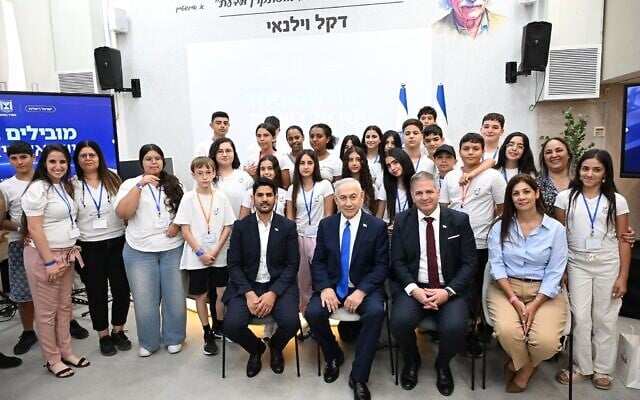
Netanyahu and Kisch made the announcement during a visit to the Dekel Vilnai Middle School in the settlement of Ma’ale Adumim, just east of Jerusalem in the West Bank.
The school was one of 28 that took part in a nationwide pilot testing an AI-powered system as part of the Education Ministry’s national initiative for personalized learning through technology.
“This is one of the most significant and ambitious revolutions ever carried out in the education system,” Kisch said. “It will enable every student to learn according to their own capabilities, pace of progress, and personal needs.”
“This move places Israel at the forefront of the world’s leading nations in integrating AI into education, representing a national jump forward in preparing the next generation for a changing world,” he added.
The initiative is called Project 720, and according to the ministry, the name “reflects its unique philosophy: 720 Degrees — representing 360 degrees around the student and 360 degrees around the teaching staff.”
“We are shifting from a one-size-fits-all teaching model to a reality where every student has the opportunity to learn in a way that suits them, while maintaining high academic standards and developing the skills required for a changing world,” said Meirav Zarviv, deputy director general of the Innovation and Technology Administration, the ministry’s branch responsible for the program, according to a statement.
“Simultaneously, we provide teachers with advanced tools, data, and support, allowing them to focus on personal mentorship and pedagogical leadership,” she added.
However, many questions remain unanswered.
The announcement comes a month after it emerged that only 22 percent of Israeli ninth graders met the requirements of the English language curriculum in Israel in the exams conducted last year by the National Authority for Educational Measurement and Evaluation (RAMA).
The pilot for 28 schools was described by the ministry as “a success,” but no data have been released presenting the results. Contacted by The Times of Israel, the ministry said the pilot results are expected to be published by the end of July.
A spokesperson said via email that the pilot is being evaluated using a combination of pedagogical, emotional, and organizational indicators, including students’ levels of motivation and independence and teachers’ ability to provide personalized support.
In the upcoming school year, Project 720 will be implemented in 180 schools, expanding it to math and science.
At the same time, AI-assisted English instruction is set to reach all middle schools through a parallel program, English for Everyone. (The public school system includes the secular, national religious, and Arab education tracks, and only a limited number of Haredi schools.)
However, the ministry did not explain the specific timeline or logistics of the nationwide implementation.
“The Project 720 and English for Everyone programs are part of the national initiative to integrate artificial intelligence into the education system and strengthen English-language instruction, with a total budget of approximately NIS 130 million [$45 million],” the spokesperson told The Times of Israel.
Asked about digital infrastructure and teacher training, the ministry said that, for the moment, the program will rely on the digital infrastructure schools currently have, and teacher training will only begin at the start of the school year.
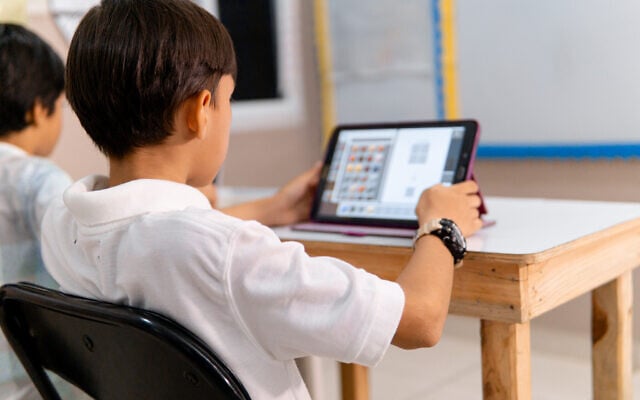
“The programs will be implemented using the digital infrastructure already in place in schools,” the spokesperson said. “A selection process is currently underway to choose the digital systems and tools that will be used as part of the programs, and teacher training will begin at the start of the school year and continue throughout the year.”
According to a report by the Hebrew newspaper Haaretz, the ministry plans to provide the necessary devices and infrastructure for all students and schools in Israel by the following school year, in cooperation with the Finance Ministry.
Is AI good for learning?
Netanyahu and Kisch both stressed the opportunities that learning with AI will offer Israeli children.
“Israel is one of the first countries that is starting to implement AI for personalized learning for every single pupil,” the prime minister said.
However, a growing number of experts and studies worldwide have increasingly pointed out that artificial intelligence and screen use do not help students advance their skills and can have detrimental effects.

A 2024 study by Columbia University researchers published in the journal PLOS ONE suggested that middle school students learn better when they read a text from a book rather than from a screen.
A comprehensive report released by the Center for Universal Education at the US think tank Brookings earlier this year found that, currently, the risks of learning with AI outweigh the potential advantages.
“Decades of research in developmental science demonstrates that children’s ability to learn — including in formal schooling — is shaped by the interconnected growth of their cognitive, social, and emotional capacities,” reads the executive summary. “These domains are mutually reinforcing: language and executive-function skills support social interaction; emotional regulation influences attention and persistence; social relationships fuel motivation and meaning-making.”
The report was compiled based on interviews, focus groups, and consultations with over 500 students, teachers, parents, education leaders, and technologists across 50 countries, and a review of over 400 studies.

The authors acknowledged that artificial intelligence can be used fruitfully for learning, but warned that “ultimately, we find that at this point in its trajectory, the risks of utilizing AI in education overshadow its benefits.”
“This is largely because the risks of AI differ in nature from its benefits—that is, these risks undermine children’s foundational development,” they wrote.
In the past decade in the United States, the presence of devices in schools has become widespread, often provided by tech companies themselves (especially Google), which have seen it as a worthwhile investment both to broaden their markets and to hook in consumers when they are young. Yet as students’ test scores and emotional well-being have steadily declined, many experts, schools, and teachers have begun to question the practice of learning through screens.
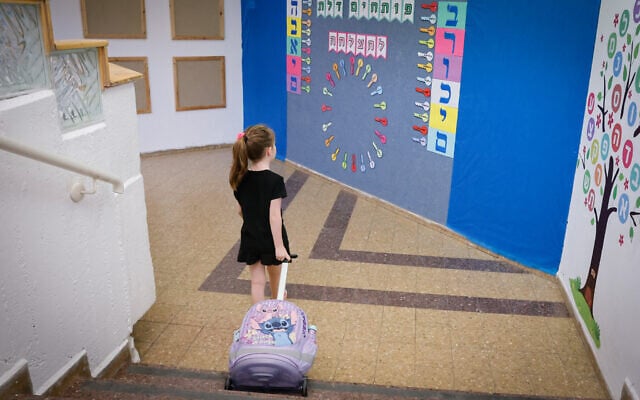
Some Israeli experts who spoke with Haaretz also highlighted the problems of relying on technology for learning.
“If you ask a child if they prefer to learn a topic from a text or from a video, they will usually choose the video,” Dr. Yishay Mor, head of the Artificial Intelligence and Education Program at the Beit Berl College, told Haaretz. “But if you test them, you will find they remember the content much better from the text and not from the video.”
Asked about the potential risks of learning through screens, the ministry said it aims to find a balanced approach that includes teaching students about effective AI use, safety and digital literacy.
“Technology should serve pedagogy — not the other way around,” a spokesperson said. “The ministry’s guidelines call for a balance between digital learning and traditional learning methods, alongside breaks and physical activity.”
“It is important to distinguish between guided and supervised educational use and private, potentially distracting use,” the spokesperson added. “Accordingly, the ministry is also leading a policy aimed at reducing mobile phone use in schools.”
‘It’s just another band-aid’
For years, the education system has struggled with a shortage of qualified English teachers.
“The easiest thing is to throw the kids in front of screens,” said an English teacher from northern Israel interviewed by Haaretz. “That’s not how you learn a language. There is no substitute for learning in front of a teacher, especially at this age.”
“It’s just another band-aid for the real problem: there are not enough teachers,” he said.
In 2024, a State Comptroller’s report denounced a shortage of English teachers and found that some 40% of the 19,000 English teachers in the public school system had not been formally trained.
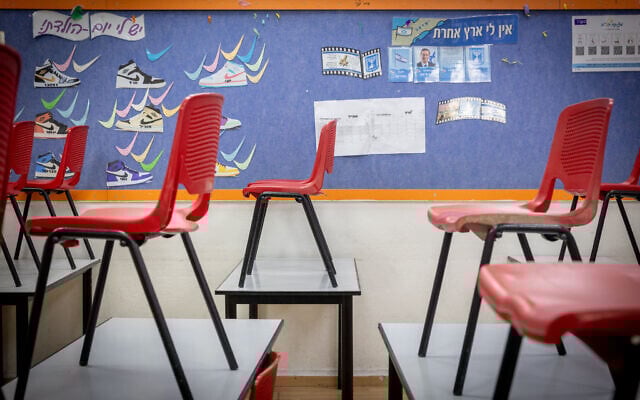
According to Zarviv, the ministry intends to invest in teachers so they can drive learning.
“Our approach is: teachers first,” she told Haaretz. “Most of the budget is intended for training.”
At the same time, a question remains about who will provide the devices for each middle schooler.
According to the Education Ministry’s statement, Project 720 is conducted “in collaboration with leading figures from high-tech, industry, and academia,” as part of “a concerted effort to bridge the gap between the education system and the skills and competencies required in the future job market.”
Asked which tech companies are involved in the project, the ministry declined to answer.
Haaretz reported that Google and Microsoft have both been partners.