Breaking
Why INEC Is Against Court Orders Nullifying 2027 Election Timetable— Amupitan Reveals

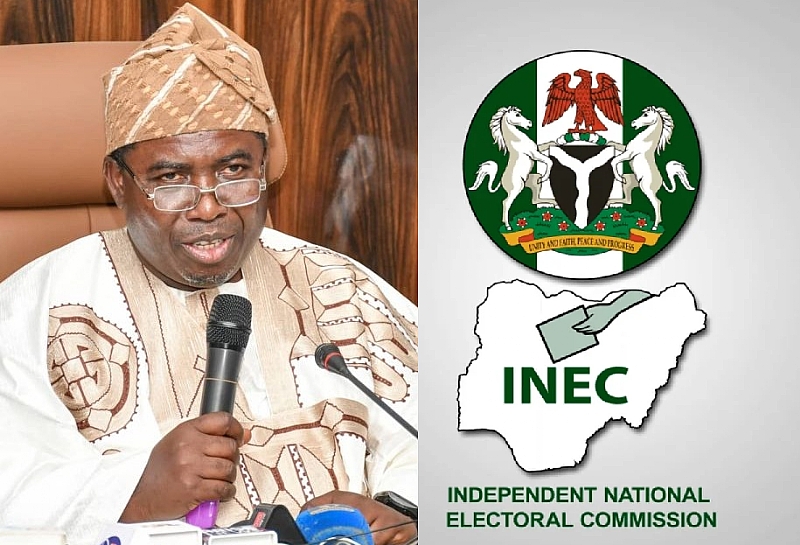
The chairman of the Independent National Electoral Commission, Prof. Joash Amupitan, has explained why the commission filed appeals against two recent Federal High Court judgments that questioned aspects of its Timetable and Schedule of Activities for the 2027 General Election, stating that the absence of coordinated electoral timelines would create uncertainty and undermine the Commission’s constitutional mandate.
Prof. Amupitan disclosed on Tuesday, 9th June, 2026, while delivering his opening remarks at the Second Quarterly Consultative Meeting with Leaders of Political Parties held at the Commission’s headquarters in Abuja.
The INEC Chairman told party leaders that in Suit No. FHC/ABJ/CS/517/2026 — Youth Party v. INEC, delivered on 20 May 2026, the Federal High Court questioned certain timelines in the Commission’s timetable. In a subsequent judgment in Suit No. FHC/ABJ/CS/720/2026 — Social Democratic Party (SDP) v. INEC, delivered on 26 May 2026, a separate court affirmed the Commission’s authority to issue an electoral timetable but nullified certain timelines relating to the nomination and substitution of candidates.
“These judgments raise important legal questions concerning the extent of the Commission’s constitutional and statutory powers in coordinating and regulating electoral activities,” Prof. Amupitan said.
He said the Commission had filed appeals against both decisions and taken the necessary legal steps to obtain authoritative pronouncements from the Appellate Courts, stressing that the activities contained in the timetable were not isolated events but interrelated operational processes essential to the orderly conduct of elections.
Prof. Amupitan listed critical electoral activities for which the Electoral Act prescribed no express statutory timelines but which must nonetheless be accommodated within the overall electoral calendar. These include the submission and verification of party membership registers, the monitoring of party primaries across the Federation, the pre-upload of primary results on the Commission’s portal, the printing of ballot papers and result sheets, quality assurance procedures, the configuration of BVAS machines, and compliance with statutory obligations such as inviting political parties to inspect election materials pursuant to Section 42 of the Electoral Act 2026.
“The Commission therefore considers it imperative that all electoral activities be harmonised within a coherent and workable framework that promotes certainty, transparency, administrative efficiency and equal treatment of all political parties,” he said, assuring the public that notwithstanding the pending appeals, the Commission remained firmly committed to conducting the 2027 General Election in strict compliance with the Constitution and the Electoral Act.
Turning to preparations for the Ekiti State Governorship Election scheduled for Saturday, 20 June 2026, the Chairman said the Commission’s Register of Voters for the election contained 1,059,360 registered voters, reflecting the addition of 66,664 new registrants from the Continuous Voter Registration exercise to the 2023 base register of 987,647. He said 2,103 double registrations had been invalidated to protect the integrity of the register.
Prof. Amupitan said logistics arrangements, technology deployment and the training of election officials were all proceeding according to schedule, reaffirming the Commission’s commitment to the simultaneous opening of all 2,445 Polling Units across the 16 Local Government Areas of Ekiti State at 8:30 a.m. on Election Day.
He noted that on the same day, the Commission would conduct bye-elections in six constituencies: Enugu North Senatorial District, Nasarawa North Senatorial District, Rivers South-East Senatorial District, Ondo South Senatorial District, Dawakin Kudu/Warawa Federal Constituency in Kano State, and Zuru State Constituency in Kebbi State, adding that the same operational standards, technological safeguards and security arrangements deployed for the Ekiti election would apply to all six bye-elections.
The INEC Chairman also drew attention to the Osun State Governorship Election scheduled for Saturday, 15 August 2026, urging all political parties to comply strictly with the prescribed timelines and regulatory requirements already being implemented under that election’s timetable and schedule of activities.
On candidate nomination for the 2027 General Election, Prof. Amupitan announced that the Commission would on Friday, 26 June 2026 issue official access codes to all political parties for the Candidate Nomination Portal, through which parties would upload the names and particulars of nominated candidates. He warned that the portal was fully automated and would close without extension at the expiration of the prescribed period, urging parties to ensure their ICT personnel and relevant officers were adequately prepared ahead of the deadline.
He also called on political parties to intensify voter education and mobilisation efforts in support of the ongoing Continuous Voter Registration exercise, urging eligible Nigerians who had attained the age of eighteen years, as well as those seeking transfers or corrections of their records, to register and subsequently collect their Permanent Voter Cards.
Prof. Amupitan expressed concern over pending court cases bordering on the internal leadership of several political parties, describing such litigation as an unnecessary distraction and urging the parties to resolve the disputes without further delay.