World
What to know about Trump’s immunity from Internal Revenue Service after Todd Blanche’s confirmation hearing for attorney-general

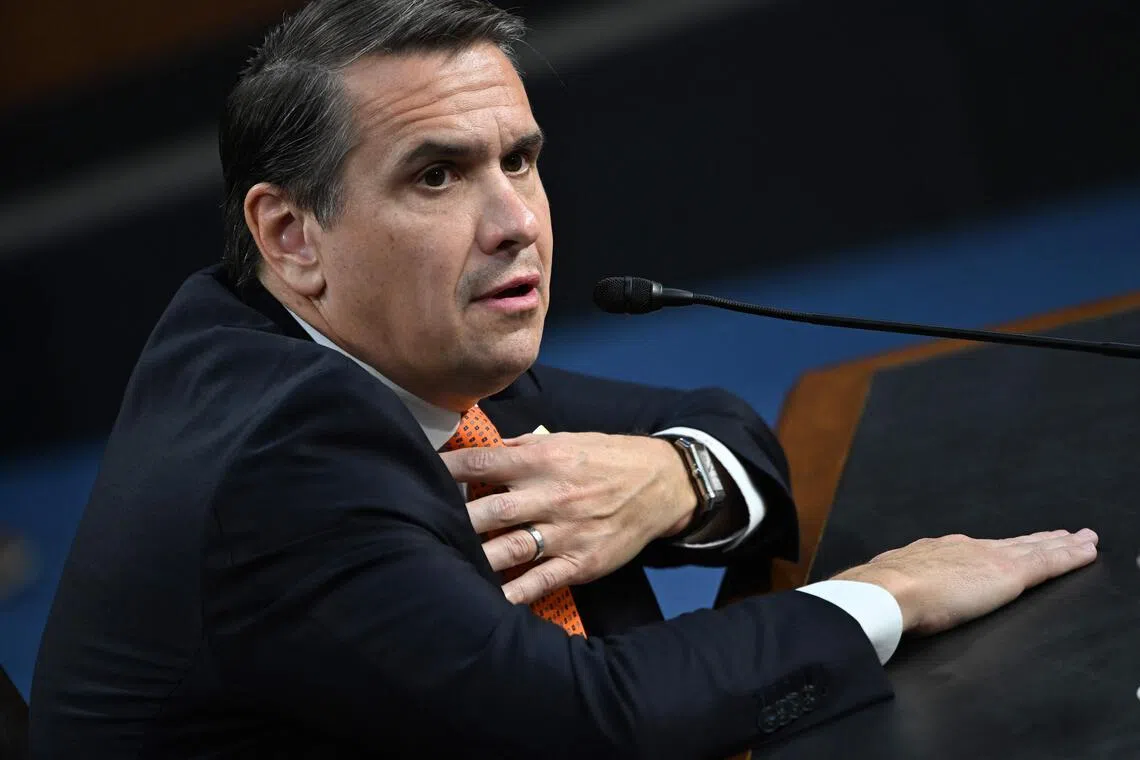
WASHINGTON – A central issue in the confirmation hearing of Todd Blanche, the acting US attorney-general, on July 15 was the extraordinary protection from Internal Revenue Service (IRS) investigations he granted President Donald Trump.
That immunity was part of a deal orchestrated by the US Justice Department to end the president’s lawsuit against the IRS. The other part of that deal, a US$1.8 billion (S$2.3 billion) fund aimed at paying political allies of Trump, set off a political firestorm on Capitol Hill, where many Republicans demanded its end. Blanche has since said that the so-called “anti-weaponisation” fund is dead.
But the audit protection remains. Democrats have excoriated it as a corrupt and illegal handout to Trump, who has aggressively avoided taxes and faced IRS audits throughout his life. Some Republicans, including Senator John Cornyn of Texas, had questions about the audit provision, too.
Here is an explanation of Blanche’s directive letting Trump off the hook from the IRS:
What does Blanche’s order say?
Blanche’s May 19 order, while just one page, is not straightforward, with its substance packed into a single rambling sentence that tax lawyers said was clearly not written by a practitioner.
But the upshot appears to be twofold.
First, the IRS has to drop any inquiries, whether civil audits or criminal investigations, it was pursuing into Trump, his family members, their companies or “affiliated individuals”. Second, the IRS cannot start any new investigations into tax returns that this potentially large pool of people and companies has already filed.
That means that any tax manoeuvre the Trumps have already used, whether the IRS was already auditing it or not, is now off limits.
The agency typically has three years after someone files a tax return to assess more in taxes. So there are potential audits of the president and his family that the IRS could have initiated – claims that “could have been asserted”, in the language of Blanche’s order – that it is now not supposed to. But the next tax return that Trump files could, theoretically, still be eligible for an audit.
“It’s not forward looking,” Blanche told lawmakers on July 15. “So to the extent there are taxes filed by the president, or his sons or the Trump Organization, after the date of that agreement, there’s no protection.”
Is that protection unusual?
It is extremely unusual, if not without precedent.
The IRS’ previous approach to the occupant of the Oval Office had been to audit his tax return every year, regardless of who is president, a practice that it developed amid concerns that it had not properly scrutinised Richard Nixon. The IRS has historically sought to avoid the appearance that it gives special treatment to the rich and powerful.
Blanche, Trump’s former personal lawyer, has cast Trump’s newly won immunity as a typical part of how the IRS settles disputes. It is true that the IRS may agree to halt audits as part of a deal to resolve a disagreement over how much tax someone owes.
But such a deal would ordinarily apply only to the people directly involved in the case and the specific tax issues under review. Blanche’s order, on the other hand, applies to a nondescript set of “matters pending or that could be pending” and offers amnesty to a loosely defined group of people and companies associated with Trump.
During the hearing on July 15, Blanche appeared to narrow the terms of his order, saying that the only people eligible for the audit protections are the parties who brought the original lawsuit against the IRS. That included Trump, two of his sons and the Trump Organization.
“The only parties that had any release with respect to any potential audits, even if they existed, were the plaintiffs in the lawsuit,” said Blanche, adding that only the IRS was bound by his order.
The lawsuit Trump filed against the IRS did not deal with a tax controversy or audit. Trump’s suit instead accused the IRS of not doing enough to prevent the leak of his tax returns during his first term, a separate category of complaint that, under federal law, can result in monetary damages. There were several possible defences against Trump’s case that the Justice Department did not raise, even though lawyers at the IRS recommended that it do so.
Is Blanche’s order legal?
It may not be. No one from the IRS put a signature to the one-page order for the audit protections, a contrast to the document creating the now-defunct US$1.8 billion fund, which was signed by the chief executive officer of the IRS.
Only Blanche signed the audit order. The IRS reports to the US Treasury Department, not Blanche, and several lawyers have questioned whether the attorney-general has the authority to direct how the tax agency conducts audits. The IRS has not responded to questions about whether it has followed Blanche’s order.
Then there is the federal law that prohibits the president and his aides from directing IRS investigations, though the statute includes an apparent carve-out for the attorney general. Any official who carries out an order from the White House to start or stop an audit could potentially go to prison if, for example, a future administration were to investigate that person.
In a 56-page ruling on July 13, Kathleen Williams, a federal judge in Miami, wrote that Blanche’s order “directly contravenes” the law prohibiting political direction of IRS audits.
But her order was focused on Trump’s underlying lawsuit against the IRS. She found that Trump had brought his lawsuit in a bad-faith attempt to wring public benefits out of the government. She barred Trump from referring to the audit immunity as a component of a “settlement” to the suit. But she noted that she was not ruling on its legality more broadly.
“Whether executive branch actors can privately agree to give themselves and their former clients blanket immunities and billions of dollars in tax monies for legally undefined grievances was never an issue advanced to this court,” she wrote.
How valuable could this be for Trump?
It is hard to know exactly. Tax information, including the status or existence of audits, is confidential under federal law – Trump’s suit against the IRS was, after all, over the disclosure of his tax returns.
But there is reason to think Trump could save a lot of money. The New York Times has previously reported that just one audit of Trump could have resulted in a bill exceeding US$100 million. Trump used to frequently complain that the IRS always audited him, and a congressional report in 2022 showed that the agency had major questions about his returns.
The audit protections arrived after a banner year for Trump financially. His most recent financial disclosure showed him bringing in at least US$2.2 billion in 2025, though it is unclear how much of that would be taxable income. Those earnings may still be subject to audit depending on when Trump files his tax return. NYTIMES
This article originally appeared in The New York Times.